Interdepartmental Centre of Industrial Agrifood Research (CIRI- AGRO) University of Bologna, Cesena, Italy.
Department of Agronomy, University of Sassari, Sassari, Italy.
PLoS One. 2018 Oct 4;13(10):e0204869. doi: 10.1371/journal.pone.0204869. eCollection 2018.
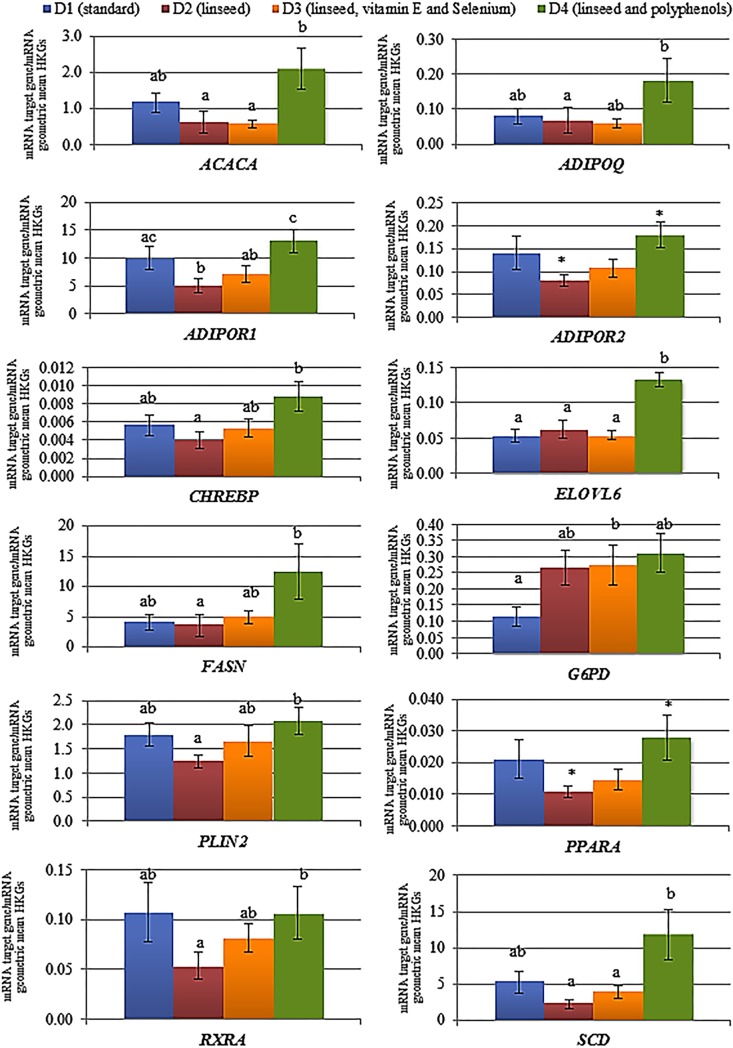
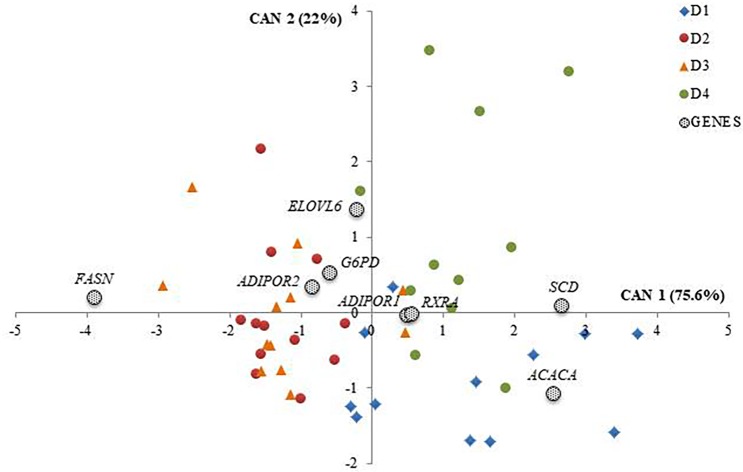
Porcine fat traits depend mostly on the interaction between nutritional and genetic factors. However, the pathways and biological processes influenced by this interaction are still poorly known in pigs, although they can have a huge impact on meat quality traits. The present research provides new knowledge insight into the effect of four diets (D1 = standard diet; D2 = linseed supplementation; D3 = linseed, vitamin E and selenium supplementation; D4 = linseed and plant-derived polyphenols supplementation) on the expression of 24 candidate genes selected for their role in lipid and energy metabolism. The data indicated that 10 out of 24 genes were differentially expressed among diets, namely ACACA, ADIPOQ, ADIPOR1, CHREBP (MLXPL), ELOVL6, FASN, G6PD, PLIN2, RXRA and SCD. Results from the univariate analysis displayed an increased expression of ACACA, ADIPOQ, ADIPOR1, CHREBP, ELOVL6, FASN, PLIN2, RXRA and SCD in D4 compared to D2. Similarly, ACACA, ADIPOQ, ADIPOR1, ELOVL6 and SCD were highly expressed in D4 compared to D3, while no differences were observed in D2-D3 comparison. Moreover, an increased expression of G6PD and ELOVL6 genes in D4 compared to D1 was observed. Results from the multivariate analysis confirmed that D2 was not different from D3 and that ACACA, SCD and FASN expression made D4 different from D2 and D3. Comparing D4 and D1, the expression levels of ELOVL6 and ACACA were the most influenced. This research provides evidence that the addition of both n-3 PUFA and polyphenols, derived from linseed, grape-skin and oregano supplementation in the diets, stimulates the expression of genes involved in lipogenesis and in oxidative processes. Results evidenced a greater effect on gene expression of the diet added with both plant extracts and n-3 PUFA, resulting in an increased expression of genes coding for fatty acid synthesis, desaturation and elongation in pig Longissimus thoracis muscle.
猪的脂肪特性主要取决于营养和遗传因素的相互作用。然而,尽管这种相互作用对肉质特性有巨大影响,但在猪身上,其影响的途径和生物学过程仍知之甚少。本研究为四种不同日粮(D1 = 标准日粮;D2 = 亚麻籽补充;D3 = 亚麻籽、维生素 E 和硒补充;D4 = 亚麻籽和植物源多酚补充)对 24 个候选基因表达的影响提供了新的知识见解,这些候选基因因在脂质和能量代谢中的作用而被选择。数据表明,24 个基因中有 10 个在日粮间差异表达,分别是 ACACA、ADIPOQ、ADIPOR1、CHREBP(MLXPL)、ELOVL6、FASN、G6PD、PLIN2、RXRA 和 SCD。单变量分析的结果显示,与 D2 相比,D4 中 ACACA、ADIPOQ、ADIPOR1、CHREBP、ELOVL6、FASN、PLIN2、RXRA 和 SCD 的表达增加。同样,与 D3 相比,D4 中 ACACA、ADIPOQ、ADIPOR1、ELOVL6 和 SCD 的表达较高,而 D2-D3 之间没有差异。此外,与 D1 相比,D4 中 G6PD 和 ELOVL6 基因的表达增加。多变量分析的结果证实,D2 与 D3 没有差异,而 ACACA、SCD 和 FASN 的表达使 D4 与 D2 和 D3 不同。与 D4 和 D1 相比,ELOVL6 和 ACACA 的表达水平受影响最大。本研究提供了证据表明,日粮中添加亚麻籽、葡萄皮和牛至提取物来源的 n-3PUFA 和多酚可刺激参与脂肪生成和氧化过程的基因表达。结果表明,添加植物提取物和 n-3PUFA 的日粮对基因表达的影响更大,导致猪背最长肌中脂肪酸合成、去饱和和延长的基因表达增加。