Divisions of Community Health Sciences and Epidemiology, University of California Berkeley School of Public Health, 2121 Berkeley Way #5302, Berkeley, CA, 94720-7360, USA.
Division of Epidemiology, University of California Berkeley School of Public Health, 2121 Berkeley Way #5302, Berkeley, CA, 94720-7360, USA.
Psychoneuroendocrinology. 2019 Jan;99:225-235. doi: 10.1016/j.psyneuen.2018.09.001. Epub 2018 Sep 5.
To examine the association between self-reported racial discrimination and allostatic load, and whether the association differs by socioeconomic position.
We recruited a purposive cross-section of midlife (ages 30-50) African American women residing in four San Francisco Bay area counties (n = 208). Racial discrimination was measured using the Experience of Discrimination scale. Allostatic load was measured as a composite of 15 biomarkers assessing cardiometabolic, neuroendocrine, and inflammatory activity. We calculated four composite measures of allostatic load and three system-specific measures of biological dysregulation. Multivariable regression was used to examine associations, while adjusting for relevant confounders.
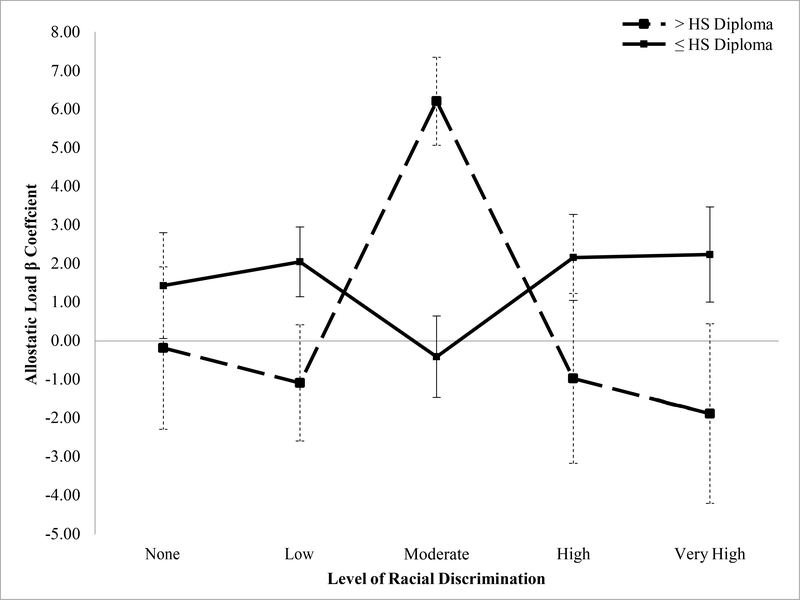
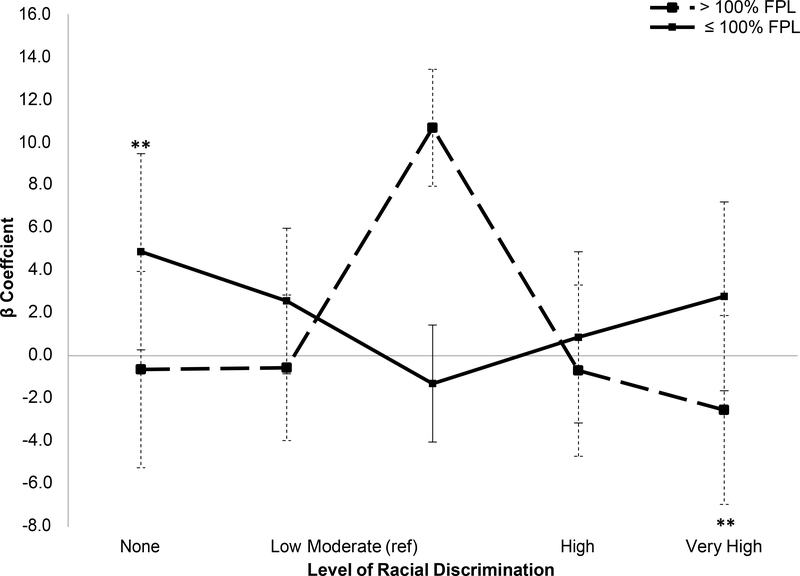
In the high education group, reporting low (b = -1.09, P = .02, 95% CI = -1.99, -0.18) and very high (b = -1.88, P = .003, 95% CI = -3.11, -0.65) discrimination was associated with lower allostatic load (reference=moderate). Among those with lower education, reporting low (b = 2.05, P = .008, 95% CI = 0.55,3.56) discrimination was associated with higher allostatic load. Similar but less consistent associations were found for poverty status. Associations were similar for cardiometabolic functioning, but not for neuroendocrine or inflammatory activity.
Racial discrimination may be an important predictor of cumulative physiologic dysregulation. Factors associated with educational attainment may mitigate this association for African American women and other groups experiencing chronic social stress.
探讨自我报告的种族歧视与身体压力的关系,以及这种关系是否因社会经济地位而异。
我们招募了居住在旧金山湾区四个县的中年(30-50 岁)非裔美国女性(n=208)进行了一项有目的的横断面研究。种族歧视是用歧视经历量表来衡量的。身体压力是通过评估心血管代谢、神经内分泌和炎症活动的 15 种生物标志物的综合指标来衡量的。我们计算了身体压力的四个综合指标和三个系统特异性的生物失调指标。多变量回归用于检验关联,同时调整了相关的混杂因素。
在高教育组中,报告低(b=-1.09,P=.02,95%置信区间=-1.99,-0.18)和非常高(b=-1.88,P=.003,95%置信区间=-3.11,-0.65)的歧视与较低的身体压力(参考值=中度)有关。在教育程度较低的人群中,报告低(b=2.05,P=.008,95%置信区间=0.55,3.56)的歧视与较高的身体压力有关。在贫困状况方面也发现了类似但不太一致的关联。在心血管代谢功能方面的关联是相似的,但在神经内分泌或炎症活动方面则不然。
种族歧视可能是累积生理失调的一个重要预测因素。与教育程度相关的因素可能会减轻非裔美国妇女和其他经历慢性社会压力的群体的这种关联。