Giordanengo Alain, Øzturk Pinar, Hansen Anne Helen, Årsand Eirik, Grøttland Astrid, Hartvigsen Gunnar
Department of Computer Science, The University of Tromsø - The Arctic University of Norway, Tromsø, Norway.
Norwegian Centre for E-health Research, University Hospital of North Norway, Tromsø, Norway.
JMIR Diabetes. 2018 Jul 11;3(3):e10431. doi: 10.2196/10431.
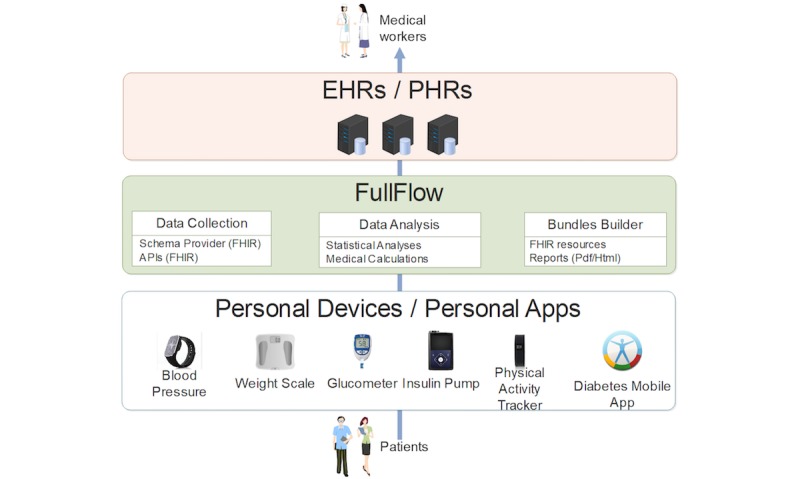
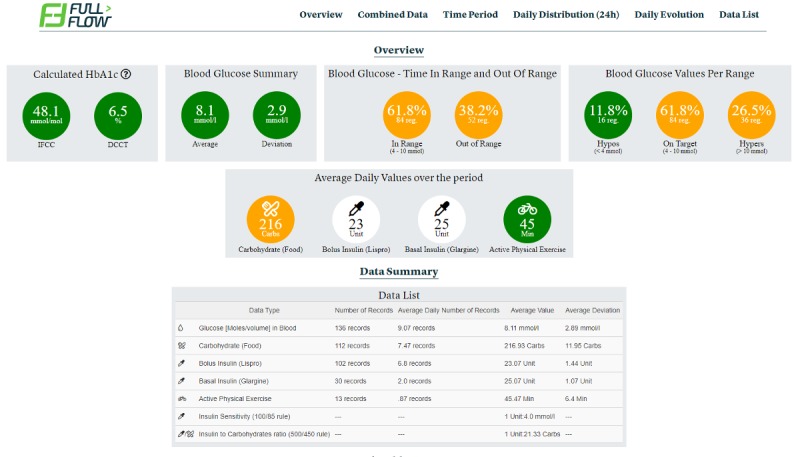
Patients with diabetes use an increasing number of self-management tools in their daily life. However, health institutions rarely use the data generated by these services mainly due to (1) the lack of data reliability, and (2) medical workers spending too much time extracting relevant information from the vast amount of data produced. This work is part of the FullFlow project, which focuses on self-collected health data sharing directly between patients' tools and EHRs.
The main objective is to design and implement a prototype for extracting relevant information and documenting information gaps from self-collected health data by patients with type 1 diabetes using a context-aware approach. The module should permit (1) clinicians to assess the reliability of the data and to identify issues to discuss with their patients, and (2) patients to understand the implication their lifestyle has on their disease.
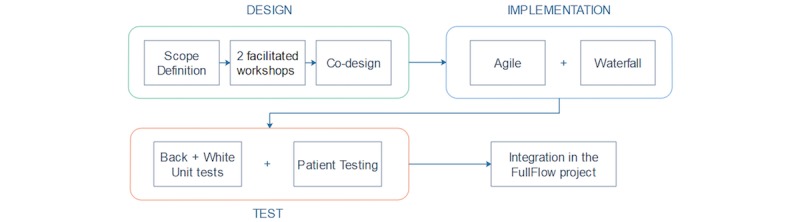
The identification of context and the design of the system relied on (1) 2 workshops in which the main author participated, 1 patient with type 1 diabetes, and 1 clinician, and (2) a co-design session involving 5 patients with type 1 diabetes and 4 clinicians including 2 endocrinologists and 2 diabetes nurses. The software implementation followed a hybrid agile and waterfall approach. The testing relied on load, and black and white box methods.
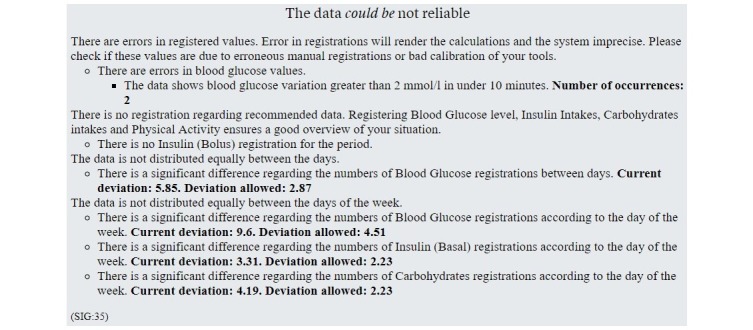
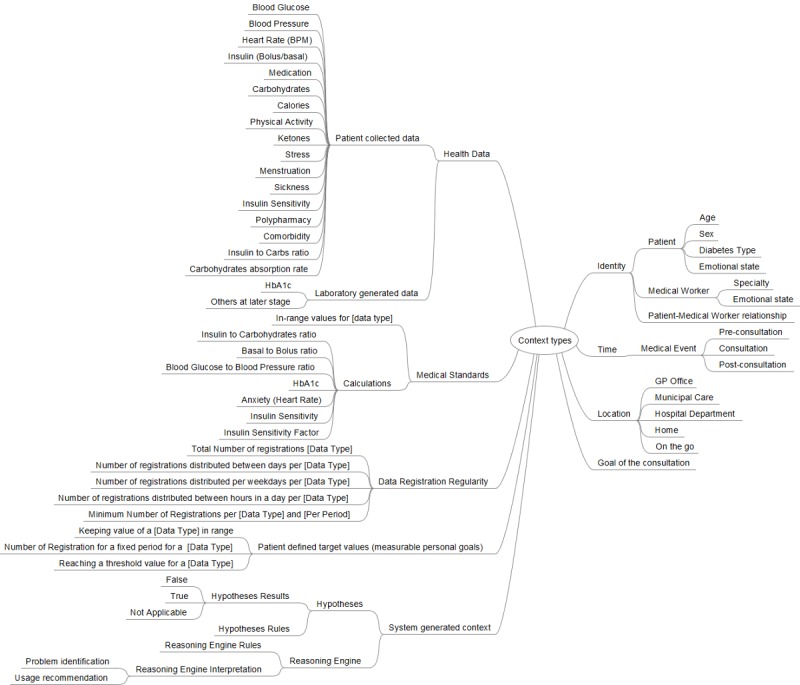
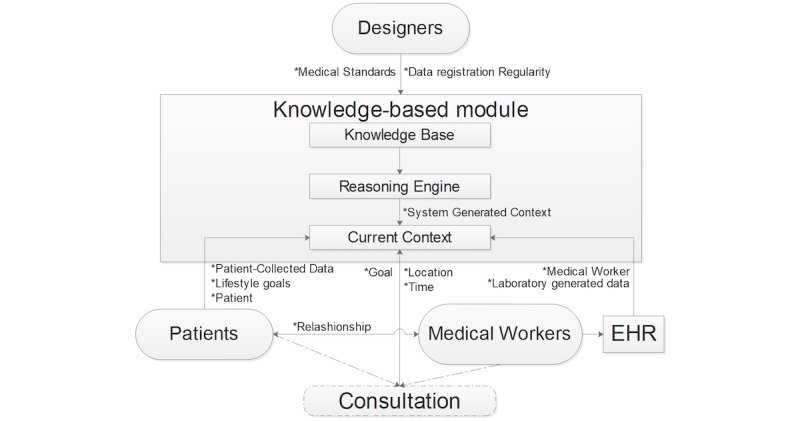
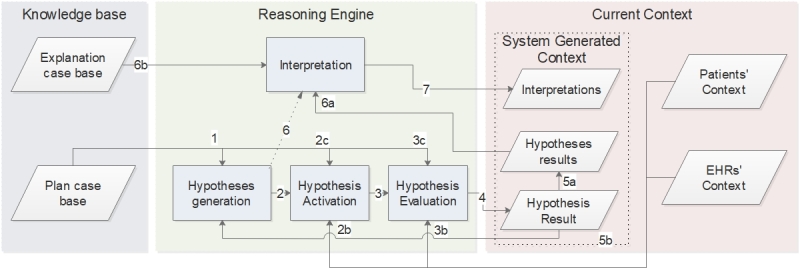
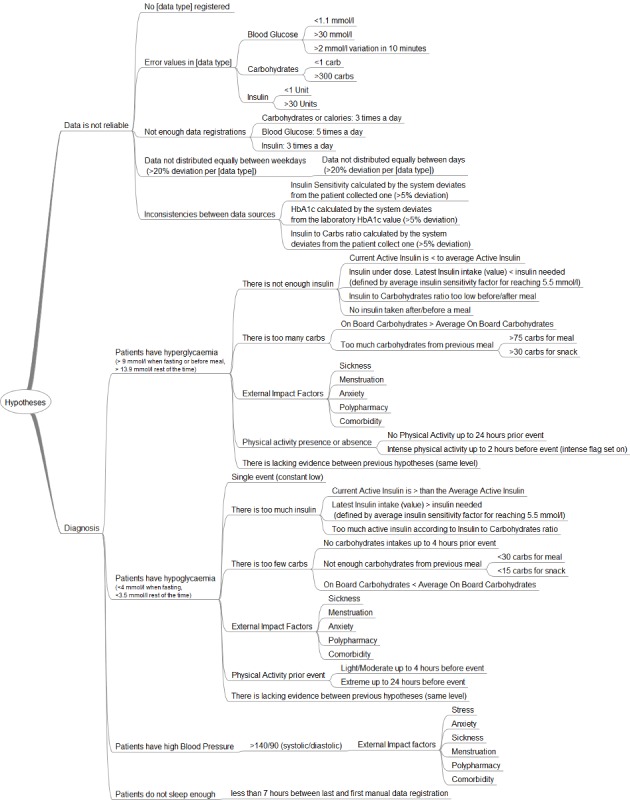
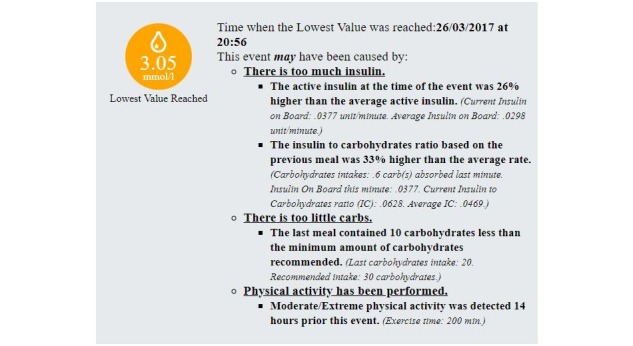
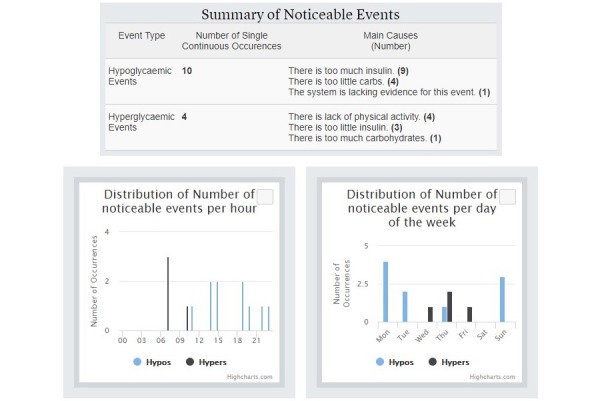
We created a context-aware knowledge-based module able to (1) detect potential errors, and information gaps from the self-collected health data, (2) pinpoint relevant data and potential causes of noticeable medical events, and (3) recommend actions to follow to improve the reliability of the data issues and medical issues to be discussed with clinicians. The module uses a reasoning engine following a hypothesize-and-test strategy built on a knowledge base and using contextual information. The knowledge base contains hypotheses, rules, and plans we defined with the input of medical experts. We identified a large set of contextual information: emotional state (eg, preferences, mood) of patients and medical workers, their relationship, their metadata (eg, age, medical specialty), the time and location of usage of the system, patient-collected data (eg, blood glucose, basal-bolus insulin), patients' goals and medical standards (eg, insulin sensitivity factor, in range values). Demonstrating the usage of the system revealed that (1) participants perceived the system as useful and relevant for consultation, and (2) the system uses less than 30 milliseconds to treat new cases.
Using a knowledge-based system to identify anomalies concerning the reliability of patients' self-collected health data to provide information on potential information gaps and to propose relevant medical subjects to discuss or actions to follow could ease the introduction of self-collected health data into consultation. Combining this reasoning engine and the system of the FullFlow project could improve the diagnostic process in health care.
糖尿病患者在日常生活中使用的自我管理工具越来越多。然而,医疗机构很少使用这些服务产生的数据,主要原因是:(1)数据缺乏可靠性;(2)医护人员要从大量产生的数据中提取相关信息,花费的时间过多。这项工作是FullFlow项目的一部分,该项目专注于患者工具与电子健康记录(EHR)之间直接共享自我收集的健康数据。
主要目的是设计并实现一个原型,用于使用情境感知方法从1型糖尿病患者的自我收集健康数据中提取相关信息并记录信息缺口。该模块应允许:(1)临床医生评估数据的可靠性,并识别需要与患者讨论的问题;(2)患者了解其生活方式对疾病的影响。
情境识别和系统设计依赖于:(1)主要作者参与的2次研讨会,1名1型糖尿病患者和1名临床医生;(2)一次协同设计会议,涉及5名1型糖尿病患者和4名临床医生,其中包括2名内分泌科医生和2名糖尿病专科护士。软件实现采用敏捷和瀑布相结合的方法。测试依赖于负载测试以及黑盒和白盒测试方法。
我们创建了一个基于情境感知知识的模块,该模块能够:(1)从自我收集的健康数据中检测潜在错误和信息缺口;(2)查明相关数据以及明显医疗事件的潜在原因;(3)推荐后续应采取的行动,以提高数据问题和需要与临床医生讨论的医疗问题的可靠性。该模块使用一个推理引擎,遵循基于知识库并使用情境信息的假设与测试策略。知识库包含我们在医学专家的参与下定义的假设、规则和计划。我们识别出了大量的情境信息:患者和医护人员的情绪状态(如偏好、情绪)、他们的关系、他们的元数据(如年龄、医学专业)、系统使用的时间和地点、患者收集的数据(如血糖、基础-餐时胰岛素)、患者的目标和医疗标准(如胰岛素敏感因子、正常范围值)。系统使用情况的展示表明:(1)参与者认为该系统对会诊有用且相关;(2)系统处理新病例的时间少于30毫秒。
使用基于知识的系统来识别与患者自我收集健康数据可靠性相关的异常情况,以提供潜在信息缺口的信息,并提出需要讨论的相关医学主题或后续应采取的行动,可能会便于将自我收集的健康数据引入会诊。将这个推理引擎与FullFlow项目的系统相结合,可以改善医疗保健中的诊断过程。