Long Weihua, Hu Maolong, Gao Jianqin, Chen Song, Zhang Jiefu, Cheng Li, Pu Huiming
Key Lab of Cotton and Rapeseed (Nanjing) of Ministry of Agriculture, Institute of the Industrial Crops, Jiangsu Academy of Agriculture Sciences, Nanjing, China.
Front Genet. 2018 Sep 20;9:399. doi: 10.3389/fgene.2018.00399. eCollection 2018.
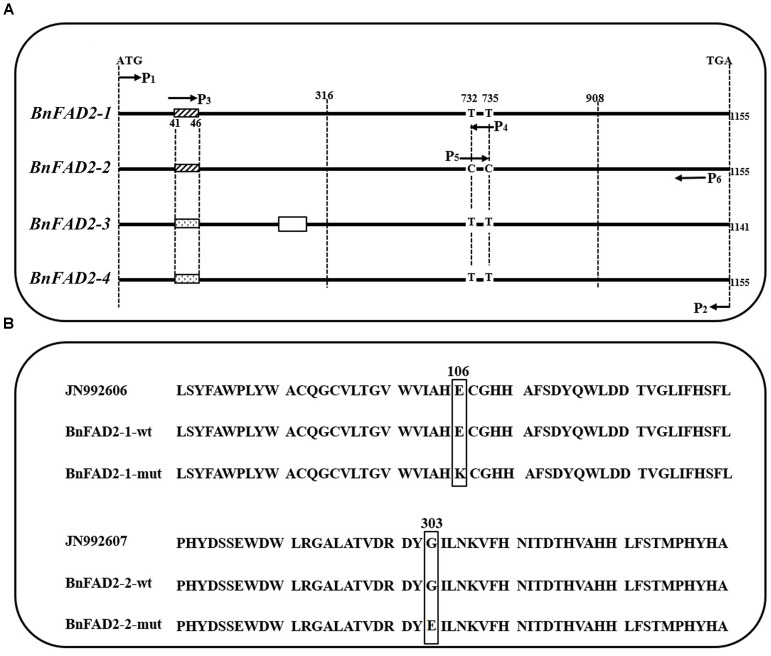
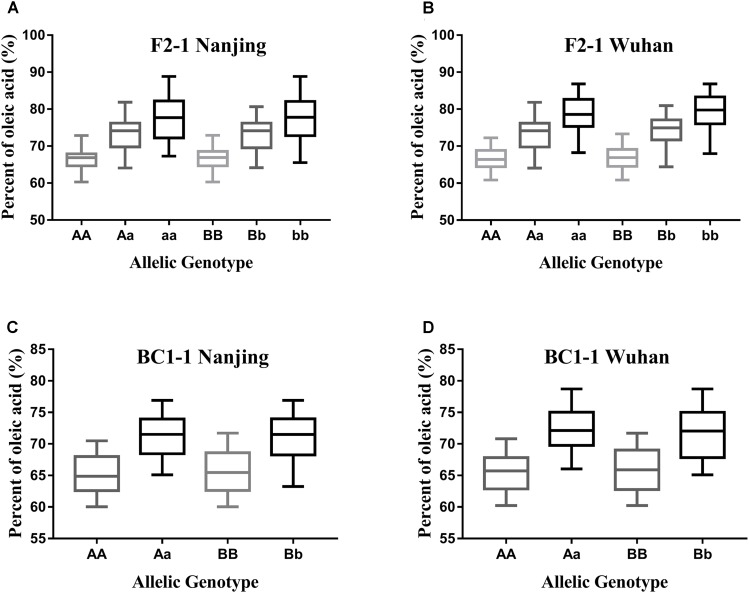
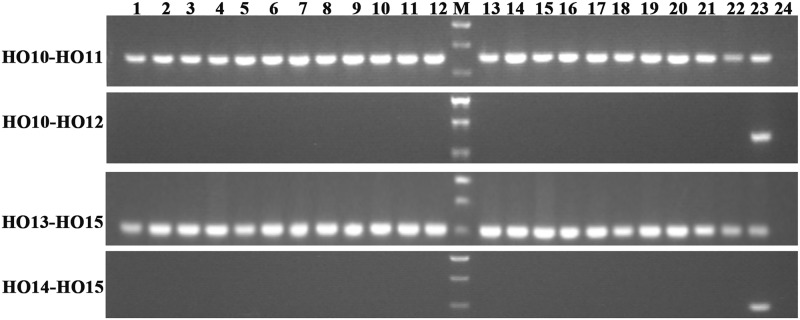
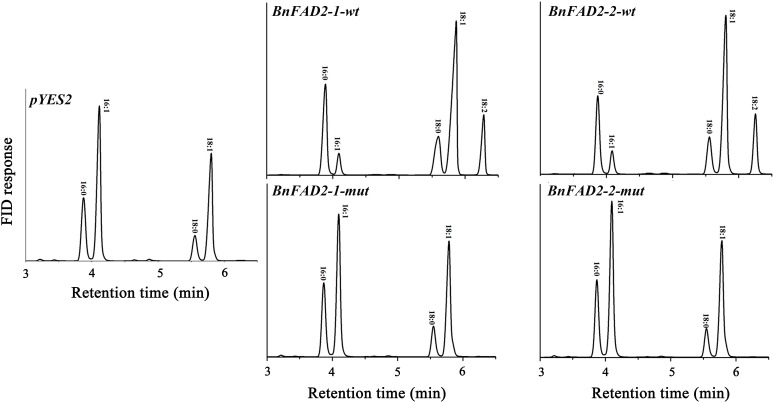
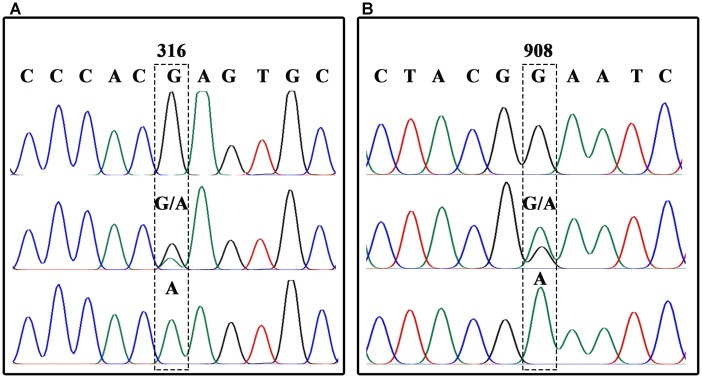
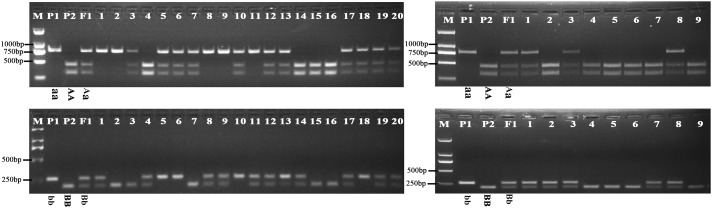
Rapeseed ( L.) is a vital oil crop worldwide. High oleic acid content is a desirable quality trait for rapeseed oil, which makes it more beneficial to human health. However, many germplasm resources with high oleic acid content in rapeseed have not been evaluated with regard to their genotypes, making it difficult to select the best strains with this trait for the breeding of high oleic acid rapeseed variety. This work was to explore the gene-regulation mechanism of this trait using a new super-high oleic acid content (∼85%) line N1379T as genetic material. In this study, the sequences of four homologous () genes were compared between super-high (∼85%, N1379T) and normal (∼63%) oleic acid content lines. Results showed that there were two single-nucleotide polymorphisms (SNPs) in and , respectively, which led to the amino acid changes (E106K and G303E) in the corresponding proteins. Functional analysis of both genes in yeast confirmed that these SNPs were loss-of-function mutations, thus limiting the conversion of oleic acid to linoleic acid and resulting in the considerable accumulation of oleic acid. Moreover, two specific cleaved amplified polymorphic sequences (CAPS) markers for the two SNPs were developed to identify genotypes of each line in the F and BC populations. Furthermore, these two mutant loci of and genes were positively associated with elevated oleic acid levels and had a similar effect with regard to the increase of oleic acid content. Taken together, these two novel SNPs in two different genes jointly regulated the high oleic acid trait in this special germplasm. The study provided insight into the genetic regulation involved in oleic acid accumulation and highlighted the use of new alleles of and in breeding high oleic acid rapeseed varieties.
油菜(L.)是全球重要的油料作物。高油酸含量是菜籽油理想的品质性状,这使其对人体健康更有益。然而,许多油菜中高油酸含量的种质资源尚未就其基因型进行评估,这使得难以选择具有该性状的最佳品系用于高油酸油菜品种的育种。这项工作旨在以一个新的超高油酸含量(约85%)品系N1379T作为遗传材料,探索该性状的基因调控机制。在本研究中,比较了超高油酸含量(约85%,N1379T)和正常油酸含量(约63%)品系中四个同源()基因的序列。结果表明,和中分别存在两个单核苷酸多态性(SNP),导致相应蛋白质中的氨基酸变化(E106K和G303E)。在酵母中对这两个基因的功能分析证实,这些SNP是功能丧失突变,从而限制了油酸向亚油酸的转化,导致油酸大量积累。此外,针对这两个SNP开发了两个特异性酶切扩增多态性序列(CAPS)标记,以鉴定F和BC群体中每个品系的基因型。此外,和基因的这两个突变位点与油酸水平升高呈正相关,在增加油酸含量方面具有相似的作用。综上所述,两个不同基因中的这两个新SNP共同调控了这种特殊种质中的高油酸性状。该研究为油酸积累所涉及的遗传调控提供了见解,并突出了和新等位基因在高油酸油菜品种育种中的应用。