Johnston Andrea, Wang Zhigao
Department of Molecular Biology, UT Southwestern, 6000 Harry Hines Blvd., NA8.202, Dallas, Texas 75390, USA.
J Nat Sci. 2018 Jul;4(7).
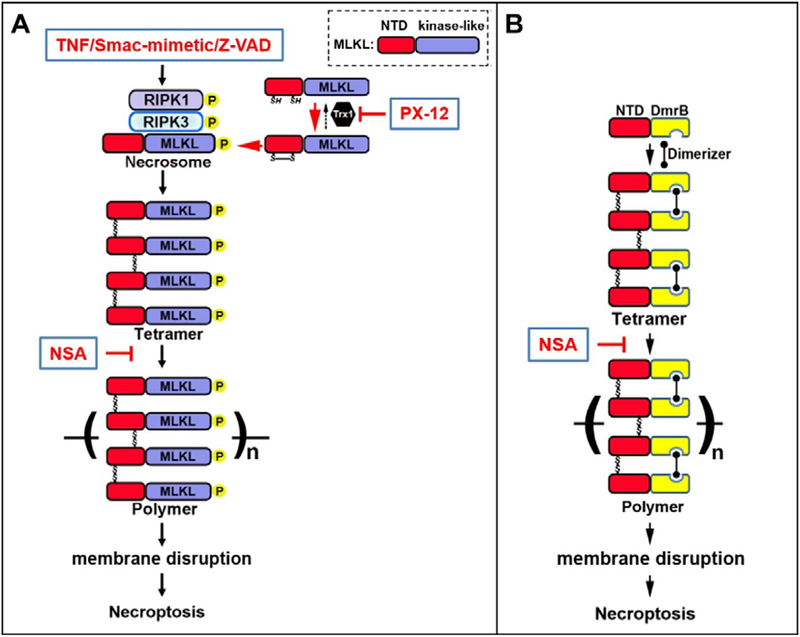
Necroptosis is a subtype of regulated necrosis that occurs when caspases are inhibited or fail to activate. Stimulus of cell death receptors results in a signaling cascade that triggers caspase independent, immunogenic cell death. The core pathway relies on receptor interacting protein kinase (RIPK) 1 and 3, which interact through their receptor homotypic interacting motif (RHIM) domains, and form amyloid-like structures termed the necrosome. RIPK3 recruits and phosphorylates mixed lineage kinase domain-like pseudokinase (MLKL), the terminal mediator in the necroptotic pathway. MLKL polymerizes to form a second amyloid-like structure that causes cell membrane disruption resulting in cell death. Although the core necroptosis pathway has been elucidated, the details of MLKL membrane translocation and membrane disruption remain an open area of research.
坏死性凋亡是一种程序性坏死的亚型,当半胱天冬酶被抑制或无法激活时发生。细胞死亡受体的刺激会导致信号级联反应,触发不依赖半胱天冬酶的免疫原性细胞死亡。核心途径依赖于受体相互作用蛋白激酶(RIPK)1和3,它们通过其受体同源相互作用基序(RHIM)结构域相互作用,并形成称为坏死小体的淀粉样结构。RIPK3招募并磷酸化混合谱系激酶结构域样假激酶(MLKL),这是坏死性凋亡途径中的终末介质。MLKL聚合形成第二个淀粉样结构,导致细胞膜破坏,从而导致细胞死亡。尽管核心坏死性凋亡途径已得到阐明,但MLKL膜易位和膜破坏的细节仍是一个开放的研究领域。