Duke University, Durham, NC, USA.
University of Pennsylvania, Philadelphia, PA, USA.
Appetite. 2019 Feb 1;133:24-31. doi: 10.1016/j.appet.2018.09.010. Epub 2018 Oct 5.
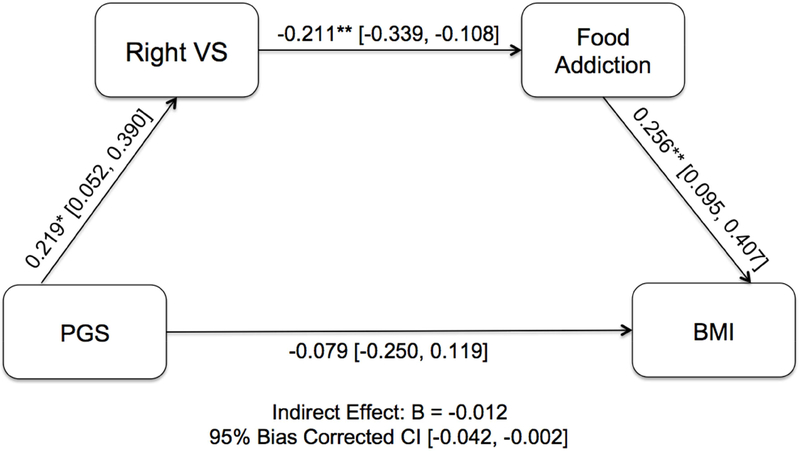
The prevalence rate of obesity continues to rise in the U.S., but effective treatment options remain elusive resulting in increased emphasis on prevention. One such area of prevention research capitalizes on the relatively novel behavioral construct of food addiction, which has been implicated in obesity. Food addiction reflects an individual's propensity for compulsive eating despite negative consequences, and shares not only symptoms with both eating and substance use disorders but also genetic and neural correlates within neural reward-circuitry modulated by dopamine. Here, we examined associations between food addiction scores, body mass index (BMI), reward-related ventral striatum activity, and a polygenic score approximating dopamine signaling in 115 non-Hispanic Caucasian young adult university students. As predicted, polygenic dopamine scores were related to ventral striatum activity, which in turn was associated with higher food addiction scores. In addition, food addiction was related to BMI. An exploratory post-hoc path analysis further indicated that polygenic scores were indirectly related to both food addiction and BMI, in part, through ventral striatum activity. Collectively, our results provide evidence supporting the utility of food addiction in weight gain prevention research by establishing links with known risk-related neural and genetic biomarkers.
美国的肥胖患病率持续上升,但有效的治疗选择仍难以捉摸,因此越来越重视预防。预防研究的一个领域利用了相对新颖的食物成瘾行为结构,这与肥胖有关。食物成瘾反映了个体尽管有负面后果仍存在强迫性进食的倾向,不仅与饮食和物质使用障碍的症状相同,而且还与多巴胺调节的神经奖励回路中的遗传和神经相关性有关。在这里,我们在 115 名非西班牙裔白种人年轻成年大学生中检查了食物成瘾评分、体重指数(BMI)、与奖励相关的腹侧纹状体活动以及近似多巴胺信号的多基因评分之间的关联。正如预测的那样,多基因多巴胺评分与腹侧纹状体活动有关,而腹侧纹状体活动又与更高的食物成瘾评分有关。此外,食物成瘾与 BMI 有关。一项探索性事后路径分析进一步表明,多基因评分通过腹侧纹状体活动与食物成瘾和 BMI 均呈间接相关。总的来说,我们的结果通过与已知的与风险相关的神经和遗传生物标志物建立联系,为食物成瘾在体重增加预防研究中的应用提供了证据。