Nilsson Henric, Nylander Eva, Borg Sabina, Tamás Éva, Hedman Kristofer
Department of Clinical Physiology and Department of Medical and Health Sciences, Linköping University, Linköping, Sweden.
Department of Cardiology and Department of Medical and Health Sciences, Linköping University, Linköping, Sweden.
Clin Physiol Funct Imaging. 2019 Jan;39(1):103-110. doi: 10.1111/cpf.12545. Epub 2018 Oct 8.
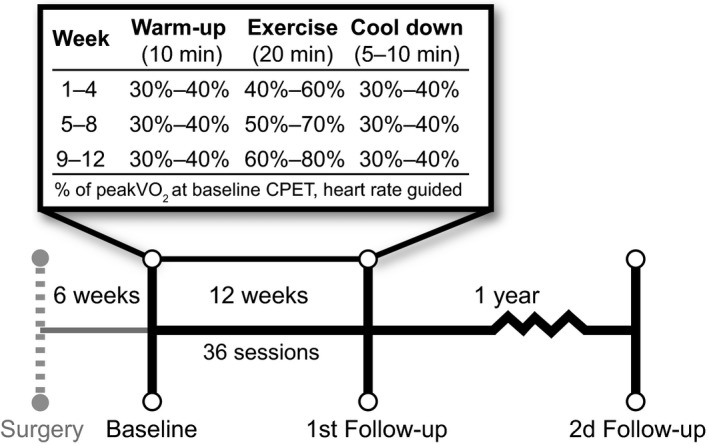
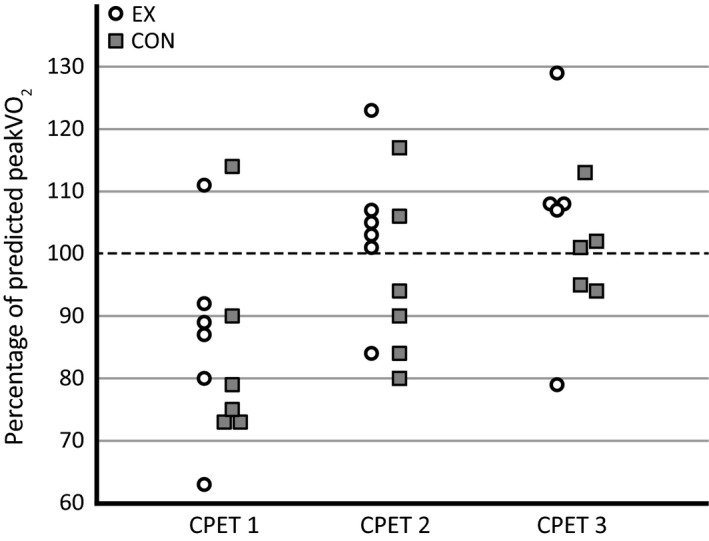
Aortic valve surgery is the definitive treatment for aortic stenosis (AS). No specific recommendation is available on how exercise training should be conducted and evaluated after aortic valve replacement (AVR). This study aimed to examine the effect of aerobic exercise training on exercise capacity following AVR. In addition to our primary outcome variable, peak oxygen uptake (peakVO ), the effect on submaximal cardiopulmonary variables including oxygen uptake kinetics (tau), oxygen uptake efficiency slope (OUES) and ventilatory efficiency (VE/VCO slope) was evaluated. Following AVR due to AS, 12 patients were randomized to either a group receiving 12 weeks of supervised aerobic exercise training (EX) or a control group (CON). Exercise capacity was assessed by a maximal cardiopulmonary exercise test (CPET). There was a significant increase in peak load (+28%, P = 0·031) and in peakVO (+23%, P = 0·031) in EX, corresponding to an increase in achieved percentage of predicted peakVO from 88 to 104% (P = 0·031). For submaximal variables, there were only non-statistically significant trends in improvement between CPETs in EX. In CON, there were no significant differences in any maximal or submaximal variable between CPETs. We conclude that 12 weeks of supervised aerobic exercise training induces significant adaptations in cardiopulmonary function following AVR, especially in regard to maximal variables including peakVO . In addition, we provide novel data on the effect on several submaximal variables following exercise training in this group of patients.
主动脉瓣手术是治疗主动脉瓣狭窄(AS)的确定性方法。对于主动脉瓣置换术(AVR)后应如何进行和评估运动训练,尚无具体建议。本研究旨在探讨有氧运动训练对AVR后运动能力的影响。除了我们的主要结局变量——峰值摄氧量(peakVO₂)外,还评估了对次最大心肺变量的影响,包括摄氧动力学(tau)、摄氧效率斜率(OUES)和通气效率(VE/VCO₂斜率)。因AS接受AVR后,12名患者被随机分为两组,一组接受为期12周的有监督有氧运动训练(EX),另一组为对照组(CON)。通过最大心肺运动试验(CPET)评估运动能力。EX组的峰值负荷(增加28%,P = 0·031)和peakVO₂(增加23%,P = 0·031)显著增加,相当于预测peakVO₂的实现百分比从88%提高到104%(P = 0·031)。对于次最大变量,EX组两次CPET之间仅存在非统计学意义的改善趋势。在CON组中,两次CPET之间在任何最大或次最大变量上均无显著差异。我们得出结论,为期12周的有监督有氧运动训练可使AVR后的心肺功能产生显著适应性变化,尤其是在包括peakVO₂在内的最大变量方面。此外,我们提供了关于该组患者运动训练后对几个次最大变量影响的新数据。