Medical Research Council Cognition and Brain Sciences Unit, University of Cambridge, Cambridge CB2 7EF, United Kingdom
Medical Research Council Cognition and Brain Sciences Unit, University of Cambridge, Cambridge CB2 7EF, United Kingdom.
J Neurosci. 2018 Nov 21;38(47):10057-10068. doi: 10.1523/JNEUROSCI.0524-18.2018. Epub 2018 Oct 9.
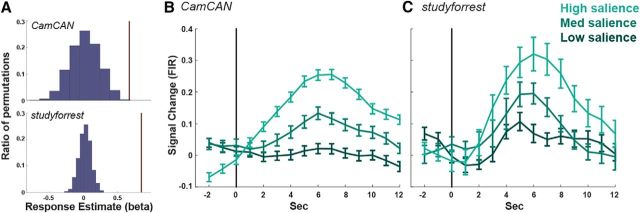
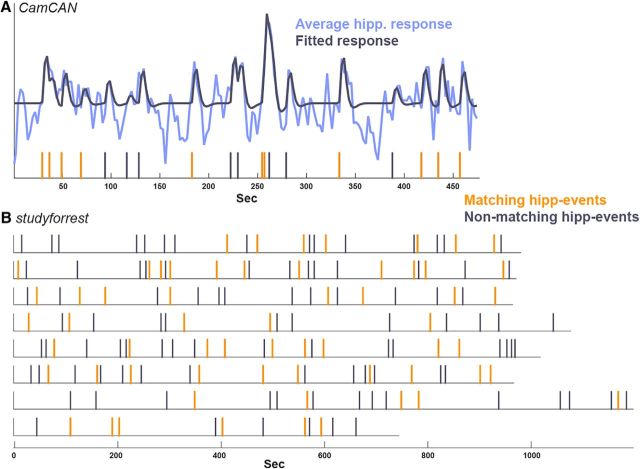
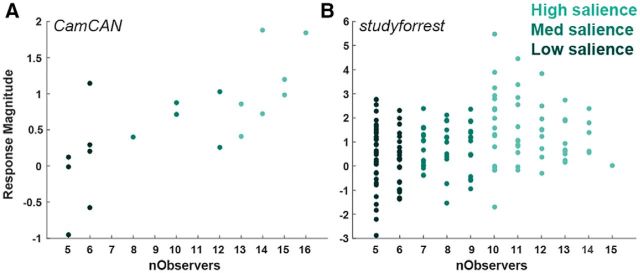
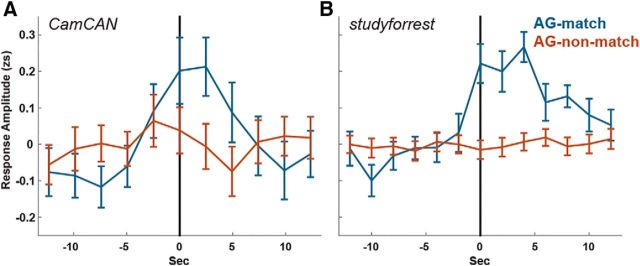
The function of the human hippocampus is normally investigated by experimental manipulation of discrete events. Less is known about what triggers hippocampal activity during more naturalistic, continuous experience. We hypothesized that the hippocampus would be sensitive to the occurrence of event boundaries, that is, moments in time identified by observers as a transition between events. To address this, we analyzed functional MRI data from two groups: one ( = 253, 131 female) who viewed an 8.5 min film and another ( = 15, 6 female) who viewed a 120 min film. We observed a strong hippocampal response at boundaries defined by independent observers, which was modulated by boundary salience (the number of observers that identified each boundary). In the longer film, there were sufficient boundaries to show that this modulation remained after covarying out a large number of perceptual factors. This hypothesis-driven approach was complemented by a data-driven approach, in which we identified hippocampal events as moments in time with the strongest hippocampal activity. The correspondence between these hippocampal events and event boundaries was highly significant, revealing that the hippocampal response is not only sensitive, but also specific to event boundaries. We conclude that event boundaries play a key role in shaping hippocampal activity during encoding of naturalistic events. Recent years have seen the field of human neuroscience research transitioning from experiments with simple stimuli to the study of more complex and naturalistic experience. Nonetheless, our understanding of the function of many brain regions, such as the hippocampus, is based primarily on the study of brief, discrete events. As a result, we know little of what triggers hippocampal activity in real-life settings when we are exposed to a continuous stream of information. When does the hippocampus "decide" to respond during the encoding of naturalistic experience? We reveal here that hippocampal activity measured by fMRI during film watching is both sensitive and specific to event boundaries, identifying a potential mechanism whereby event boundaries shape experience by modulation of hippocampal activity.
人类海马体的功能通常通过对离散事件的实验操作来研究。在更自然、连续的体验中,是什么引发了海马体活动,这方面的了解较少。我们假设海马体会对事件边界的发生敏感,也就是说,观察者认为是事件之间的过渡的时间点。为了解决这个问题,我们分析了来自两组的 fMRI 数据:一组(=253,131 名女性)观看了 8.5 分钟的电影,另一组(=15,6 名女性)观看了 120 分钟的电影。我们观察到,在独立观察者定义的边界处,海马体有强烈的反应,这种反应受到边界显著程度(确定每个边界的观察者数量)的调节。在较长的电影中,有足够的边界可以表明,在协变量中包含大量感知因素后,这种调节仍然存在。这种基于假设的方法通过数据驱动的方法得到了补充,在这种方法中,我们将海马体活动识别为具有最强海马体活动的时间点。这些海马体事件与事件边界之间的对应关系非常显著,这表明海马体的反应不仅敏感,而且对事件边界具有特异性。我们的结论是,事件边界在自然事件编码过程中对塑造海马体活动起着关键作用。近年来,人类神经科学研究领域已从简单刺激的实验过渡到更复杂和自然的体验研究。尽管如此,我们对许多大脑区域(如海马体)的功能的理解主要还是基于对短暂、离散事件的研究。因此,当我们暴露在连续的信息流中时,我们对在现实生活中引发海马体活动的因素知之甚少。在自然体验的编码过程中,海马体什么时候“决定”做出反应?我们在这里揭示,在观看电影时通过 fMRI 测量的海马体活动对事件边界既敏感又特异,这确定了一种潜在的机制,即通过调节海马体活动来塑造体验。