Institute for Global Health Sciences, University of California, San Francisco, Mission Hall, Box 1224, 550 16th Street, Third Floor, San Francisco, CA, 94158, USA.
Department of Obstetrics, Gynecology & Reproductive Sciences, University of California, San Francisco, USA.
Reprod Health. 2018 Oct 10;15(1):169. doi: 10.1186/s12978-018-0588-2.
We conducted a systematic review to summarize the global evidence on person-centered care (PCC) interventions in delivery facilities in order to: (1) map the PCC objectives of past interventions (2) to explore the impact of PCC objectives on PCC and clinical outcomes.
We developed a search strategy based on a current definition of PCC. We searched for English-language, peer-reviewed and original research articles in multiple databases from 1990 to 2016 and conducted hand searches of the Cochrane library and gray literature. We used systematic review methodology that enabled us to extract and synthesize quantitative and qualitative data. We categorized interventions according to their primary and secondary PCC objectives. We categorized outcomes into person-centered and clinical (labor and delivery, perinatal, maternal mental health).
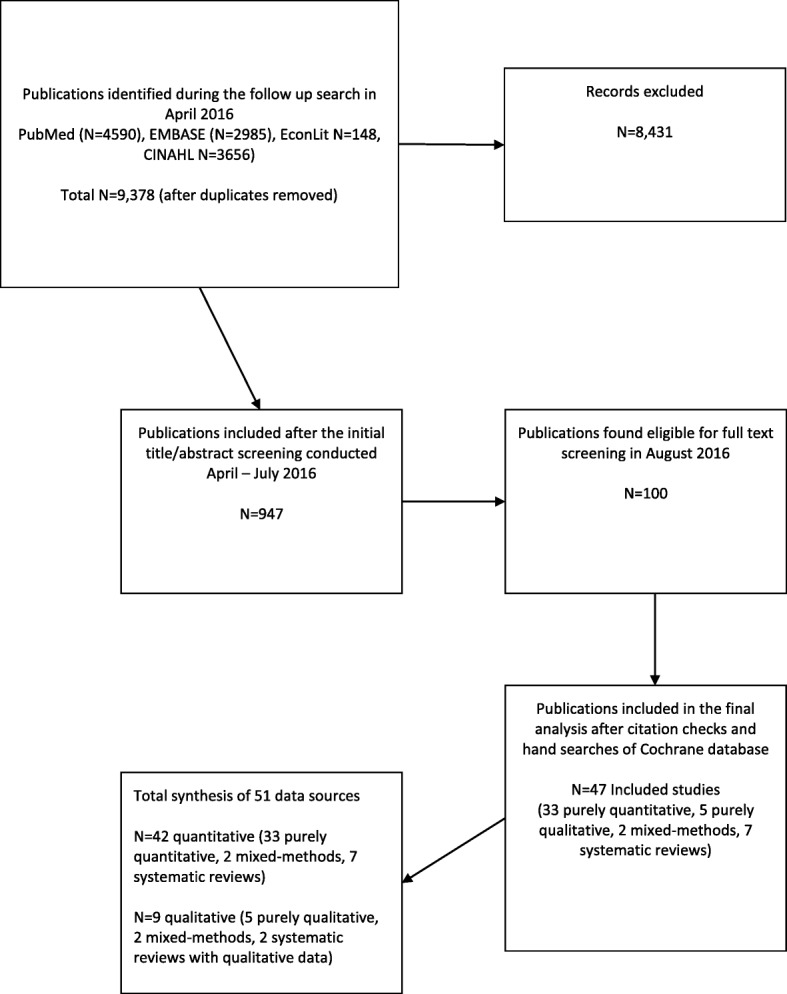
Our initial search strategy yielded 9378 abstracts; we conducted full-text reviews of 32 quantitative, 6 qualitative, 2 mixed-methods studies, and 7 systematic reviews (N = 47). Past interventions pursued these primary PCC objectives: autonomy, supportive care, social support, the health facility environment, and dignity. An intervention's primary and secondary PCC objectives frequently did not align with the measured person-centered outcomes. Generally, PCC interventions either improved or made no difference to person-centered outcomes. There was no clear relationship between PCC objectives and clinical outcomes.
This systematic review presents a comprehensive analysis of facility-based delivery interventions using a current definition of person-centered care. Current definitions of PCC propose new domains of inquiry but may leave out previous domains.
我们进行了一项系统评价,以总结全球范围内在分娩场所实施以患者为中心的护理(PCC)干预措施的证据,目的是:(1)绘制过去干预措施的 PCC 目标;(2)探索 PCC 目标对 PCC 和临床结局的影响。
我们根据当前的 PCC 定义制定了搜索策略。我们在多个数据库中搜索了 1990 年至 2016 年期间发表的英文同行评审和原始研究文章,并对手头的 Cochrane 图书馆和灰色文献进行了检索。我们使用系统评价方法,以便提取和综合定量和定性数据。我们根据主要和次要 PCC 目标对干预措施进行分类。我们将结局分为以患者为中心的结局和临床结局(分娩和产程、围产期、产妇心理健康)。
我们最初的搜索策略产生了 9378 篇摘要;我们对 32 篇定量研究、6 篇定性研究、2 篇混合方法研究和 7 篇系统评价(N=47)进行了全文审查。过去的干预措施追求以下主要 PCC 目标:自主权、支持性护理、社会支持、卫生机构环境和尊严。干预措施的主要和次要 PCC 目标通常与测量的以患者为中心的结局不匹配。通常,PCC 干预措施要么改善,要么对以患者为中心的结局没有影响。PCC 目标与临床结局之间没有明确的关系。
本系统评价使用当前的以患者为中心的护理定义,对基于机构的分娩干预措施进行了全面分析。当前的 PCC 定义提出了新的研究领域,但可能遗漏了以前的领域。