Department of Social and Preventive Epidemiology, Graduate School of Medicine, University of Tokyo, Tokyo 113-0033, Japan.
Department of Social and Preventive Epidemiology, School of Public Health, University of Tokyo, Tokyo 113-0033, Japan.
Nutrients. 2018 Oct 10;10(10):1474. doi: 10.3390/nu10101474.
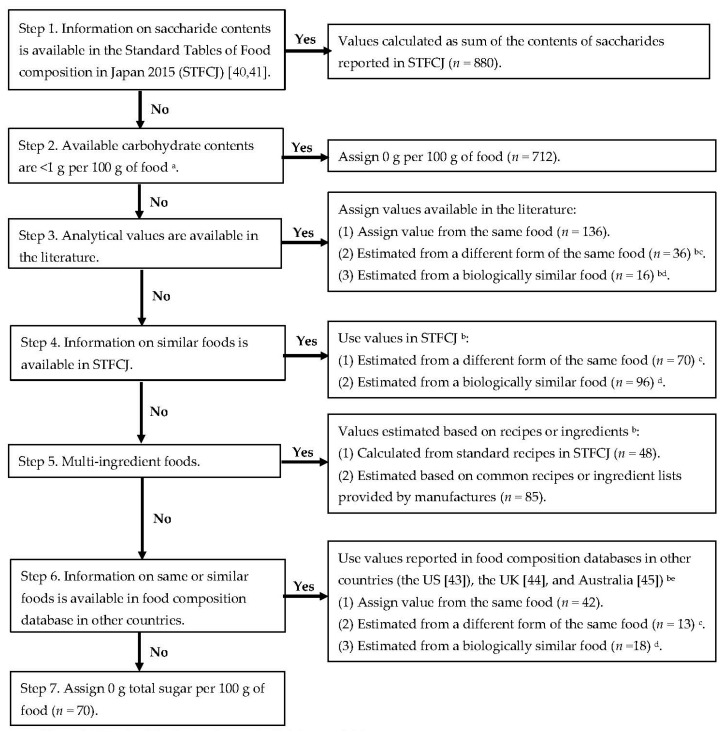
Due to a lack of a food composition database on starch and sugars, we developed a comprehensive database on starch and seven types of sugars in commonly consumed foods ( = 2222) in Japan. Dietary record data of 368 toddlers (aged 18⁻35 months), 376 preschool children (aged 3⁻6 years), 915 schoolchildren (aged 8⁻14 years) and 392 adults (aged 20⁻69 years) were used. The mean starch intake ranged from 55.6 g/day (female toddlers) to 206.0 g/day (male schoolchildren). Irrespective of age and sex, >50% of starch was provided by rice and grains. The mean total sugar intake ranged from 46.1 g/day (female toddlers) to 68.7 g/day (male schoolchildren). In all age and sex groups, the major contributors of total sugar included sucrose (mean: 18.2⁻34.0 g/day), glucose (7.8⁻13.1 g/day), lactose (5.3⁻13.1 g/day) and fructose (7.6⁻11.1 g/day). The top food sources were dairy products (toddlers) and confectionaries (other age groups) for total sugar, confectionaries for sucrose, fruits (toddlers) and vegetables (other age groups) for glucose, dairy products for lactose and fruits (toddlers and preschool children) and vegetables (schoolchildren and adults) for fructose. In conclusion, this study clarified the starch and sugar intake in Japan and provides a foundation for future research.
由于缺乏关于淀粉和糖的食物成分数据库,我们在日本开发了一个关于常见食物中淀粉和七种糖的综合数据库(= 2222 种)。使用了 368 名幼儿(18-35 个月)、376 名学龄前儿童(3-6 岁)、915 名学童(8-14 岁)和 392 名成年人(20-69 岁)的饮食记录数据。淀粉的平均摄入量从 55.6 克/天(女幼儿)到 206.0 克/天(男学童)不等。无论年龄和性别如何,超过 50%的淀粉来自米饭和谷物。总糖的平均摄入量从 46.1 克/天(女幼儿)到 68.7 克/天(男学童)不等。在所有年龄和性别组中,总糖的主要来源包括蔗糖(平均:18.2-34.0 克/天)、葡萄糖(7.8-13.1 克/天)、乳糖(5.3-13.1 克/天)和果糖(7.6-11.1 克/天)。总糖的主要食物来源是乳制品(幼儿)和糖果(其他年龄组),蔗糖的主要食物来源是糖果,葡萄糖的主要食物来源是水果(幼儿)和蔬菜(其他年龄组),乳糖的主要食物来源是乳制品,果糖的主要食物来源是水果(幼儿和学龄前儿童)和蔬菜(学童和成年人)。总之,本研究阐明了日本的淀粉和糖摄入量,并为未来的研究提供了基础。