Ruiz Emma, Rodriguez Paula, Valero Teresa, Ávila José M, Aranceta-Bartrina Javier, Gil Ángel, González-Gross Marcela, Ortega Rosa M, Serra-Majem Lluis, Varela-Moreiras Gregorio
Spanish Nutrition Foundation (FEN), C/General Álvarez de Castro 20, 28010 Madrid, Spain.
Department of Preventive Medicine and Public Health, University of Navarra, C/Irunlarrea 1, 31008 Pamplona, Spain.
Nutrients. 2017 Mar 14;9(3):275. doi: 10.3390/nu9030275.
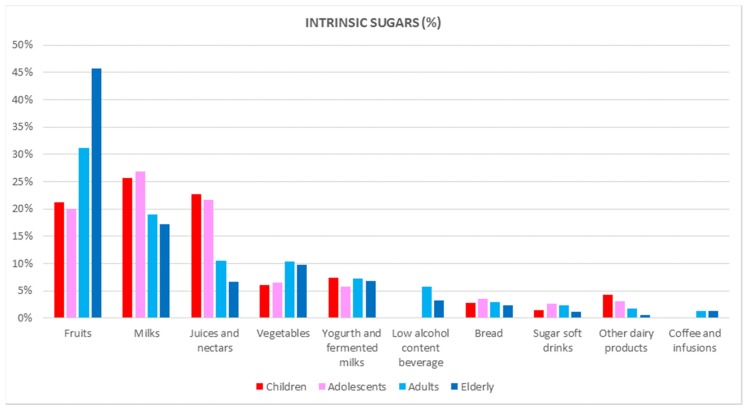
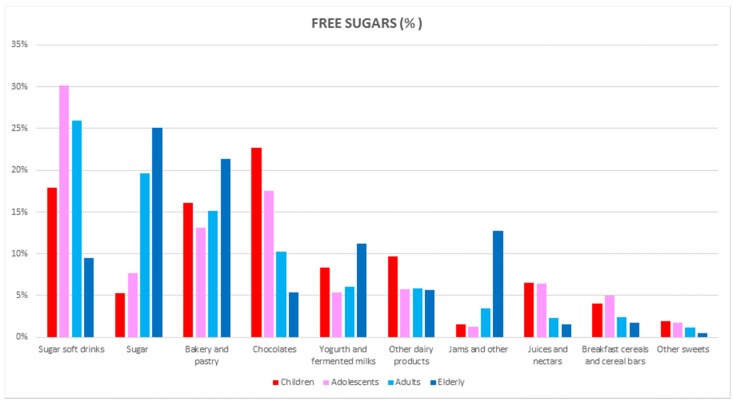
The consumption of total and individual sugars is controversial and little is known about consumption and dietary sources in Spain. The purpose was to examine free and intrinsic sugar intake and food and beverage sources. The ANIBES Study (Anthropometry, Intake and Energy Balance in Spain), a cross-sectional study of a representative sample of the Spanish population (9-75 years old; = 2009) carried out in 2013, was used. Food and beverage records were obtained by a three-day dietary record by using a tablet device. The median total sugar intake was 71.5 g/day (17% Total Energy, TE), the intrinsic sugar intake was 38.3 g/day (9.6% TE), and the free sugar was 28.8 g/day (7.3% TE). Total sugar intake (free and intrinsic) was higher in men than in women for all age groups, although in terms of the contribution to total energy intake, the opposite was observed. Differences were observed for free sugar consumption dependent on age and marked differences (up to two-fold) were observed when considering the percent TE, which was much higher in children and adolescents. For the intrinsic sugar, however, a higher contribution to TE was observed in the elderly. The major sources of intrinsic sugars were fruits (31.8%), milks (19.6%), juices and nectars (11.1%), vegetables (9.89%), yogurt and fermented milk (7.18%), low-alcohol-content beverages (4,94%), bread (2.91%), and sugar soft drinks (2.24%), greater than 90% from diet contribution. As for free sugars, sources were sugar soft drinks (25.5%), sugar (17.8%), bakery and pastry items (15.2%), chocolates (11.4%), yogurt and fermented milk (6.44%), other dairy products (5.99%), jams (3.58%), juices and nectars (2.91%), and breakfast cereals and cereal bars (2.78%), summing up to 90% of the contribution. The present study demonstrates that only a moderate percentage of the Spanish population adhered to the present recommendations for total sugar intake, and urgent efforts are needed to improve diet quality in the youngest populations.
总糖和各类糖的摄入量存在争议,而且对于西班牙人的糖摄入量及其饮食来源知之甚少。本研究旨在调查游离糖和内源性糖的摄入量以及食物和饮料来源。研究采用了ANIBES研究(西班牙人体测量、摄入量与能量平衡研究),这是一项针对西班牙人群(9至75岁;n = 2009)的代表性样本于2013年开展的横断面研究。通过使用平板电脑设备记录三天的饮食情况来获取食物和饮料记录。总糖摄入量中位数为71.5克/天(占总能量的17%,即TE),内源性糖摄入量为38.3克/天(占TE的9.6%),游离糖为28.8克/天(占TE的7.3%)。所有年龄组男性的总糖摄入量(游离糖和内源性糖)均高于女性,不过就对总能量摄入的贡献而言,情况则相反。观察到游离糖的摄入量因年龄而异,在考虑TE百分比时,观察到显著差异(高达两倍),儿童和青少年的TE百分比要高得多。然而,对于内源性糖,老年人对TE的贡献更高。内源性糖的主要来源是水果(31.8%)、牛奶(19.6%)、果汁和花蜜(11.1%)、蔬菜(9.89%)、酸奶和发酵乳(7.18%)、低酒精饮料(4.94%)、面包(2.91%)和含糖软饮料(2.24%),超过90%来自饮食贡献。至于游离糖,来源包括含糖软饮料(25.5%)、糖(17.8%)、烘焙食品和糕点(15.2%)、巧克力(11.4%)、酸奶和发酵乳(6.44%)、其他乳制品(5.99%)、果酱(3.58%)、果汁和花蜜(2.91%)以及早餐谷物和谷物棒(2.78%),总计占贡献的90%。本研究表明,只有适度比例的西班牙人口符合目前关于总糖摄入量的建议,因此迫切需要做出努力来改善最年轻人群的饮食质量。