Christian Doppler-Laboratory for Monitoring of Microbial Contaminants, Institute for Milk Hygiene, Milk Technology and Food Science, Department of Farm Animal and Public Health in Veterinary Medicine, University of Veterinary Medicine, Veterinärplatz 1, 1210, Vienna, Austria.
Institute of Milk Hygiene, Milk Technology and Food Science, Department of Farm Animal and Public Health in Veterinary Medicine, University of Veterinary Medicine, Veterinärplatz 1, 1210, Vienna, Austria.
Sci Rep. 2018 Oct 11;8(1):15132. doi: 10.1038/s41598-018-33595-5.
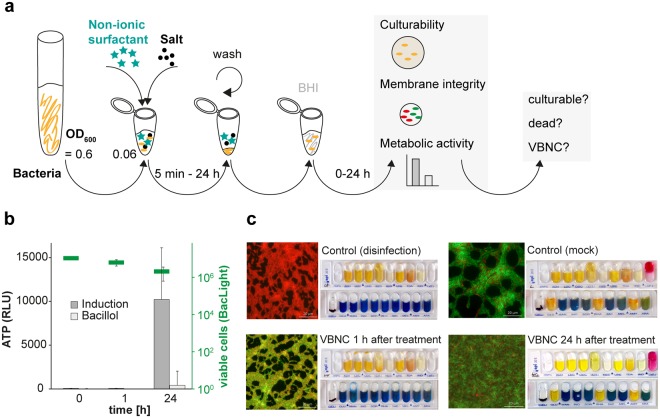
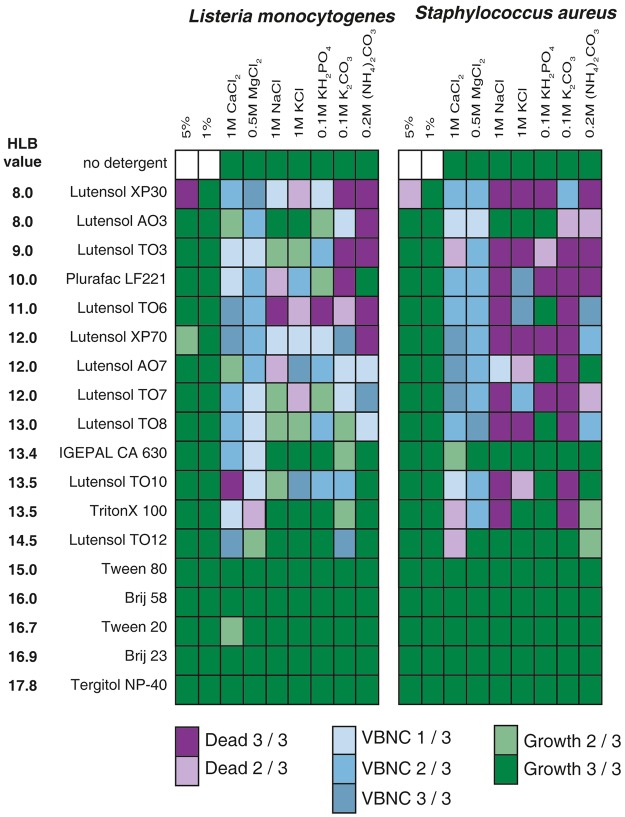
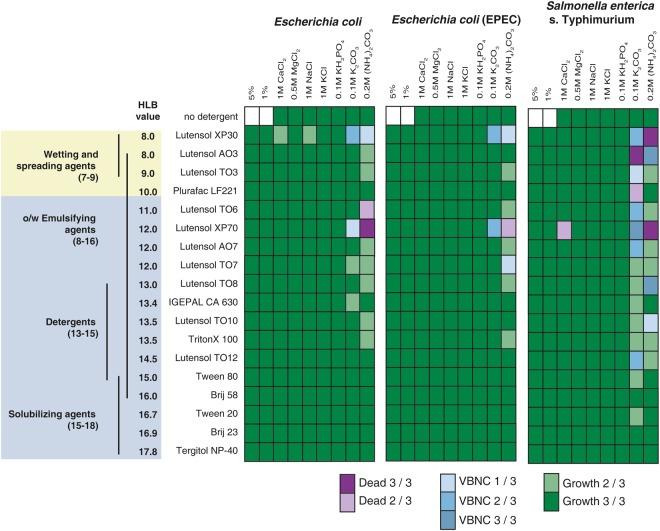
Effective monitoring of microbial pathogens is essential for a successful preventive food safety and hygiene strategy. However, as most monitoring strategies are growth-based, these tests fail to detect pathogenic bacteria that have entered the viable but non-culturable (VBNC) state. The present study reports the induction of the VBNC state in five human pathogens by commercially available household cleaners in combination with inorganic salts. We determined that non-ionic surfactants, a common ingredient in household cleaners, can induce the VBNC state, when combined with salts. A screening study with 630 surfactant/salt combinations indicates a correlation between the hydrophobicity of the surfactant and VBNC induction in L. monocytogenes, E. coli, S. enterica serovar Typhimurium, S. aureus and toxin-producing enteropathogenic E. coli. Cells that were exposed to combinations of surfactants and salts for 5 min and up to 1 h lost their culturability on standard growth media while retaining their ATP production, fermentation of sugars and membrane integrity, which suggests intact and active metabolism. Screening also revealed major differences between Gram-negative and Gram-positive bacteria; the latter being more susceptible to VBNC induction. Combinations of such detergents and salts are found in many different environments and reflect realistic conditions in industrial and domestic surroundings. VBNC cells present in industrial environments, food-processing plants and even our daily routine represent a serious health risk due to possible resuscitation, unknown spreading, production of toxins and especially their invisibility to routine detection methods, which rely on culturability of cells and fail to detect VBNC pathogens.
有效监测微生物病原体对于成功实施预防性食品安全和卫生策略至关重要。然而,由于大多数监测策略基于生长,这些测试无法检测已进入存活但非可培养 (VBNC) 状态的致病菌。本研究报告了五种人类病原体通过市售家用清洁剂与无机盐联合诱导进入 VBNC 状态。我们确定非离子表面活性剂,家用清洁剂中的常见成分,当与盐结合时可以诱导 VBNC 状态。对 630 种表面活性剂/盐组合进行的筛选研究表明,表面活性剂的疏水性与单核细胞增生李斯特菌、大肠杆菌、肠炎沙门氏菌血清型 Typhimurium、金黄色葡萄球菌和产毒性肠致病性大肠杆菌中 VBNC 诱导之间存在相关性。暴露于表面活性剂和盐组合 5 分钟至 1 小时的细胞在标准生长培养基上失去可培养性,同时保持其 ATP 产生、糖发酵和膜完整性,这表明代谢完整且活跃。筛选还揭示了革兰氏阴性和革兰氏阳性细菌之间的主要差异;后者更容易诱导 VBNC。许多不同环境中都存在此类清洁剂和盐的组合,反映了工业和家庭环境中的实际情况。工业环境、食品加工厂甚至我们的日常生活中存在的 VBNC 细胞由于可能复苏、未知传播、产生毒素以及特别是它们对常规检测方法的不可见性(这些方法依赖于细胞的可培养性,无法检测到 VBNC 病原体),构成了严重的健康风险。