Correa Tomas A, Pal Bidyut, van Arkel Richard J, Vanacore Felice, Amis Andrew A
Biomechanics Group, Mechanical Engineering Department, Imperial College London, London SW7 2AZ, UK.
Biomechanics Group, Mechanical Engineering Department, Imperial College London, London SW7 2AZ, UK; School of Engineering, University of Portsmouth, Portsmouth PO1 3DJ, UK.
Med Eng Phys. 2018 Dec;62:22-28. doi: 10.1016/j.medengphy.2018.09.006. Epub 2018 Oct 10.
Revision total knee arthroplasty (RTKA) has poorer results than primary total knee arthroplasty (TKA), and the prostheses are invasive and cause strain-shielding of the bones near the knee. This paper describes an RTKA system with extracortical fixation. It was hypothesised that this would reduce strain-shielding compared with intramedullary fixation.
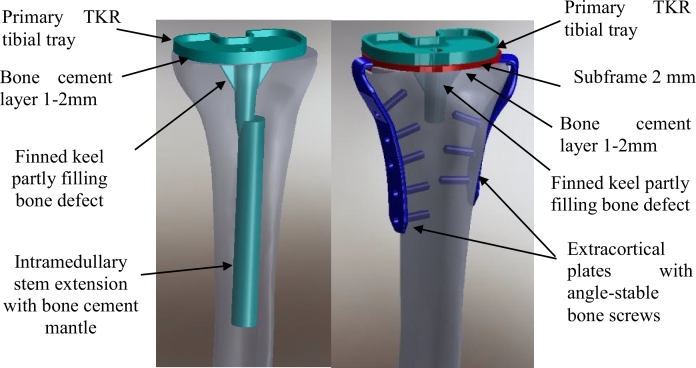
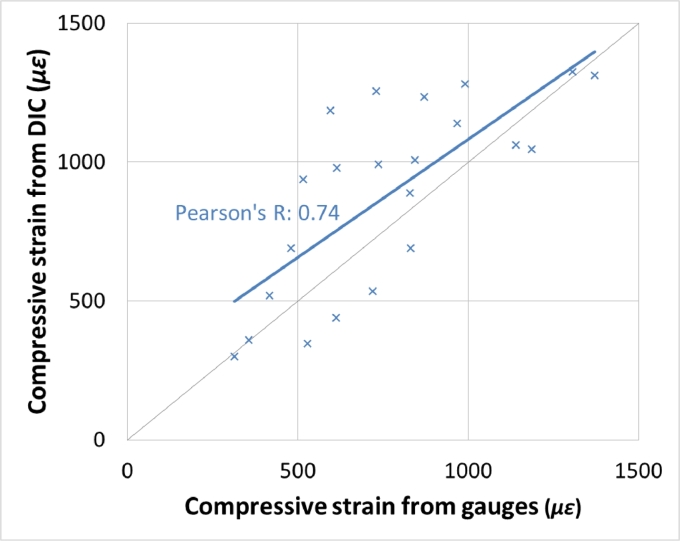
Twelve replica tibiae were prepared for full-field optical surface strain analysis. They were either left intact, implanted with RTKA components with cemented intramedullary fixation stems, or implanted with a novel design with a tibial tray subframe supported by two extracortical fixation plates and screw fixation. They were loaded to simulate peak walking and stair climbing loads and the surface strains were measured using digital image correlation. The measurements were validated with strain gauge rosettes.
Compared to the intact bone model, extracortical fixation reduced surface strain-shielding by half versus intramedullary fixation. For all load cases and bone regions examined, the extracortical implant shielded 8-27% of bone strain, whereas the intramedullary component shielded 37-56%.
The new fixation design, which offers less bone destruction than conventional RTKA, also reduced strain-shielding. Clinically, this design may allow greater rebuilding of bone loss, and should increase long-term fixation.
全膝关节置换翻修术(RTKA)的效果比初次全膝关节置换术(TKA)差,并且假体具有侵入性,会导致膝关节附近骨骼的应力遮挡。本文描述了一种采用皮质外固定的RTKA系统。据推测,与髓内固定相比,这种固定方式可减少应力遮挡。
准备12个胫骨复制体用于全场光学表面应变分析。它们要么保持完整,要么植入带有骨水泥固定髓内固定柄的RTKA组件,要么植入一种新颖设计,该设计带有由两个皮质外固定板和螺钉固定支撑的胫骨托子框架。对它们进行加载以模拟行走峰值和爬楼梯负荷,并使用数字图像相关技术测量表面应变。测量结果用应变片花进行验证。
与完整骨模型相比,皮质外固定与髓内固定相比,将表面应力遮挡减少了一半。对于所有测试的负荷情况和骨区域,皮质外植入物可屏蔽8% - 27%的骨应变,而髓内组件可屏蔽37% - 56%。
这种新的固定设计比传统的RTKA对骨骼的破坏更小,同时也减少了应力遮挡。在临床上,这种设计可能允许更大程度地修复骨丢失,并应能增强长期固定效果。