Sandersen Charlotte, Ceusters Justine, Fourez Alexia, Tosi Irene, Graide Helene, Lejeune Jean-Philippe, Serteyn Didier
Department of Clinical Sciences, Faculty of Veterinary Medicine, University of Liege;
Department of Clinical Sciences, Faculty of Veterinary Medicine, University of Liege.
J Vis Exp. 2018 Sep 26(139):58023. doi: 10.3791/58023.
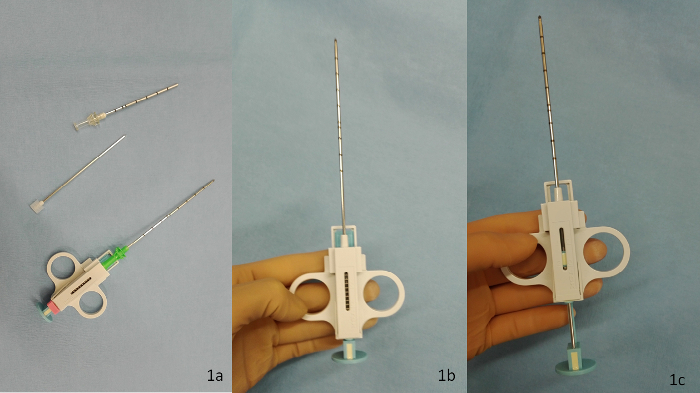
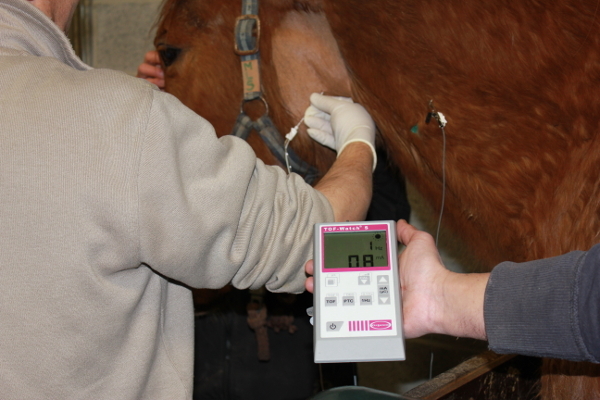
Recurrent laryngeal neuropathy (RLN) commonly affects horses and is characterized by abnormal respiratory sounds and exercise intolerance. The recurrent laryngeal nerve shows lesions of demyelination. The benefit of applying stem cells to demyelinated nerves has been demonstrated in various animal models. The aim of the study was to test the feasibility and safety of a peri-neuronal injection of autologous muscle-derived mesenchymal stem cells to the left recurrent laryngeal nerve in healthy horses by using an electrical nerve stimulator. Muscle-derived stems cell are obtained from five healthy Standardbred horses by sampling 20 mg of muscle tissue with a semi-automatic 14 G biopsy needle from the triceps muscle. Movements of the larynx are monitored via upper-airway video endoscopy. The left recurrent laryngeal nerve is approached with an insulated nerve block needle. Nerve stimulation is applied, starting at 2 mA, and the successful abduction of the left arytenoid is monitored. The stimulation intensity is reduced progressively. When a loss of the motor response is observed at 0.5 mA, 10 autologous muscle-derived stem cells are injected. Two examiners, who are blinded to the time point, score the laryngeal function of the horses prior to the treatment and at day 1, day 7, and day 28 after the injection of the cells. In a sixth horse, 1 mL of 2% lidocaine is injected to further confirm the correct positioning of the needle. This leads to a temporary paralysis of the left arytenoid cartilage. This study proves that the recurrent laryngeal nerve can be approached with the help of an electrical nerve stimulator and that the electrical stimulation of the nerve is well tolerated by the horses. No modification of the laryngeal function was observed in any of the horses after the injection of the stem cells. Further studies should be conducted to describe the effects of a peri-neuronal injection of autologous muscle-derived mesenchymal stem cells to horses suffering from RLN.
喉返神经病变(RLN)常见于马匹,其特征为呼吸音异常和运动不耐受。喉返神经出现脱髓鞘病变。在各种动物模型中已证明将干细胞应用于脱髓鞘神经的益处。本研究的目的是通过使用神经电刺激器,测试在健康马匹的左侧喉返神经周围神经元注射自体肌肉来源间充质干细胞的可行性和安全性。从五匹健康的标准赛马中获取肌肉来源的干细胞,使用半自动14G活检针从三头肌采集20mg肌肉组织。通过上呼吸道视频内窥镜监测喉部运动。用绝缘神经阻滞针靠近左侧喉返神经。从2mA开始施加神经刺激,并监测左侧杓状软骨的成功外展。刺激强度逐渐降低。当在0.5mA时观察到运动反应丧失时,注射10个自体肌肉来源的干细胞。两名对时间点不知情的检查人员在治疗前以及注射细胞后的第1天、第7天和第28天对马匹的喉部功能进行评分。在第六匹马中,注射1mL 2%利多卡因以进一步确认针的正确定位。这会导致左侧杓状软骨暂时麻痹。本研究证明借助神经电刺激器可以靠近喉返神经,并且马匹对神经的电刺激耐受性良好。注射干细胞后,在任何一匹马中均未观察到喉部功能的改变。应进行进一步研究以描述在患有喉返神经病变的马匹中神经元周围注射自体肌肉来源间充质干细胞的效果。