University of Illinois at Chicago, Department of Psychiatry, United States; University of Michigan, Department of Psychiatry, United States.
University of Illinois at Chicago, Department of Psychiatry, United States.
Neuroimage Clin. 2018;20:1001-1009. doi: 10.1016/j.nicl.2018.10.004. Epub 2018 Oct 4.
Major Depressive Disorder (MDD) is a prevalent, disruptive illness. A majority of those with MDD are at high risk for recurrence and increased risk for morbidity and mortality. This study examined whether multimodal baseline (and retest) Cognitive Control performance and neuroimaging markers (task activation and neural connectivity between key brain nodes) could differentiate between those with and without future recurrence of a major depressive (MD) episode within one year. We hypothesized that performance and neuroimaging measures of Cognitive Control would identify markers that differ between these two groups.
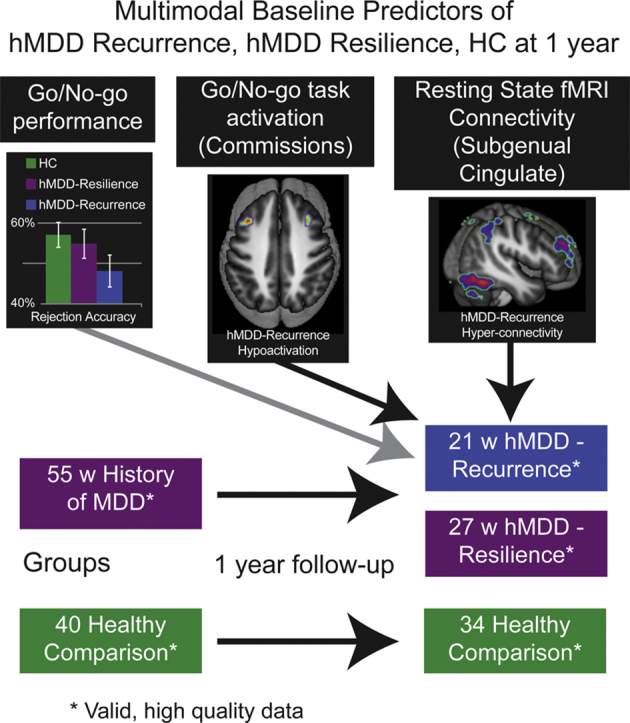
A prospective cohort study of young adults (ages 18-23) with history (h) of early-onset MDD (N = 60), now remitted, and healthy young adults (N = 49). Baseline Cognitive Control measures of performance, task fMRI and resting state connectivity (and reliability retest 4-12 weeks later) were used to compare those with future recurrence of MDD (N = 21) relative to those without future recurrence of MDD (N = 34 with resilience). The measures tested were (1) Parametric Go/No-Go (PGNG) performance, and task activation for (2) PGNG Correct Rejections, (3) PGNG Commission errors, and (4 & 5), resting state connectivity analyses of Cognitive Control Network to and from subgenual anterior cingulate.
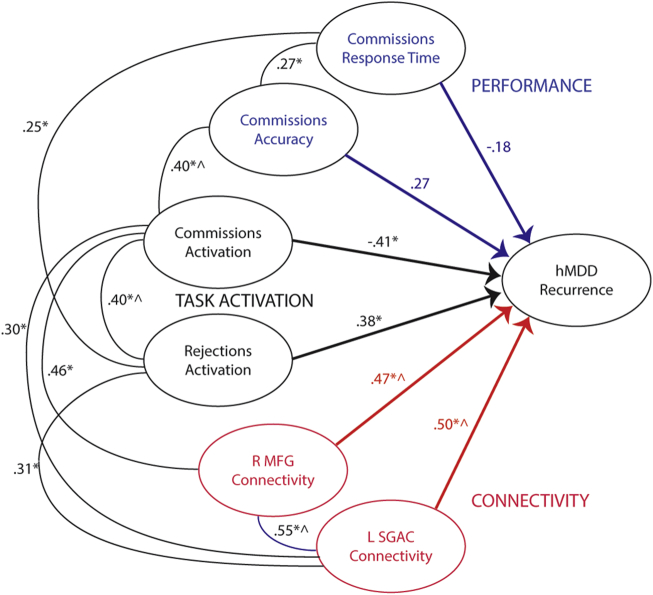
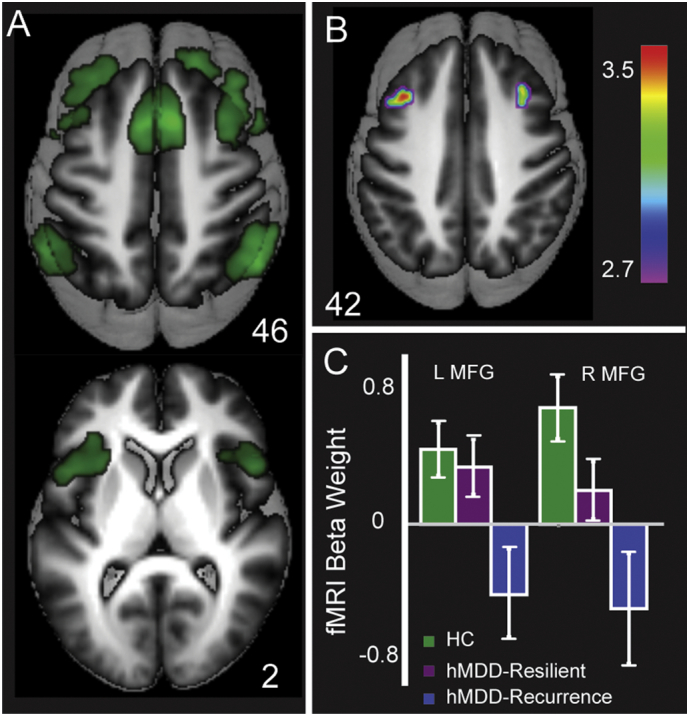
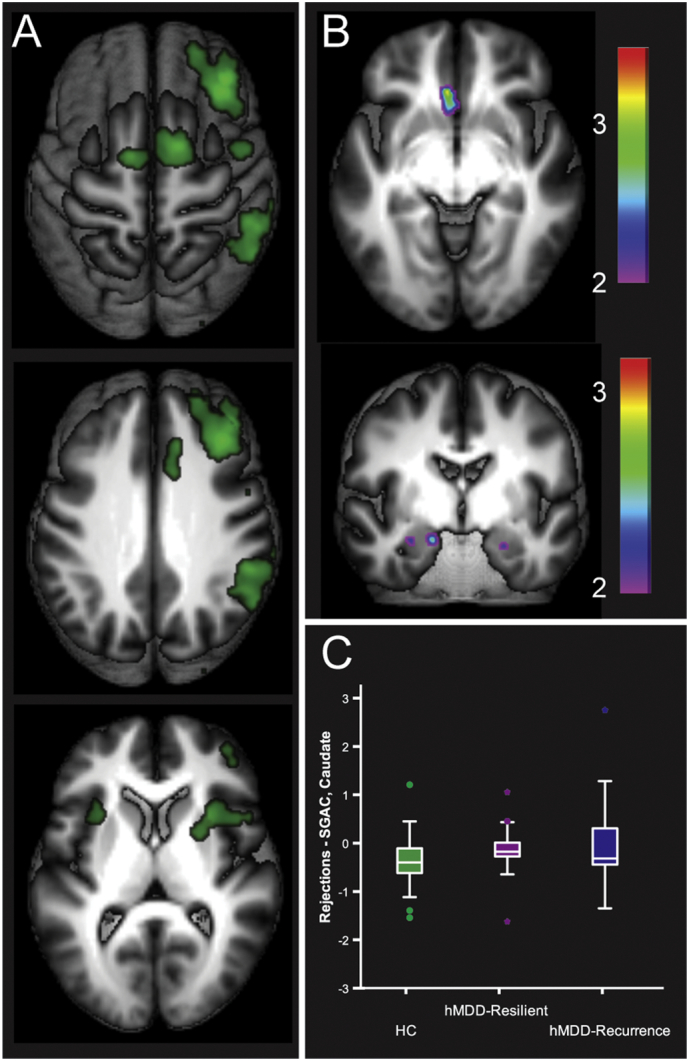
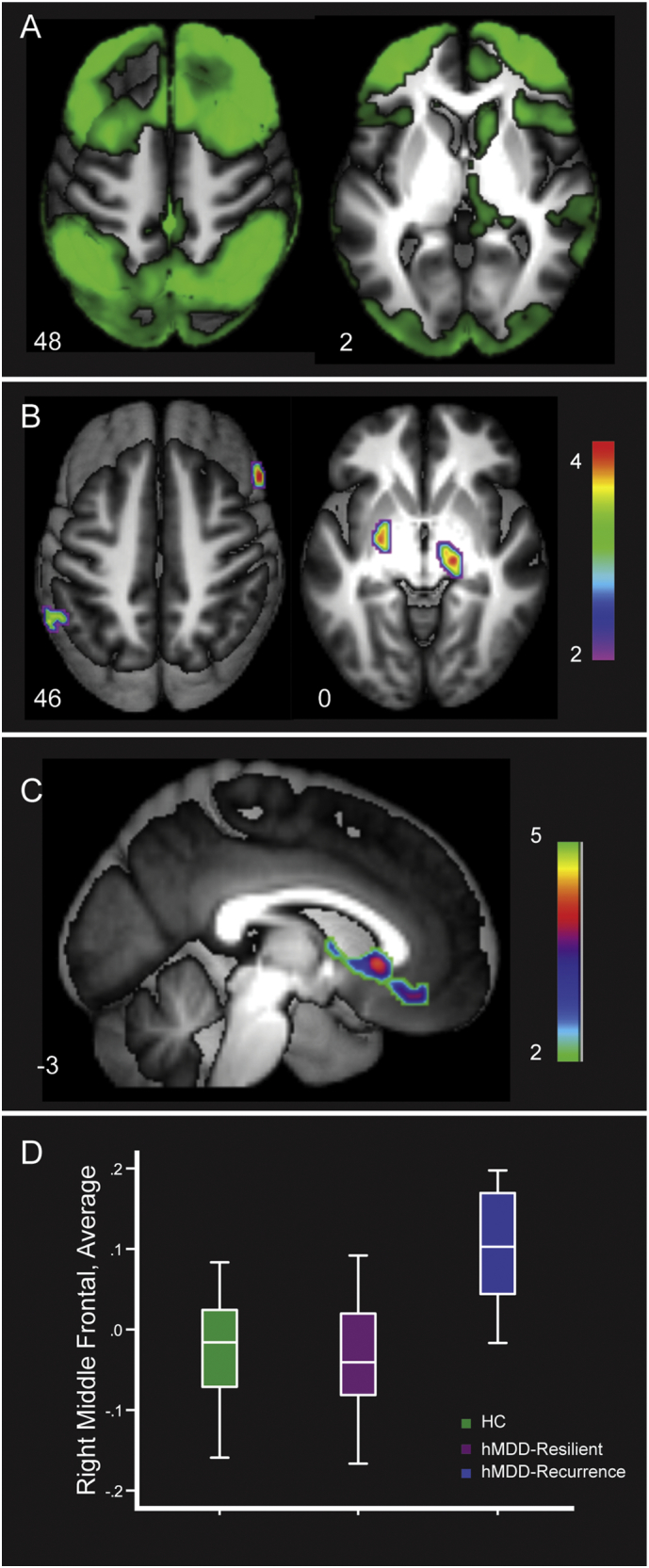
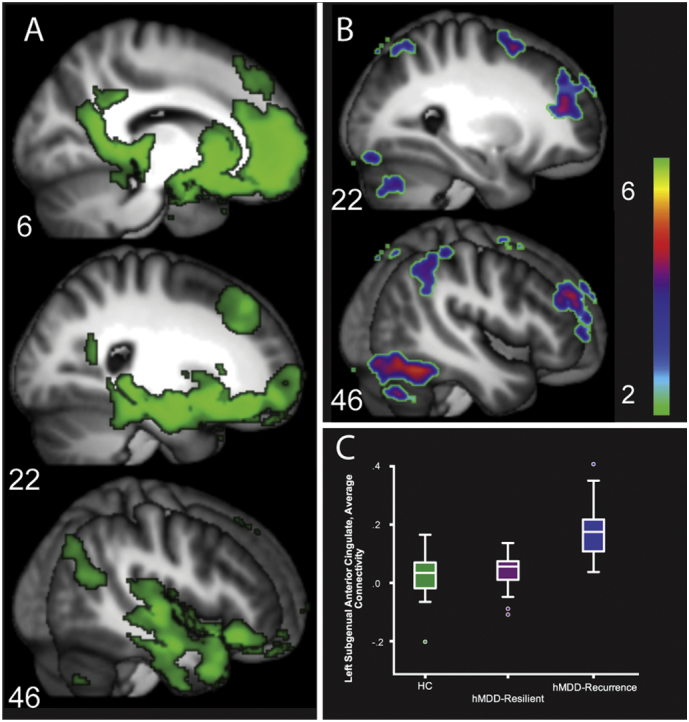
Relative to other groups at baseline, the group with MDD Recurrence had less bilateral middle frontal gyrus activation during commission errors. MDD Recurrence exhibited greater connectivity of right middle frontal gyrus to subgenual anterior cingulate (SGAC). SGAC connectivity was also elevated in this group to numerous regions in the Cognitive Control Network. Moderate to strong ICCs were present from test to retest, and highest for rs-fMRI markers. There were modest, significant correlations between task, connectivity and behavioral markers that distinguished between groups.
Markers of Cognitive Control function could identify those with early course MD who are at risk for depression recurrence. Those at high risk for recurrence would benefit from maintenance or preventative treatments. Future studies could test and validate these markers as potential predictors, accounting for sample selection and bias in feature detection.
重度抑郁症(MDD)是一种普遍存在且具有破坏性的疾病。大多数 MDD 患者都有很高的复发风险,并且发病率和死亡率也会增加。本研究探讨了多模态基线(和复测)认知控制表现和神经影像学标志物(任务激活和关键脑节点之间的神经连接)是否可以区分未来一年内是否会发生重大抑郁(MD)发作的患者。我们假设认知控制的表现和神经影像学测量将确定这两组之间的差异标记。
一项对年轻成年人(18-23 岁)的前瞻性队列研究,他们有早期发作 MDD 的病史(h)(N=60),现已缓解,以及健康的年轻成年人(N=49)。使用基线认知控制表现、任务 fMRI 和静息状态连接的测量(并在 4-12 周后进行可靠性复测),将那些未来有 MDD 复发的患者(N=21)与那些未来没有 MDD 复发的患者(N=34 名有抗复发能力的患者)进行比较。所测试的措施包括(1)参数 Go/No-Go(PGNG)表现,以及(2)PGNG 正确拒绝、(3)PGNG 错误的任务激活,以及(4&5),从认知控制网络到和发自扣带回前侧(subgenual anterior cingulate)的静息状态连接分析。
与基线时的其他组相比,MDD 复发组在犯错误时双侧额中回的激活较少。MDD 复发组的右侧额中回与扣带回前侧(subgenual anterior cingulate)的连接更强。在这个组中,扣带回前侧的连接也升高到认知控制网络中的许多区域。从测试到复测,ICC 值适中且较强,静息状态 fMRI 标志物的 ICC 值最高。任务、连接和行为标志物之间存在适度但显著的相关性,可以区分不同的组别。
认知控制功能的标志物可以识别那些有早期 MDD 病程且有抑郁复发风险的患者。那些有高复发风险的患者将受益于维持或预防性治疗。未来的研究可以测试和验证这些标志物作为潜在的预测指标,同时考虑到样本选择和特征检测中的偏差。