Population Health Sciences, Bristol Medical School, Bristol, UK.
Department of Health Sciences, University of York, York, UK.
BMJ Open. 2018 Oct 15;8(10):e020222. doi: 10.1136/bmjopen-2017-020222.
To identify potentially effective complementary approaches for musculoskeletal (MSK)-mental health (MH) comorbidity, by synthesising evidence on effectiveness, cost-effectiveness and safety from systematic reviews (SRs).
Scoping review of SRs.
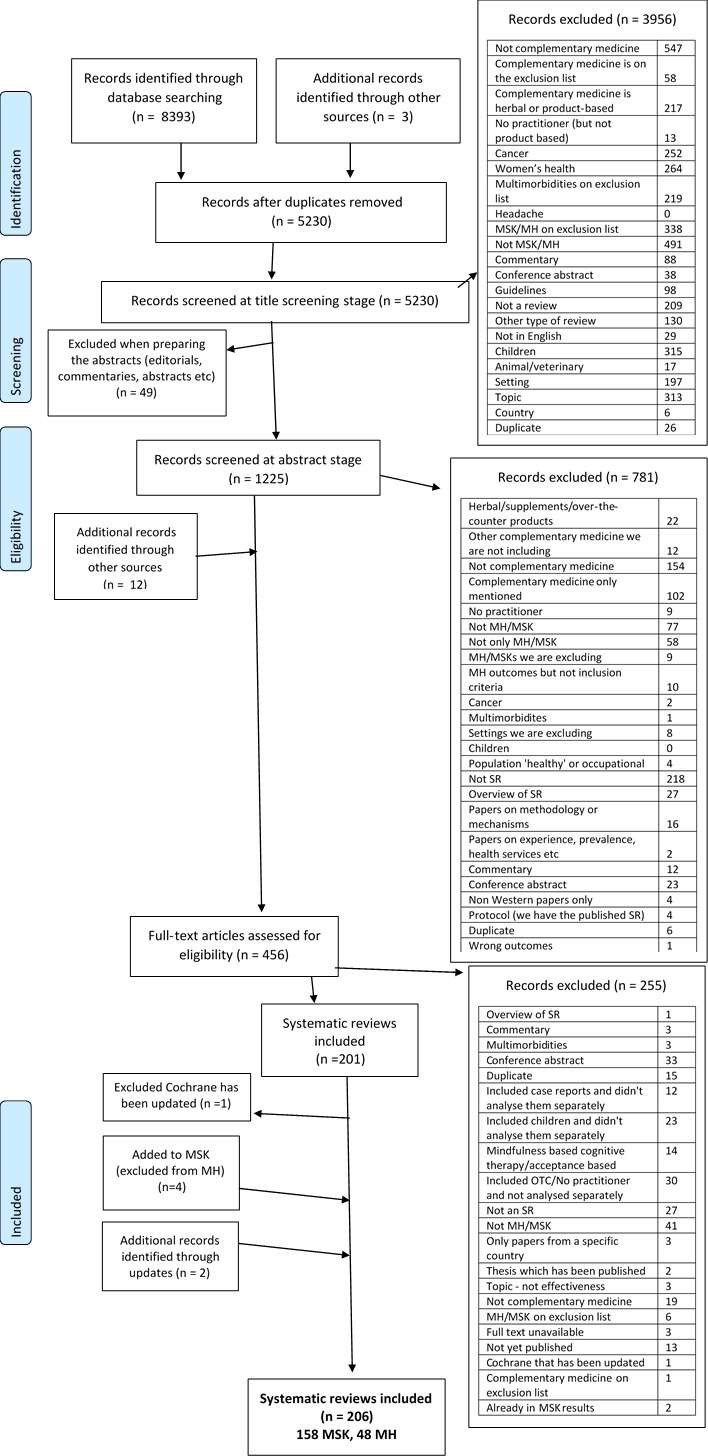
We searched literature databases, registries and reference lists, and contacted key authors and professional organisations to identify SRs of randomised controlled trials for complementary medicine for MSK or MH. Inclusion criteria were: published after 2004, studying adults, in English and scoring >50% on Assessing the Methodological Quality of Systematic Reviews (AMSTAR); quality appraisal checklist). SRs were synthesised to identify research priorities, based on moderate/good quality evidence, sample size and indication of cost-effectiveness and safety.
We included 84 MSK SRs and 27 MH SRs. Only one focused on MSK-MH comorbidity. Meditative approaches and yoga may improve MH outcomes in MSK populations. Yoga and tai chi had moderate/good evidence for MSK and MH conditions. SRs reported moderate/good quality evidence (any comparator) in a moderate/large population for: low back pain (LBP) (yoga, acupuncture, spinal manipulation/mobilisation, osteopathy), osteoarthritis (OA) (acupuncture, tai chi), neck pain (acupuncture, manipulation/manual therapy), myofascial trigger point pain (acupuncture), depression (mindfulness-based stress reduction (MBSR), meditation, tai chi, relaxation), anxiety (meditation/MBSR, moving meditation, yoga), sleep disorders (meditative/mind-body movement) and stress/distress (mindfulness). The majority of these complementary approaches had some evidence of safety-only three had evidence of harm. There was some evidence of cost-effectiveness for spinal manipulation/mobilisation and acupuncture for LBP, and manual therapy/manipulation for neck pain, but few SRs reviewed cost-effectiveness and many found no data.
Only one SR studied MSK-MH comorbidity. Research priorities for complementary medicine for both MSK and MH (LBP, OA, depression, anxiety and sleep problems) are yoga, mindfulness and tai chi. Despite the large number of SRs and the prevalence of comorbidity, more high-quality, large randomised controlled trials in comorbid populations are needed.
通过综合系统评价(SRs)关于有效性、成本效益和安全性的证据,确定治疗肌肉骨骼(MSK)-心理健康(MH)共病的潜在有效补充方法。
SR 的范围审查。
我们搜索了文献数据库、注册处和参考文献列表,并联系了主要作者和专业组织,以确定补充医学治疗 MSK 或 MH 的随机对照试验的 SR。纳入标准为:2004 年后发表,研究对象为成年人,采用英语且在评估系统评价方法学质量(AMSTAR)中得分>50%;质量评估检查表)。根据高质量/中等质量证据、样本量以及成本效益和安全性的指示,对 SR 进行综合分析,以确定研究重点。
我们纳入了 84 篇 MSK SR 和 27 篇 MH SR。只有一篇专注于 MSK-MH 共病。冥想方法和瑜伽可能改善 MSK 人群的心理健康结果。瑜伽和太极对 MSK 和 MH 疾病有高质量/中等质量证据。SR 报告了针对中/大人群的高质量/中等质量证据(任何比较):下腰痛(瑜伽、针灸、脊柱手法/松动、整骨)、骨关节炎(针灸、太极)、颈痛(针灸、手法/手法治疗)、肌筋膜触发点疼痛(针灸)、抑郁(正念减压(MBSR)、冥想、太极、放松)、焦虑(冥想/MBSR、动态冥想、瑜伽)、睡眠障碍(冥想/身心运动)和压力/压力(正念)。这些补充方法中的大多数都有安全性证据,只有三种方法有危害证据。对于下腰痛的脊柱手法/松动和针灸,以及颈痛的手法治疗/手法,有一些成本效益的证据,但很少有 SR 审查成本效益,而且很多都没有数据。
只有一篇 SR 研究了 MSK-MH 共病。补充医学治疗 MSK 和 MH(下腰痛、骨关节炎、抑郁、焦虑和睡眠问题)的研究重点是瑜伽、正念和太极。尽管有大量的 SR 和共病的流行,但在共病人群中需要更多高质量、大型的随机对照试验。