Division of Gastroenterology and Hepatology, Mayo Clinic College of Medicine and Science, Rochester, MN 55905, USA.
Center for Cell Signaling in Gastroenterology, Mayo Clinic, Rochester, MN 55905, USA.
Int J Mol Sci. 2018 Oct 16;19(10):3188. doi: 10.3390/ijms19103188.
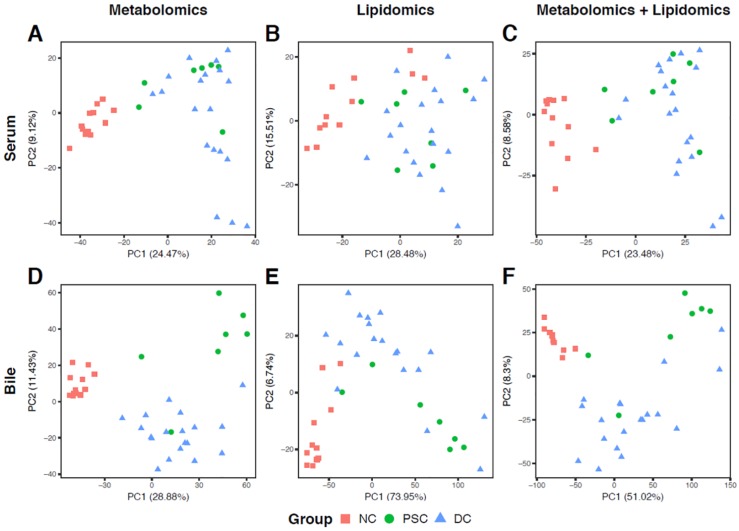
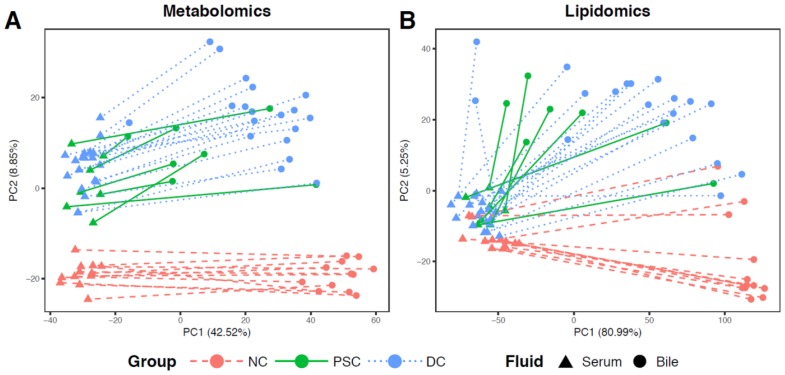
Primary sclerosing cholangitis (PSC) is a pathogenically complex, chronic, fibroinflammatory disorder of the bile ducts without known etiology or effective pharmacotherapy. Emerging in vitro and in vivo evidence support fundamental pathophysiologic mechanisms in PSC centered on enterohepatic circulation. To date, no studies have specifically interrogated the chemical footprint of enterohepatic circulation in PSC. Herein, we evaluated the metabolome and lipidome of portal venous blood and bile obtained at the time of liver transplantation in patients with PSC ( = 7) as compared to individuals with noncholestatic, end-stage liver disease (viral, metabolic, etc. (disease control, DC, = 19)) and to nondisease controls (NC, living donors, = 12). Global metabolomic and lipidomic profiling was performed on serum derived from portal venous blood (portal serum) and bile using ultraperformance liquid chromatography-tandem mass spectrometry (UPLC-MS/MS) and differential mobility spectroscopy-mass spectroscopy (DMS-MS; complex lipid platform). The Mann⁻Whitney test was used to identify metabolites that significantly differed between groups. Principal-component analysis (PCA) showed significant separation of both PSC and DC from NC for both portal serum and bile. Metabolite set enrichment analysis of portal serum and bile demonstrated that the liver-disease cohorts (PSC and DC) exhibited similar enrichment in several metabolite categories compared to NC. Interestingly, the bile in PSC was uniquely enriched for dipeptide and polyamine metabolites. Finally, analysis of patient-matched portal serum and biliary metabolome revealed that these biological fluids were more homogeneous in PSC than in DC or NC, suggesting aberrant bile formation and enterohepatic circulation. In summary, PSC and DC patients exhibited alterations in several metabolites in portal serum and bile, while PSC patients exhibited a unique bile metabolome. These specific alterations in PSC are amenable to hypothesis testing and, potentially, therapeutic pharmacologic manipulation.
原发性硬化性胆管炎(PSC)是一种病因复杂、慢性、纤维炎症性胆管疾病,其病因和有效药物治疗方法尚不清楚。新出现的体外和体内证据支持 PSC 的基本病理生理机制,这些机制集中在肠肝循环上。迄今为止,尚无研究专门探讨 PSC 中肠肝循环的化学特征。在此,我们评估了 PSC 患者(n = 7)在肝移植时获得的门静脉血液和胆汁的代谢组和脂质组,并与非胆汁淤积性终末期肝病患者(病毒性、代谢性等疾病对照组,DC,n = 19)和非疾病对照组(NC,活体供体,n = 12)进行比较。使用超高效液相色谱-串联质谱(UPLC-MS/MS)和差分迁移光谱-质谱(DMS-MS;复杂脂质平台)对门静脉血清(门静脉血清)和胆汁进行了全局代谢组学和脂质组学分析。采用 Mann-Whitney U 检验来识别组间差异有统计学意义的代谢物。主成分分析(PCA)表明,门静脉血清和胆汁中 PSC 和 DC 与 NC 之间存在明显分离。门静脉血清和胆汁的代谢物集富集分析表明,与 NC 相比,肝病组(PSC 和 DC)在几个代谢物类别中表现出相似的富集。有趣的是,PSC 的胆汁中独特地富含二肽和多胺代谢物。最后,分析患者匹配的门静脉血清和胆汁代谢组学发现,与 DC 或 NC 相比,PSC 患者的这些生物液体更为同质,这表明胆汁形成和肠肝循环异常。总之,PSC 和 DC 患者的门静脉血清和胆汁中存在几种代谢物的改变,而 PSC 患者的胆汁代谢组具有独特性。PSC 中这些特定的改变适合进行假说检验,并可能进行治疗性药物干预。