
语义特征网络早期发展中的知识空白。
Knowledge gaps in the early growth of semantic feature networks.
作者信息
Sizemore Ann E, Karuza Elisabeth A, Giusti Chad, Bassett Danielle S
机构信息
Department of Bioengineering, School of Engineering and Applied Science, University of Pennsylvania, Philadelphia, PA, USA.
Department of Psychology, College of Arts and Sciences, University of Pennsylvania, Philadelphia, PA, USA.
出版信息
Nat Hum Behav. 2018 Sep;2(9):682-692. doi: 10.1038/s41562-018-0422-4. Epub 2018 Sep 7.
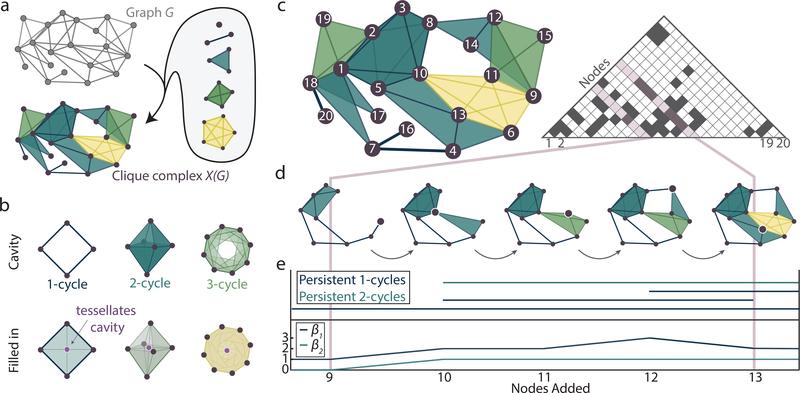
Understanding language learning, and more general knowledge acquisition, requires characterization of inherently qualitative structures. Recent work has applied network science to this task by creating semantic feature networks, in which words correspond to nodes and connections to shared features, then characterizing the structure of strongly inter-related groups of words. However, the importance of sparse portions of the semantic network - knowledge gaps - remains unexplored. Using applied topology we query the prevalence of knowledge gaps, which we propose manifest as cavities within the growing semantic feature network of toddlers. We detect topological cavities of multiple dimensions and find that despite word order variation, global organization remains similar. We also show that nodal network measures correlate with filling cavities better than basic lexical properties. Finally, we discuss the importance of semantic feature network topology in language learning and speculate that the progression through knowledge gaps may be a robust feature of knowledge acquisition.
理解语言学习以及更广泛的知识获取,需要对内在的定性结构进行表征。最近的研究工作通过创建语义特征网络将网络科学应用于这项任务,在语义特征网络中,单词对应节点,连接对应共享特征,然后对高度相关的单词组的结构进行表征。然而,语义网络中稀疏部分——知识缺口——的重要性仍未得到探索。利用应用拓扑学,我们探究了知识缺口的普遍性,我们认为知识缺口表现为幼儿不断增长的语义特征网络中的空洞。我们检测到多个维度的拓扑空洞,并发现尽管词序有所变化,但全局组织仍然相似。我们还表明,节点网络度量比基本词汇属性与填补空洞的相关性更好。最后,我们讨论了语义特征网络拓扑在语言学习中的重要性,并推测通过知识缺口的进展可能是知识获取的一个稳健特征。


 Zotero 插件