Department of Tumor Immunology, Radboud Institute for Molecular Life Sciences, Radboud University Medical Center, Nijmegen, Netherlands.
VA San Diego Healthcare System, San Diego, CA, United States.
Front Immunol. 2018 Oct 4;9:2199. doi: 10.3389/fimmu.2018.02199. eCollection 2018.
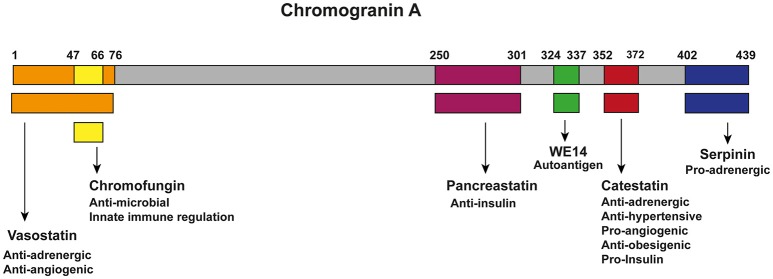
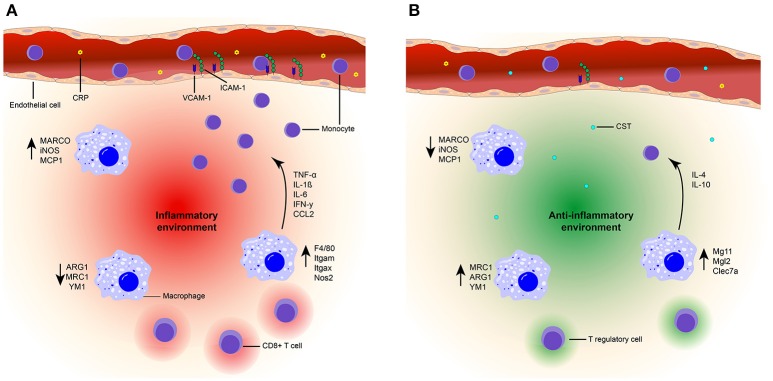
It is increasingly clear that inflammatory diseases and cancers are influenced by cleavage products of the pro-hormone chromogranin A (CgA), such as the 21-amino acids long catestatin (CST). The goal of this review is to provide an overview of the anti-inflammatory effects of CST and its mechanism of action. We discuss evidence proving that CST and its precursor CgA are crucial for maintaining metabolic and immune homeostasis. CST could reduce inflammation in various mouse models for diabetes, colitis and atherosclerosis. In these mouse models, CST treatment resulted in less infiltration of immune cells in affected tissues, although monocyte migration was increased by CST. Both and , CST can shift macrophage differentiation from a pro- to an anti-inflammatory phenotype. Thus, the concept is emerging that CST plays a role in tissue homeostasis by regulating immune cell infiltration and macrophage differentiation. These findings warrant studying the effects of CST in humans and make it an interesting therapeutic target for treatment and/or diagnosis of various metabolic and immune diseases.
越来越多的证据表明,炎症性疾病和癌症受前激素嗜铬粒蛋白 A (CgA) 的裂解产物影响,如 21 个氨基酸长的 catestatin (CST)。本文综述的目的在于概述 CST 的抗炎作用及其作用机制。我们讨论了证明 CST 和其前体 CgA 对于维持代谢和免疫平衡至关重要的证据。CST 可减少糖尿病、结肠炎和动脉粥样硬化等各种小鼠模型的炎症。在这些小鼠模型中,CST 治疗导致受影响组织中免疫细胞浸润减少,尽管 CST 增加了单核细胞迁移。CST 既能减少,也能增加,可将巨噬细胞分化从促炎表型转为抗炎表型。因此,出现了 CST 通过调节免疫细胞浸润和巨噬细胞分化来维持组织平衡的概念。这些发现证明了 CST 在人类中的作用,并使其成为治疗和/或诊断各种代谢和免疫疾病的一个有趣的治疗靶点。