Sun XiaoXue, Luo Shuangxia, Luo Lei, Wang Xing, Chen Xueping, Lu Yin, Shen Shuxing, Zhao Jianjun, Bonnema Guusje
Key Laboratory of Vegetable Germplasm Innovation and Utilization of Hebei, Collaborative Innovation Center of Vegetable Industry in Hebei, Department of Horticulture, Hebei Agricultural University, Baoding, China.
Plant Breeding, Wageningen University & Research, Wageningen, Netherlands.
Front Plant Sci. 2018 Oct 4;9:1455. doi: 10.3389/fpls.2018.01455. eCollection 2018.
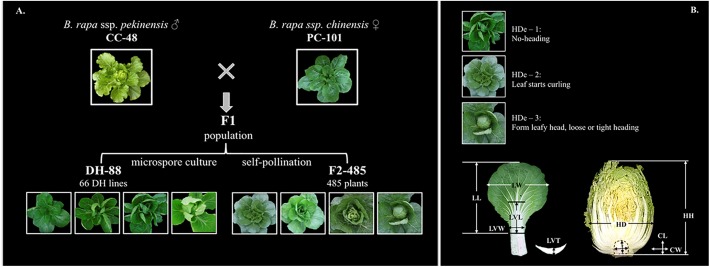
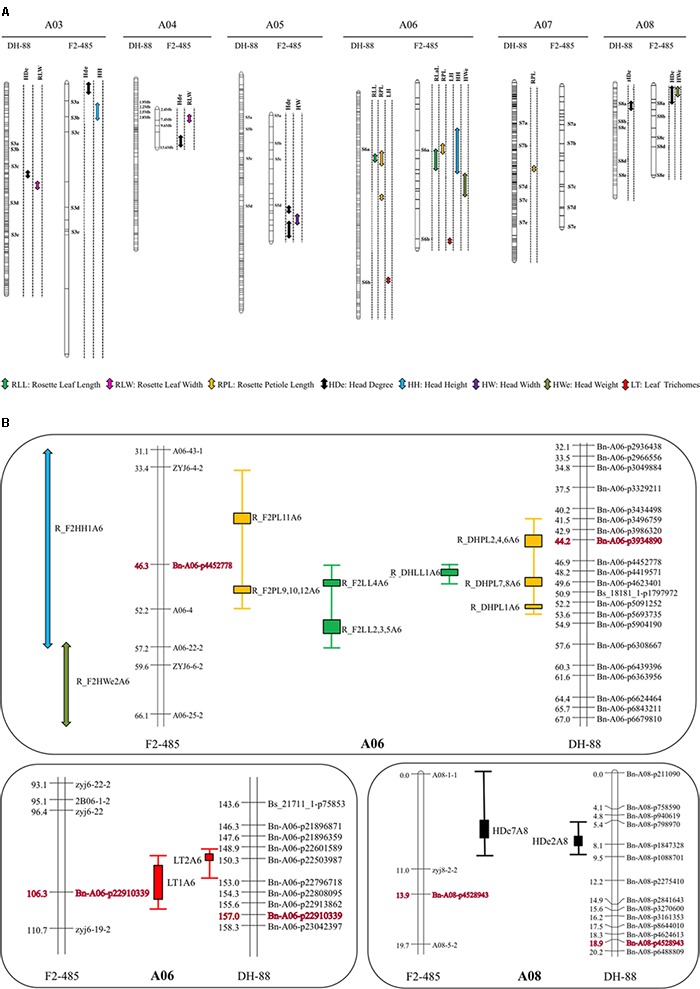
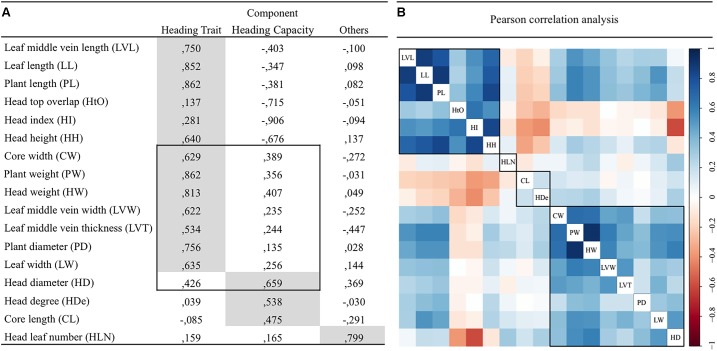
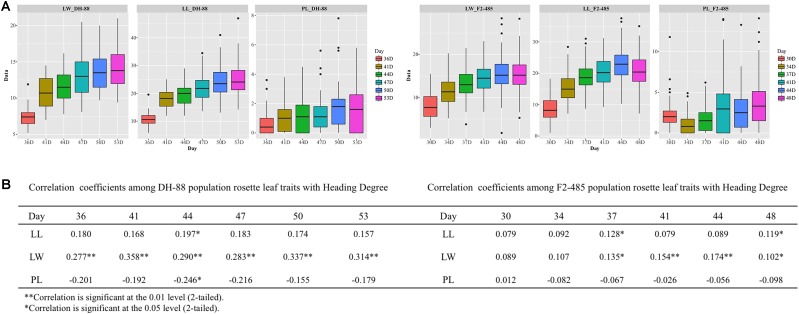
To understand the genetic regulation of the domestication trait leafy-head formation of Chinese cabbages, we exploit the diversity within . To improve our understanding of the relationship between variation in rosette-leaves and leafy heads, we phenotyped a diversity set of 152 Chinese cabbages. This showed correlation between rosette-leaf traits and both head traits and heading capacity. Interestingly, the leaf number of the mature head is not correlated to heading degree nor head shape. We then chose a non-heading pak choi genotype to cross to a Chinese cabbage to generate populations segregating for the leafy head traits. Both a large F2 (485 plants) and a smaller Doubled Haploid (88 lines) mapping population were generated. A high density DH-88 genetic map using the SNP array and an F2 map with a subset of these SNPs and InDel markers was used for quantitative trait locus (QTL) analysis. Thirty-one quantitative trait loci (QTLs) were identified for phenotypes of rosette-leaves in time and both heading degree and several heading traits. On chromosome A06 in both DH-88 and F2-485 QTLs for rosette leaf length and petiole length at different developmental days and an F2 QTL for head height co-located. Variation in head height, width and weight all correlate with variation in heading degree with co-locating QTLs, respectively, on chromosome A03, A05, and A08 in F2-485. The correlation between rosette-leaf and heading traits provides not only insight in the leaf requirements to form a head, but also can be used for selection by Chinese cabbage breeders.
为了解大白菜驯化性状叶球形成的遗传调控,我们利用了其中的多样性。为了更好地理解莲座叶变异与叶球之间的关系,我们对152份大白菜多样性材料进行了表型分析。结果表明莲座叶性状与叶球性状和结球能力之间存在相关性。有趣的是,成熟叶球的叶片数量与结球程度和叶球形状均无相关性。然后,我们选择了一个不结球的小白菜基因型与大白菜杂交,构建了用于叶球性状分离的群体。构建了一个大的F2群体(485株)和一个较小的双单倍体群体(88个株系)。利用SNP芯片构建了高密度的DH-88遗传图谱,并利用这些SNP中的一部分和InDel标记构建了F2图谱,用于数量性状位点(QTL)分析。针对莲座叶不同时期的表型以及结球程度和几个结球性状,共鉴定出31个数量性状位点(QTL)。在DH-88和F2-485群体中,位于A06染色体上的不同发育时期莲座叶长度和叶柄长度的QTL以及F2群体中一个叶球高度的QTL共定位。在F2-485群体中,叶球高度、宽度和重量的变异分别与位于A03、A05和A08染色体上的结球程度变异以及共定位的QTL相关。莲座叶与结球性状之间的相关性不仅有助于了解形成叶球所需的叶片条件,也可供大白菜育种者用于选择。