CIBER of Frailty and Healthy Aging (CIBERFES), Madrid, Spain.
GENUD Toledo Research Group, University of Castilla-La Mancha, Toledo, Spain.
PLoS One. 2018 Oct 22;13(10):e0206013. doi: 10.1371/journal.pone.0206013. eCollection 2018.
Aging is associated with a progressive decrease in bone mass (BM), and being physical active is one of the main strategies to combat this continuous loss. Nonetheless, because daily time is limited, time spent on each movement behavior is co-dependent. The aim of this study was to determine the relationship between BM and movement behaviors in elderly people using compositional data analysis.
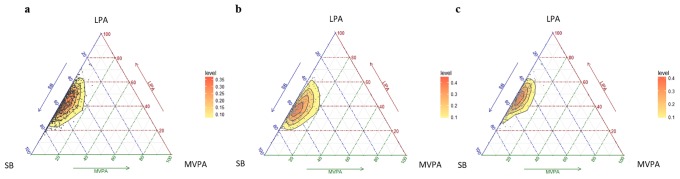
We analyzed 871 older people [395 men (76.9±5.3y) and 476 women (76.7±4.7y)]. Time spent in sedentary behavior (SB), light physical activity (LPA) and moderate-to-vigorous physical activity (MVPA), was assessed using accelerometry. BM was determined by bone densitometry (DXA). The sample was divided according to sex and bone health indicators.
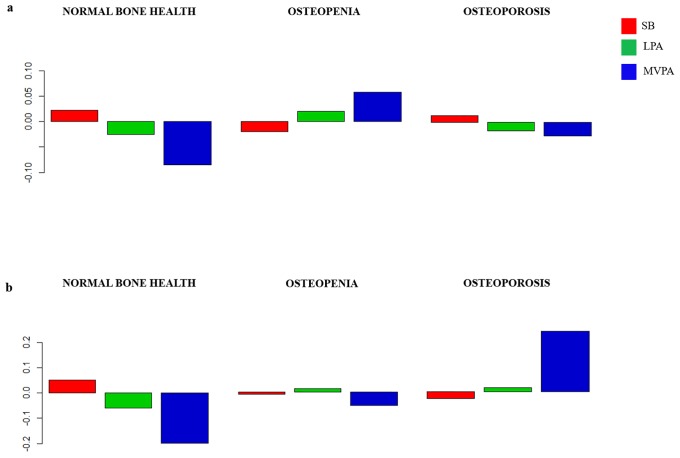
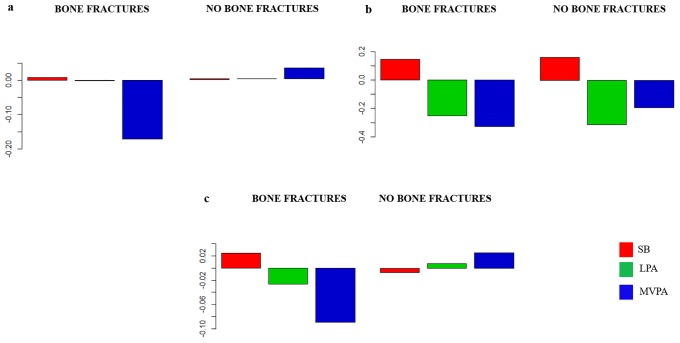
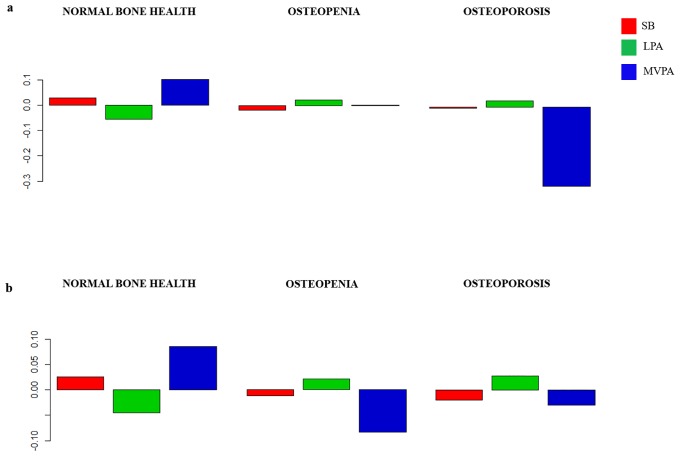
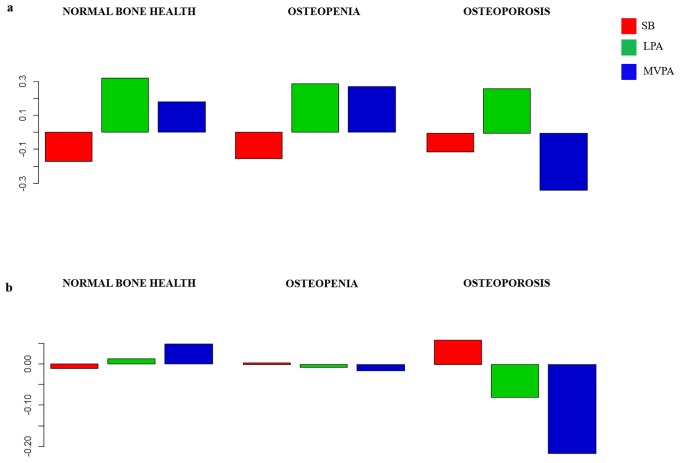
The combined effect of all movement behaviors (PA and SB) was significantly associated with whole body, leg and femoral region BM in the whole sample (p≤0.05), with leg and pelvic BM (p<0.05) in men and, with whole body, arm and leg BM (p<0.05) in women. In men, arm and pelvic BM were negatively associated with SB and whole body, pelvic and leg BM were positively associated with MVPA (p≤0.05). In women, whole body and leg BM were positively associated with SB. Arm and whole body BM were positively associated and leg BM was negatively associated with LPA and arm BM was negatively associated with MVPA (p≤0.05). Women without bone fractures spent less time in SB and more in LPA and MVPA than the subgroup with bone fractures.
We identified that the positive effect of MVPA relative to the other behaviors on bone mass is the strongest overall effect in men. Furthermore, women might decrease bone fracture risk through PA increase and SB reduction, despite the fact that no clear benefits of PA for bone mass were found.
随着年龄的增长,骨量(BM)逐渐减少,而积极运动是对抗这种持续流失的主要策略之一。然而,由于每天的时间有限,因此用于每种运动行为的时间是相互依赖的。本研究旨在使用成分数据分析来确定老年人的 BM 与运动行为之间的关系。
我们分析了 871 名老年人[395 名男性(76.9±5.3 岁)和 476 名女性(76.7±4.7 岁)]。使用加速度计评估久坐行为(SB)、低强度体力活动(LPA)和中等到剧烈体力活动(MVPA)的时间。通过骨密度仪(DXA)确定 BM。根据性别和骨骼健康指标对样本进行分组。
在整个样本中,所有运动行为(PA 和 SB)的综合效应与全身、腿部和股骨区域的 BM 显著相关(p≤0.05),在男性中与腿部和骨盆 BM 相关(p<0.05),在女性中与全身、手臂和腿部 BM 相关(p<0.05)。在男性中,手臂和骨盆 BM 与 SB 呈负相关,全身、骨盆和腿部 BM 与 MVPA 呈正相关(p≤0.05)。在女性中,全身和腿部 BM 与 SB 呈正相关。手臂和全身 BM 呈正相关,腿部 BM 与 LPA 呈负相关,手臂 BM 与 MVPA 呈负相关(p≤0.05)。无骨折的女性比骨折亚组花费更少的时间进行 SB,更多的时间进行 LPA 和 MVPA。
我们发现,与其他行为相比,MVPA 对 BM 的积极影响是男性的最强总体效应。此外,尽管没有发现 PA 对 BM 的明显益处,但女性可能通过增加 PA 和减少 SB 来降低骨折风险。