Singulani Junya L, Scorzoni Liliana, de Oliveira Haroldo C, Marcos Caroline M, Assato Patricia A, Fusco-Almeida Ana Marisa, Mendes-Giannini Maria José S
School of Pharmaceutical Sciences, São Paulo State University (UNESP), Araraquara, São Paulo 14800-903, Brazil.
J Fungi (Basel). 2018 Oct 19;4(4):118. doi: 10.3390/jof4040118.
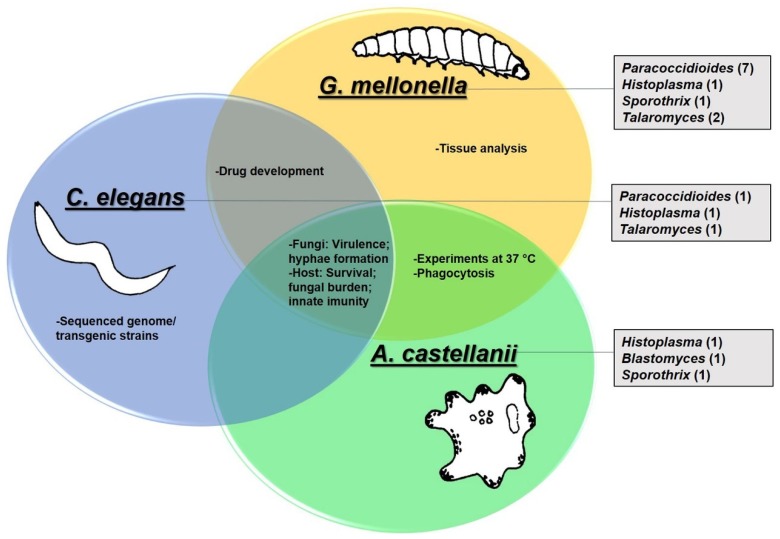
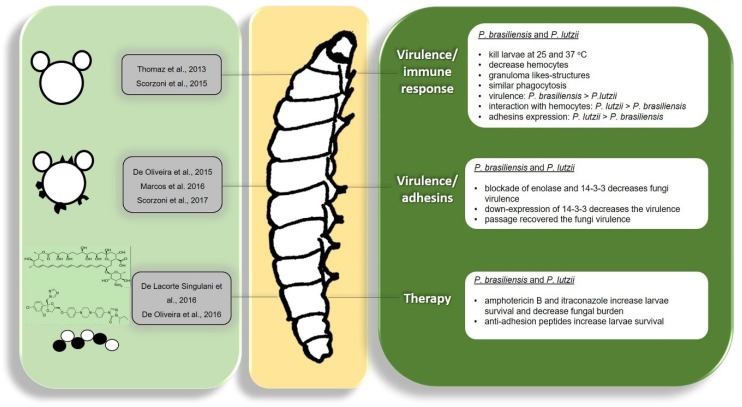
Dimorphic fungi can be found in the yeast form during infection and as hyphae in the environment and are responsible for a large number of infections worldwide. Invertebrate animals have been shown to be convenient models in the study of fungal infections. These models have the advantages of being low cost, have no ethical issues, and an ease of experimentation, time-efficiency, and the possibility of using a large number of animals per experiment compared to mammalian models. Invertebrate animal models such as , , and have been used to study dimorphic fungal infections in the context of virulence, innate immune response, and the efficacy and toxicity of antifungal agents. In this review, we first summarize the features of these models. In this aspect, the growth temperature, genome sequence, availability of different strains, and body characteristics should be considered in the model choice. Finally, we discuss the contribution and advances of these models, with respect to dimorphic fungi spp., , , spp., and .
双相真菌在感染期间以酵母形式存在,在环境中则为菌丝,在全球范围内导致大量感染。无脊椎动物已被证明是研究真菌感染的便捷模型。与哺乳动物模型相比,这些模型具有成本低、无伦理问题、易于实验、时间效率高以及每次实验可使用大量动物的优点。诸如秀丽隐杆线虫、果蝇和家蚕等无脊椎动物模型已被用于研究双相真菌感染的毒力、先天免疫反应以及抗真菌药物的疗效和毒性。在本综述中,我们首先总结这些模型的特征。在这方面,选择模型时应考虑生长温度、基因组序列、不同菌株的可用性以及身体特征。最后,我们讨论这些模型对于双相真菌荚膜组织胞浆菌、皮炎芽生菌、粗球孢子菌、巴西副球孢子菌和申克孢子丝菌的贡献和进展。