Jin Lairun, Bai Ran, Zhou Jun, Shi Wei, Xu Liang, Sheng Jun, Peng Hui, Jin Yuelong, Yuan Hui
School of Public Health, Wannan Medical College, Wuhu, Anhui, China (mainland).
Department of Rheumatology, Affiliated Yijishan Hospital of Wannan Medical College, Wuhu, Anhui, China (mainland).
Med Sci Monit Basic Res. 2018 Oct 23;24:168-176. doi: 10.12659/MSMBR.910949.
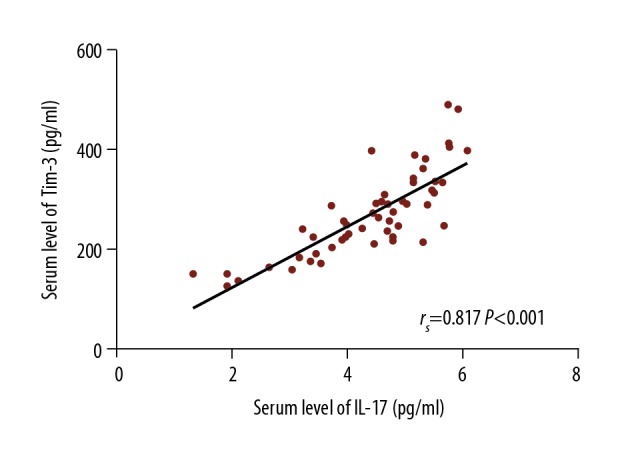
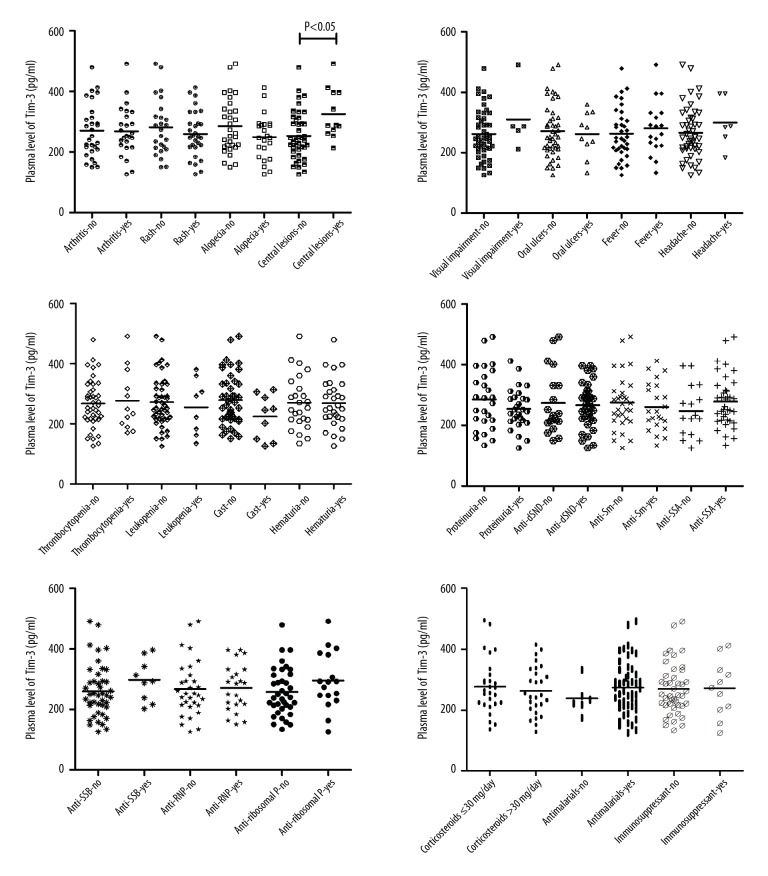
BACKGROUND Previous studies have shown that T cell immunoglobulin domain and mucin-3 (Tim-3) and interleukin-17 (IL-17) are implicated in the development of several autoimmune diseases. However, it is unclear whether these proteins contribute to the pathogenesis of systemic lupus erythematosus (SLE). The purpose of this study was to evaluate SLE patient serum Tim-3 and IL-17 levels, and to assess correlations between these proteins and major clinical parameters of SLE. MATERIAL AND METHODS Overall, 55 SLE patients and 55 healthy controls were recruited in a case-control study. Serum Tim-3 and IL-17 levels were quantified using an enzyme-linked immunosorbent assay (ELISA) kit. RESULTS Serum Tim-3 and IL-17 levels in SLE patients were significantly elevated relative to healthy controls (all P<0.05). Serum Tim-3 levels were significantly lower in SLE patients with nephritis than in those SLE without nephritis (P<0.05), while no statistically significant correlation between serum IL-17 and nephritis was detected (P>0.05). Serum Tim-3 with IL-17 levels were positively correlated in SLE patients (rs=0.817, P<0.01); however, no statistically significant correlation was found between serum Tim-3 or IL-17 levels and systemic lupus erythematosus disease activity index (SLEDAI) scores in those with SLE (all P>0.05). In addition, serum Tim-3 was associated with central lesions in SLE patients, while there were no significant correlations between serum Tim-3 or IL-17 levels and other SLE clinical parameters. CONCLUSIONS Increased serum Tim-3 and IL-17 levels and their clinical associations in SLE patients suggest their possible role in this disease.
背景 先前的研究表明,T细胞免疫球蛋白结构域和粘蛋白3(Tim-3)以及白细胞介素17(IL-17)与多种自身免疫性疾病的发生发展有关。然而,这些蛋白是否参与系统性红斑狼疮(SLE)的发病机制尚不清楚。本研究旨在评估SLE患者血清中Tim-3和IL-17水平,并评估这些蛋白与SLE主要临床参数之间的相关性。材料与方法 在一项病例对照研究中,共纳入了55例SLE患者和55例健康对照。采用酶联免疫吸附测定(ELISA)试剂盒对血清Tim-3和IL-17水平进行定量检测。结果 SLE患者血清Tim-3和IL-17水平相对于健康对照显著升高(均P<0.05)。有肾炎的SLE患者血清Tim-3水平显著低于无肾炎的SLE患者(P<0.05),而血清IL-17与肾炎之间未检测到统计学显著相关性(P>0.05)。SLE患者血清Tim-3与IL-17水平呈正相关(rs=0.817,P<0.01);然而,SLE患者血清Tim-3或IL-17水平与系统性红斑狼疮疾病活动指数(SLEDAI)评分之间未发现统计学显著相关性(均P>0.05)。此外,血清Tim-3与SLE患者的中枢性病变有关,而血清Tim-3或IL-17水平与其他SLE临床参数之间无显著相关性。结论 SLE患者血清Tim-3和IL-17水平升高及其临床关联提示它们可能在该疾病中发挥作用。