Tian Shiyi, Wang Jue, Yu Hu, Wang Jing, Zhu Weiyun
National Center for International Research on Animal Gut Nutrition, Jiangsu Key Laboratory of Gastrointestinal Nutrition and Animal Health, Laboratory of Gastrointestinal Microbiology, College of Animal Science and Technology, Nanjing Agricultural University, Nanjing, 210095 China.
J Anim Sci Biotechnol. 2018 Oct 18;9:75. doi: 10.1186/s40104-018-0290-9. eCollection 2018.
Most research on galacto-oligosaccharides (GOS) has mainly focused on their prebiotic effects on the hindgut, but their beneficial effects on the small intestine (SI) have received little attention. Since jejunum is the important place to digest and absorb nutrients efficiently, optimal maturation of the jejunum is necessary for maintaining the high growth rate in the neonate. Therefore, this study investigates the effect of the early intervention with GOS on the intestinal development of the jejunum.
A total of 6 litters of neonatal piglets (10 piglets per litter; Duroc × Landrace × Large White) with an average birth weight of 1.55 ± 0.05 kg received 1 of 2 treatments based on their assignment to either the control (CON) group or the GOS (GOS) group in each litter. Piglets in the GOS group were orally administrated 10 mL of a GOS solution (reaching 1 g GOS/kg body weight) per day from the age of 1 to 7 d; the piglets in the CON group were treated with the same dose of physiological saline. All piglets were weaned on d 21. On d 8 and 21 of the experimental trial, 1 pig per group from each of the 6 litters was euthanized.
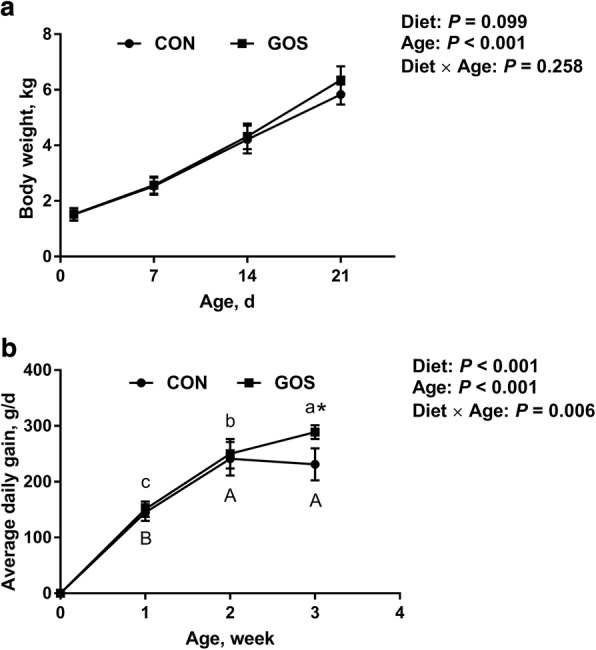
The early intervention with GOS increased the average daily gains in the third week ( < 0.05). Decreased crypt depth was also observed in the jejunum of the piglets on d 21 ( < 0.05). The early intervention with GOS increased the jejunal lactase activity on d 8, maltase activity and sucrase activity on d 21 ( < 0.05). In addition, the early intervention with GOS also facilitated the mRNA expression of Sodium glucose co-transporter 1 () on d 8 and the mRNA expression of Glucose transporter type 2 () on d 21 ( < 0.05). It was further determined that GOS up-regulated the mRNA expression of preproglucagon (), insulin-like growth factor 1 (), insulin-like growth factor 1 receptor () and epidermal growth factor (). GOS also up-regulated the protein expression of glucagon-like peptide-2 (GLP-2) and EGF in the jejunum of the piglets. Furthermore, it was also found that GOS enhanced the protein expression of ZO-1 and occludin on d 8 ( < 0.05), as well as increased the mRNA expression of and decrease the mRNA expression of ( < 0.05).
These results indicate that GOS have a positive effect on piglet growth performance in addition to decreasing the crypt depth and enhancing functional development in jejunum of suckling piglets.
大多数关于低聚半乳糖(GOS)的研究主要集中在其对后肠的益生元效应,但其对小肠(SI)的有益作用却很少受到关注。由于空肠是高效消化和吸收营养物质的重要场所,空肠的最佳成熟对于维持新生儿的高生长速率至关重要。因此,本研究调查了GOS早期干预对空肠肠道发育的影响。
总共6窝新生仔猪(每窝10头仔猪;杜洛克×长白×大白),平均出生体重为1.55±0.05千克,根据每窝仔猪被分配到对照组(CON)或GOS组接受两种处理中的一种。GOS组的仔猪从1日龄至7日龄每天口服10毫升GOS溶液(达到1克GOS/千克体重);CON组的仔猪用相同剂量的生理盐水处理。所有仔猪在21日龄断奶。在试验的第8天和第21天,从6窝中的每窝每组中安乐死1头仔猪。
GOS早期干预增加了第三周的平均日增重(<0.05)。在21日龄时,还观察到仔猪空肠隐窝深度降低(<0.05)。GOS早期干预增加了第8天的空肠乳糖酶活性、第21天的麦芽糖酶活性和蔗糖酶活性(<0.05)。此外GOS早期干预还促进了第8天的钠葡萄糖共转运蛋白1()的mRNA表达和第21天的葡萄糖转运蛋白2()的mRNA表达(<0.05)。进一步确定GOS上调了胰高血糖素原()、胰岛素样生长因子1()、胰岛素样生长因子1受体()和表皮生长因子()的mRNA表达。GOS还上调了仔猪空肠中胰高血糖素样肽-2(GLP-2)和表皮生长因子(EGF)的蛋白表达。此外,还发现GOS在第8天增强了紧密连接蛋白1(ZO-1)和闭合蛋白的蛋白表达(<0.05),以及增加了()的mRNA表达并降低了()的mRNA表达(<0.05)。
这些结果表明,GOS除了可降低哺乳仔猪空肠隐窝深度并促进其功能发育外,对仔猪生长性能也有积极影响。