Botany Department, Faculty of Science, Tanta University, Tanta 31527, Egypt.
UMR CNRS 8256 (B2A), IBPS, Université Paris VI, 75005 Paris, France.
Int J Mol Sci. 2018 Oct 24;19(11):3310. doi: 10.3390/ijms19113310.
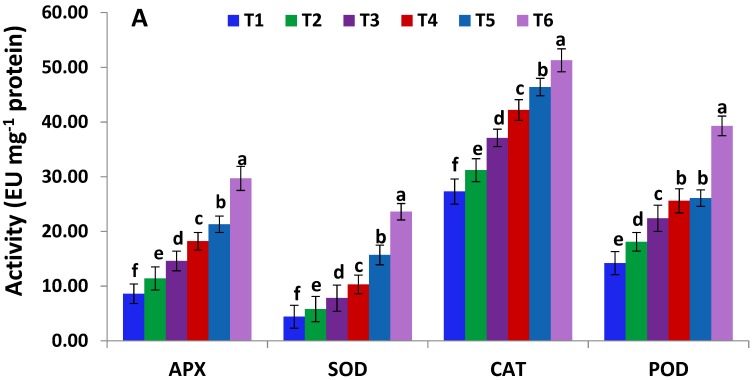
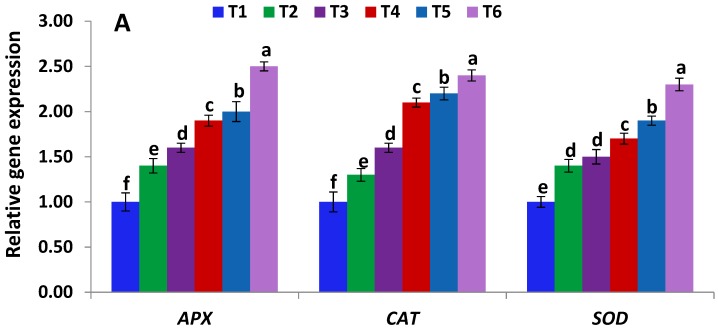
High salinity mitigates crop productivity and quality. Plant growth-promoting soil rhizobacteria (PGPR) improve plant growth and abiotic stress tolerance via mediating various physiological and molecular mechanisms. This study investigated the effects of the PGPR strain KM4 on the growth and physiological and molecular responsiveness of maize ( L.) plants under salinity stress (0, 80, and 160 mM NaCl). High salinity significantly reduced plant growth and biomass production, nutrient uptake, leaf relative water content, pigment content, leaf gas exchange attributes, and total flavonoid and phenolic contents in maize. However, osmolyte content (e.g., soluble proteins, proline, and free amino acids), oxidative stress markers, and enzymatic and non-enzymatic antioxidants levels were increased in maize under high salinity. On the other hand, KM4 inoculation significantly reduced oxidative stress markers, but increased the maize growth and biomass production along with better leaf gas exchange, osmoregulation, antioxidant defense systems, and nutrient uptake under salt stress. Moreover, it was found that all these improvements were accompanied with the upregulation of stress-related genes (, , , , , , , and ), and downregulation of the key gene in ABA biosynthesis (). Taken together, the results demonstrate the beneficial role of KM4 in improving plant growth and salt stress tolerance in maize by regulating ion homeostasis, redox potential, leaf gas exchange, and stress-related genes expression.
高盐度会降低作物的生产力和质量。植物促生土壤根际细菌(PGPR)通过调节各种生理和分子机制来促进植物生长和提高非生物胁迫耐受性。本研究探讨了 PGPR 菌株 KM4 对盐胁迫(0、80 和 160mM NaCl)下玉米( L.)植株生长以及生理和分子响应的影响。高盐度显著降低了玉米的生长和生物量积累、养分吸收、叶片相对含水量、色素含量、叶片气体交换特性以及总类黄酮和酚类含量。然而,在高盐度下,玉米中的渗透物质(如可溶性蛋白质、脯氨酸和游离氨基酸)、氧化应激标志物以及酶和非酶抗氧化剂水平增加。另一方面,KM4 接种显著降低了氧化应激标志物,但在盐胁迫下增加了玉米的生长和生物量积累,同时改善了叶片气体交换、渗透调节、抗氧化防御系统和养分吸收。此外,研究发现,所有这些改善都伴随着与胁迫相关基因(、、、、、、和)的上调和 ABA 生物合成关键基因()的下调。综上所述,这些结果表明,KM4 通过调节离子稳态、氧化还原电位、叶片气体交换和与胁迫相关基因的表达,在提高玉米生长和耐盐性方面发挥有益作用。