Wu Zengrui, Li Weihua, Liu Guixia, Tang Yun
Shanghai Key Laboratory of New Drug Design, School of Pharmacy, East China University of Science and Technology, Shanghai, China.
Front Pharmacol. 2018 Oct 9;9:1134. doi: 10.3389/fphar.2018.01134. eCollection 2018.
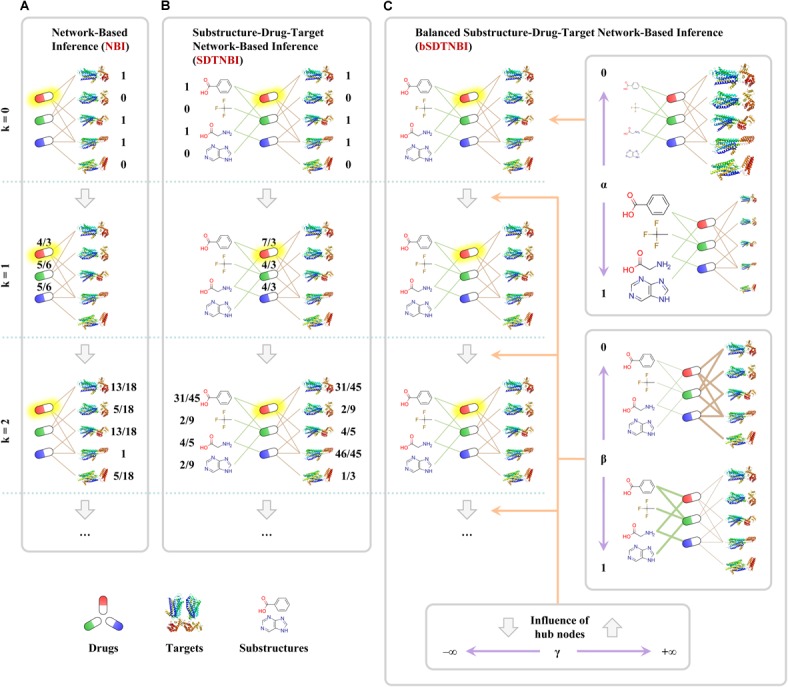
Drug-target interaction (DTI) is the basis of drug discovery. However, it is time-consuming and costly to determine DTIs experimentally. Over the past decade, various computational methods were proposed to predict potential DTIs with high efficiency and low costs. These methods can be roughly divided into several categories, such as molecular docking-based, pharmacophore-based, similarity-based, machine learning-based, and network-based methods. Among them, network-based methods, which do not rely on three-dimensional structures of targets and negative samples, have shown great advantages over the others. In this article, we focused on network-based methods for DTI prediction, in particular our network-based inference (NBI) methods that were derived from recommendation algorithms. We first introduced the methodologies and evaluation of network-based methods, and then the emphasis was put on their applications in a wide range of fields, including target prediction and elucidation of molecular mechanisms of therapeutic effects or safety problems. Finally, limitations and perspectives of network-based methods were discussed. In a word, network-based methods provide alternative tools for studies in drug repurposing, new drug discovery, systems pharmacology and systems toxicology.
药物-靶点相互作用(DTI)是药物发现的基础。然而,通过实验确定DTI既耗时又昂贵。在过去十年中,人们提出了各种计算方法来高效且低成本地预测潜在的DTI。这些方法大致可分为几类,如基于分子对接的方法、基于药效团的方法、基于相似性的方法、基于机器学习的方法和基于网络的方法。其中,基于网络的方法不依赖于靶点的三维结构和阴性样本,已显示出相对于其他方法的巨大优势。在本文中,我们重点关注用于DTI预测的基于网络的方法,特别是我们从推荐算法衍生而来的基于网络的推理(NBI)方法。我们首先介绍了基于网络的方法的方法学和评估,然后重点阐述了它们在广泛领域中的应用,包括靶点预测以及治疗效果或安全性问题的分子机制阐释。最后,讨论了基于网络的方法的局限性和前景。总之,基于网络的方法为药物再利用、新药发现、系统药理学和系统毒理学研究提供了替代工具。