Daalderop L A, Wieland B V, Tomsin K, Reyes L, Kramer B W, Vanterpool S F, Been J V
Department of Paediatrics, Maastricht University Medical Centre, Maastricht, Netherlands.
Department of Oral Biology, University of Florida, Gainesville, FL, USA.
JDR Clin Trans Res. 2018 Jan;3(1):10-27. doi: 10.1177/2380084417731097. Epub 2017 Sep 25.
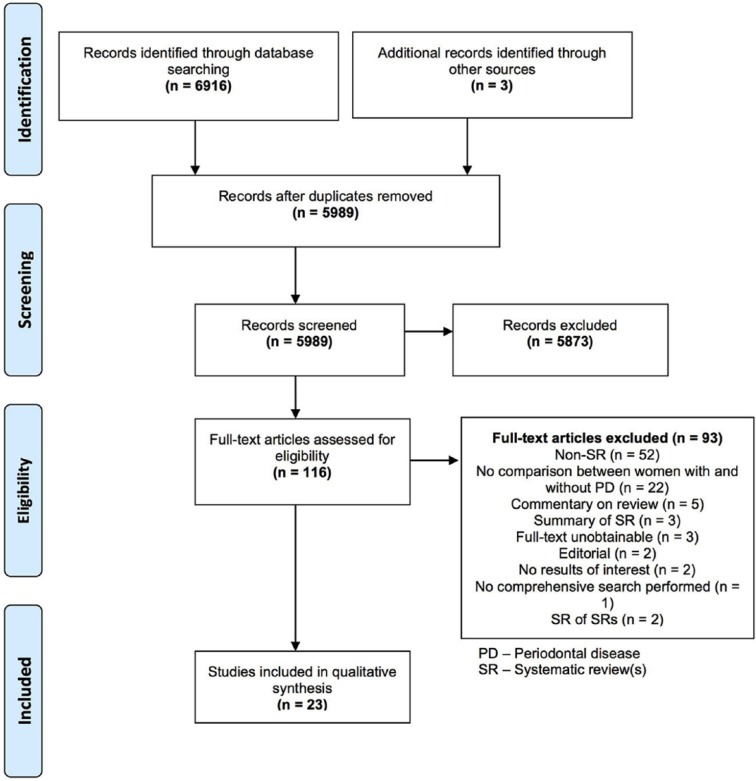
Periodontal disease is very common during pregnancy. Although it has been linked to adverse pregnancy outcomes, systematic reviews have reached discrepant conclusions on these links. Therefore, we conducted a systematic overview of systematic reviews studying the association between periodontal disease and adverse pregnancy outcomes. We searched 6 online databases up to November 2016 and hand-searched references and citations of eligible papers. Systematic reviews of studies comparing pregnancy outcomes among women with and without periodontal disease were eligible for inclusion. Primary outcomes were maternal mortality, preterm birth, and perinatal mortality. Two reviewers extracted data and assessed risk of bias of individual systematic reviews. Findings are described in tabular and narrative form. Twenty-three systematic reviews (including between 3 and 45 studies) were included. None reported the association between periodontal disease and maternal or perinatal mortality. Systematic reviews with the lowest risk of bias consistently demonstrated positive associations between periodontal disease and preterm birth (relative risk, 1.6; 95% confidence interval, 1.3 to 2.0; 17 studies, 6,741 participants), low birth weight (LBW; relative risk, 1.7; 95% CI, 1.3 to 2.1; 10 studies, 5,693 participants), preeclampsia (odds ratio, 2.2; 95% CI, 1.4 to 3.4; 15 studies, 5,111 participants), and preterm LBW (relative risk 3.4; 95% CI, 1.3 to 8.8; 4 studies, 2,263 participants). Based on these figures, estimated population-attributable fractions for periodontal disease were 5% to 38% for preterm birth, 6% to 41% for LBW, and 10% to 55% for preeclampsia. In terms of limitations, as several primary studies did not adjust for confounding, meta-analyses may have overestimated the strength of the associations under study. Due to substantial overlap in included primary studies, we could not aggregate results across reviews. Consistent evidence from systematic reviews with low risk of bias indicates that pregnant women with periodontal disease are at increased risk of developing preeclampsia and delivering a preterm and/or LBW baby (PROSPERO: CRD42015030132). : This study highlights that periodontal disease is an important risk factor for several common adverse pregnancy outcomes. Clinicians should be aware of this link to guide risk selection. Research is needed to develop novel preventive and treatment strategies.
牙周疾病在孕期非常常见。尽管它与不良妊娠结局有关,但系统评价对这些关联得出了不一致的结论。因此,我们对研究牙周疾病与不良妊娠结局之间关联的系统评价进行了系统综述。我们检索了截至2016年11月的6个在线数据库,并手工检索了符合条件论文的参考文献和引用文献。比较有和没有牙周疾病的女性妊娠结局的研究的系统评价符合纳入标准。主要结局为孕产妇死亡率、早产和围产期死亡率。两名评价者提取数据并评估各个系统评价的偏倚风险。研究结果以表格和叙述形式呈现。纳入了23项系统评价(包括3至45项研究)。没有一项报告牙周疾病与孕产妇或围产期死亡率之间的关联。偏倚风险最低的系统评价一致表明,牙周疾病与早产(相对危险度,1.6;95%置信区间,1.3至2.0;17项研究,6741名参与者)、低出生体重(LBW;相对危险度,1.7;95%CI,1.3至2.1;10项研究,5693名参与者)、子痫前期(比值比,2.2;95%CI,1.4至3.4;15项研究,5111名参与者)以及早产低体重儿(相对危险度3.4;95%CI,1.3至8.8;4项研究,2263名参与者)之间存在正相关。基于这些数据,牙周疾病导致早产的人群归因分数估计为5%至38%,导致低出生体重的为6%至41%,导致子痫前期的为10%至55%。在局限性方面,由于一些原始研究未对混杂因素进行校正,荟萃分析可能高估了所研究关联的强度。由于纳入的原始研究存在大量重叠,我们无法汇总各综述的结果。来自偏倚风险低的系统评价的一致证据表明,患有牙周疾病的孕妇发生子痫前期以及分娩早产和/或低出生体重儿的风险增加(国际前瞻性系统评价注册库:CRD42015030132)。本研究强调,牙周疾病是几种常见不良妊娠结局的重要危险因素。临床医生应了解这种关联以指导风险评估。需要开展研究以制定新的预防和治疗策略。