Department of Materials Science and Engineering, Stanford University, Stanford, CA, 94305, USA.
Department of Mechanical Engineering, Stanford University, Stanford, CA, 94305, USA.
Nat Commun. 2018 Oct 30;9(1):4510. doi: 10.1038/s41467-018-06760-7.
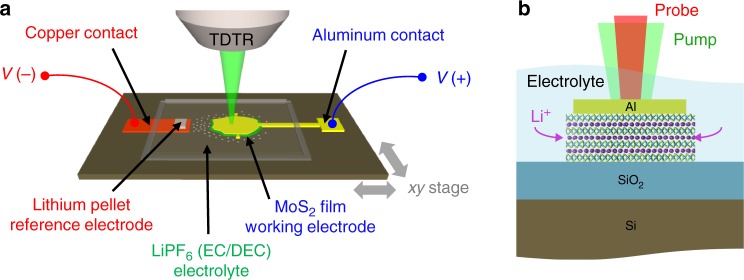
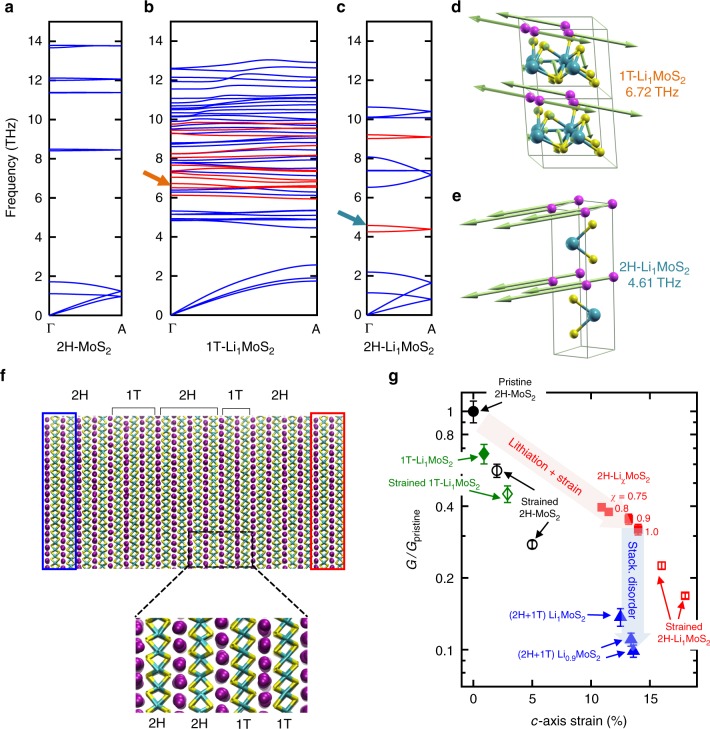
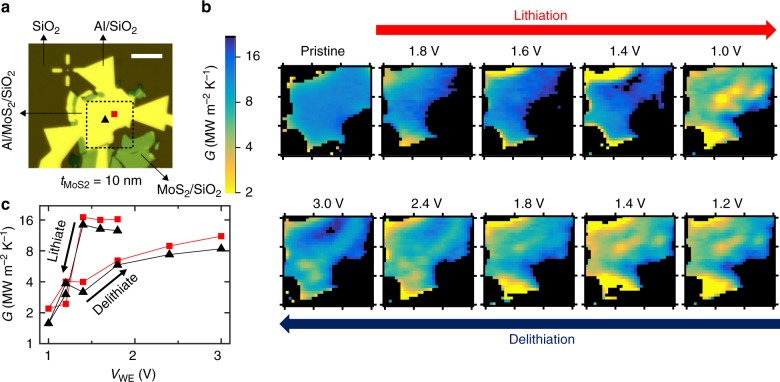
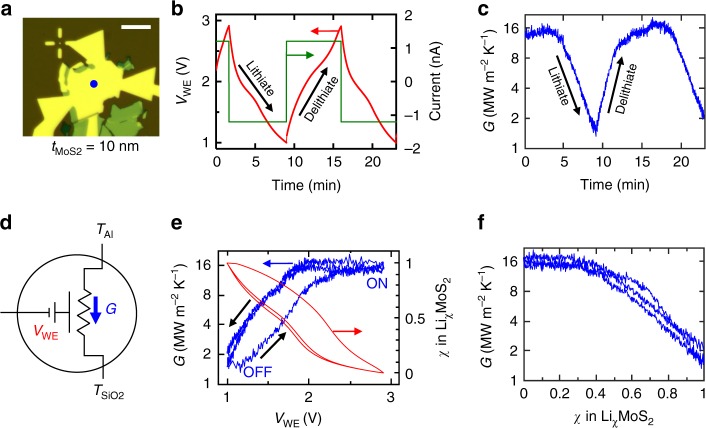
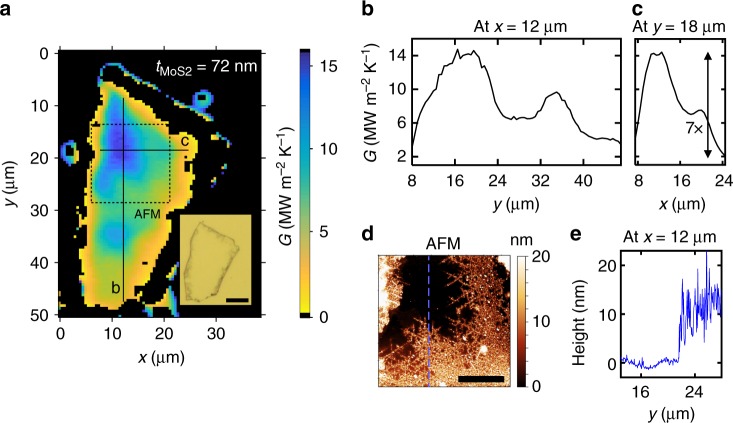
The ability to actively regulate heat flow at the nanoscale could be a game changer for applications in thermal management and energy harvesting. Such a breakthrough could also enable the control of heat flow using thermal circuits, in a manner analogous to electronic circuits. Here we demonstrate switchable thermal transistors with an order of magnitude thermal on/off ratio, based on reversible electrochemical lithium intercalation in MoS thin films. We use spatially-resolved time-domain thermoreflectance to map the lithium ion distribution during device operation, and atomic force microscopy to show that the lithiated state correlates with increased thickness and surface roughness. First principles calculations reveal that the thermal conductance modulation is due to phonon scattering by lithium rattler modes, c-axis strain, and stacking disorder. This study lays the foundation for electrochemically-driven nanoscale thermal regulators, and establishes thermal metrology as a useful probe of spatio-temporal intercalant dynamics in nanomaterials.
在纳米尺度上主动调节热流的能力可能会彻底改变热管理和能量收集等应用。这一突破还可以使用热电路来控制热流,类似于电子电路。在这里,我们展示了基于 MoS 薄膜中可逆电化学锂离子嵌入的具有热开关比的热晶体管,其热开关比高达一个数量级。我们使用空间分辨时域热反射率来绘制器件工作过程中的锂离子分布,原子力显微镜显示,锂离子化状态与厚度增加和表面粗糙度增加相关。第一性原理计算表明,热导调制是由锂离子 rattler 模式、c 轴应变和堆叠无序引起的声子散射引起的。这项研究为电化学驱动的纳米尺度热调节器奠定了基础,并确立了热计量学作为纳米材料中空间和时间插层剂动力学的有用探针。