Department of Functional Genomics, University of Science and Technology (UST), Daejeon, Korea.
Genome Editing Research Center, Personalized Genomic Medicine Research Center, Korea Research Institute of Bioscience and Biotechnology (KRIBB), Daejeon, Korea.
Mol Cells. 2018 Nov 30;41(11):953-963. doi: 10.14348/molcells.2018.0213. Epub 2018 Nov 1.
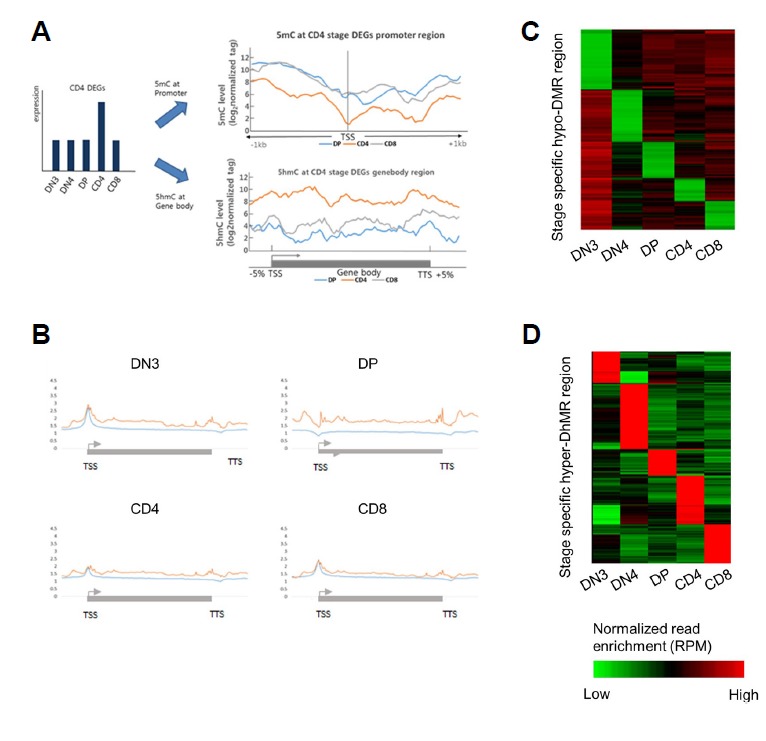
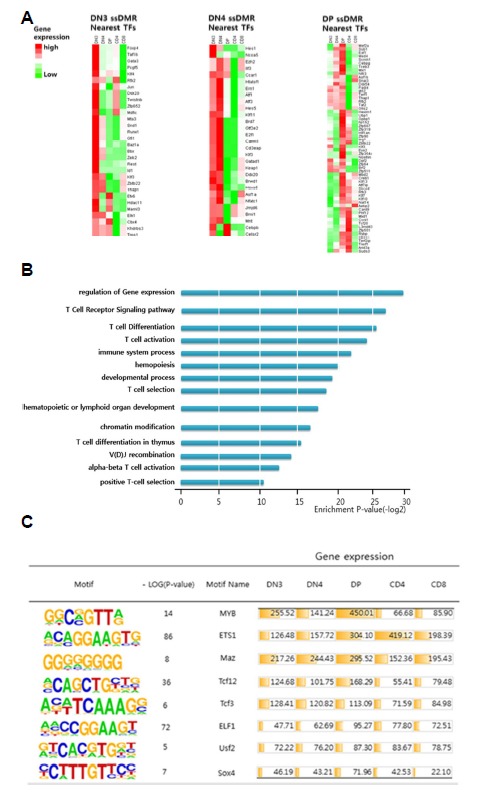
The stepwise development of T cells from a multipotent precursor is guided by diverse mechanisms, including interactions among lineage-specific transcription factors (TFs) and epigenetic changes, such as DNA methylation and hydroxymethylation, which play crucial roles in mammalian development and lineage commitment. To elucidate the transcriptional networks and epigenetic mechanisms underlying T-cell lineage commitment, we investigated genome-wide changes in gene expression, DNA methylation and hydroxymethylation among populations representing five successive stages of T-cell development (DN3, DN4, DP, CD4, and CD8) by performing RNA-seq, MBD-seq and hMeDIP-seq, respectively. The most significant changes in the transcriptomes and epigenomes occurred during the DN4 to DP transition. During the DP stage, many genes involved in chromatin modification were up-regulated and exhibited dramatic changes in DNA hydroxymethylation. We also observed 436 alternative splicing events, and approximately 57% (252) of these events occurred during the DP stage. Many stage-specific, differentially methylated regions were observed near the stage-specific, differentially expressed genes. The dynamic changes in DNA methylation and hydroxymethylation were associated with the recruitment of stage-specific TFs. We elucidated interactive networks comprising TFs, chromatin modifiers, and DNA methylation and hope that this study provides a framework for the understanding of the molecular networks underlying T-cell lineage commitment.
T 细胞由多能前体细胞逐步发育,这一过程受到多种机制的调控,包括谱系特异性转录因子(TFs)之间的相互作用以及表观遗传改变,如 DNA 甲基化和羟甲基化,它们在哺乳动物发育和谱系决定中起着至关重要的作用。为了阐明 T 细胞谱系决定的转录网络和表观遗传机制,我们通过 RNA-seq、MBD-seq 和 hMeDIP-seq,分别研究了代表 T 细胞发育的五个连续阶段(DN3、DN4、DP、CD4 和 CD8)的细胞群体中基因表达、DNA 甲基化和羟甲基化的全基因组变化。在 DN4 到 DP 的转变过程中,转录组和表观基因组发生了最显著的变化。在 DP 阶段,许多参与染色质修饰的基因上调,并表现出 DNA 羟甲基化的剧烈变化。我们还观察到 436 个可变剪接事件,其中约 57%(252 个)发生在 DP 阶段。在特异性表达基因的附近观察到许多阶段特异性、差异甲基化区域。DNA 甲基化和羟甲基化的动态变化与阶段特异性 TF 的募集有关。我们阐明了包含 TF、染色质修饰因子和 DNA 甲基化的互作网络,希望本研究为理解 T 细胞谱系决定的分子网络提供了一个框架。