Ferguson James C, Tangl Stefan, Barnewitz Dirk, Genzel Antje, Heimel Patrick, Hruschka Veronika, Redl Heinz, Nau Thomas
Ludwig Boltzmann Institute for Experimental and Clinical Traumatology in AUVA research center, Vienna, Austria.
Austrian Cluster for Tissue Regeneration, Vienna, Austria.
BMC Vet Res. 2018 Nov 6;14(1):330. doi: 10.1186/s12917-018-1648-0.
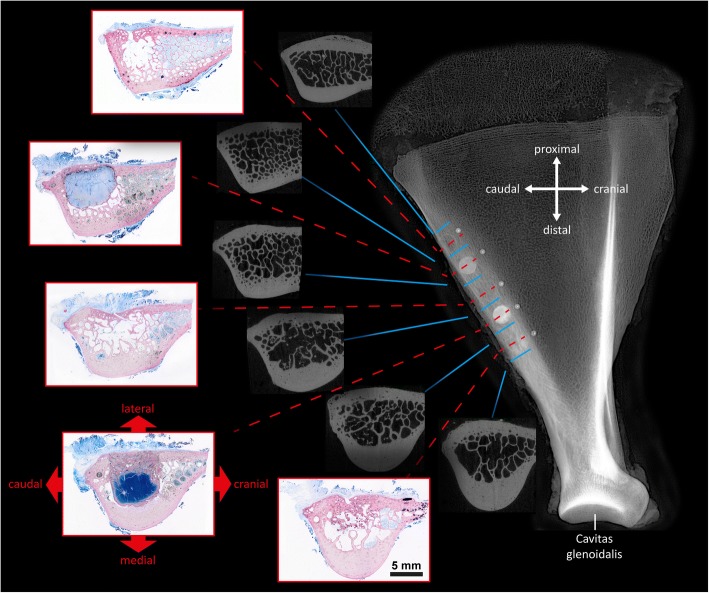
The need for bone graft substitutes including those being developed to be applied together with new strategies of bone regeneration such as tissue engineering and cell-based approaches is growing. No large animal model of bone regeneration has been accepted as a standard testing model. Standardization may be the key to moving systematically towards better bone regeneration. This study aimed to establish a model of bone regeneration in the sheep that lends itself to strict standardization and in which a number of substances can be tested within the same animal. To this end the caudal border of the ovine scapula was used as a consistent bed of mineralized tissue that provided sufficient room for a serial alignment of multiple experimental drill holes.
The findings show that for the sake of standardization, surgery should be restricted to the middle part of the caudal margin, an area at least 80 mm proximal from the Glenoid cavity, but not more than 140 mm away from it, in the adult female Land Merino sheep. A distance of 5 mm from the caudal margin should also be observed.
This standardized model with defined uniform defects and defect sites results in predictable and reproducible bone regeneration processes. Defects are placed unilaterally in only one limb of the animal, avoiding morbidity in multiple limbs. The fact that five defects per animal can be evaluated is conducive to intra-animal comparisons and reduces the number of animals that have to be subject to experimentation.
对骨移植替代物的需求不断增加,包括那些与骨再生新策略(如组织工程和基于细胞的方法)一起开发的替代物。目前尚无大型动物骨再生模型被公认为标准测试模型。标准化可能是系统地迈向更好的骨再生的关键。本研究旨在建立一种绵羊骨再生模型,该模型易于严格标准化,并且可以在同一只动物体内测试多种物质。为此,将绵羊肩胛骨的尾缘用作一致的矿化组织床,为多个实验钻孔的连续排列提供了足够的空间。
研究结果表明,为了实现标准化,手术应仅限于成年雌性兰德美利奴绵羊尾缘的中部,该区域距离关节盂至少80毫米,但不超过140毫米,且距尾缘应保持5毫米的距离。
这种具有明确统一缺损和缺损部位的标准化模型可产生可预测和可重复的骨再生过程。缺损仅单侧置于动物的一个肢体中,避免了多个肢体发病。每只动物可评估五个缺损这一事实有利于动物体内比较,并减少了必须进行实验的动物数量。