Department of Biology, The University of Alabama at Birmingham, Alabama 35294
Department of Biology, Washington University in St. Louis, Missouri 63130.
Genetics. 2018 Nov;210(3):757-772. doi: 10.1534/genetics.118.301146.
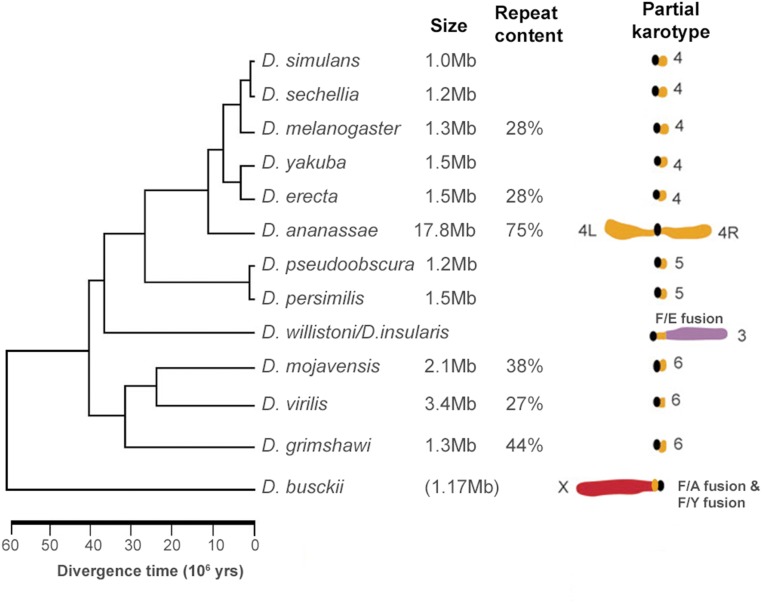
The F element of the karyotype (the fourth chromosome in ) is often referred to as the "dot chromosome" because of its appearance in a metaphase chromosome spread. This chromosome is distinct from other autosomes in possessing both a high level of repetitious sequences (in particular, remnants of transposable elements) and a gene density similar to that found in the other chromosome arms, ∼80 genes distributed throughout its 1.3-Mb "long arm." The dot chromosome is notorious for its lack of recombination and is often neglected as a consequence. This and other features suggest that the F element is packaged as heterochromatin throughout. F element genes have distinct characteristics (, low codon bias, and larger size due both to larger introns and an increased number of exons), but exhibit expression levels comparable to genes found in euchromatin. Mapping experiments show the presence of appropriate chromatin modifications for the formation of DNaseI hypersensitive sites and transcript initiation at the 5' ends of active genes, but, in most cases, high levels of heterochromatin proteins are observed over the body of these genes. These various features raise many interesting questions about the relationships of chromatin structures with gene and chromosome function. The apparent evolution of the F element as an autosome from an ancestral sex chromosome also raises intriguing questions. The findings argue that the F element is a unique chromosome that occupies its own space in the nucleus. Further study of the F element should provide new insights into chromosome structure and function.
染色体核型的 F 因子(第 4 号染色体)通常被称为“点染色体”,因为在中期染色体展开时,它呈现出点状。这条染色体与其他常染色体不同,因为它既有高水平的重复序列(特别是转座元件的残余物),又有与其他染色体臂相似的基因密度,在其 1.3Mb 的“长臂”中分布着约 80 个基因。点染色体因缺乏重组而臭名昭著,因此经常被忽视。这一特点和其他特点表明,F 因子在整个染色体中都被包装成异染色质。F 因子基因具有独特的特征(低密码子偏好性,以及由于更大的内含子和更多的外显子而导致的更大的大小),但表现出与常染色质基因相当的表达水平。作图实验表明,在活性基因的 5'端形成 DNaseI 超敏位点和转录起始,存在适当的染色质修饰,但在大多数情况下,这些基因的主体上观察到高水平的异染色质蛋白。这些各种特征提出了许多关于染色质结构与基因和染色体功能关系的有趣问题。F 因子作为一个从祖先性染色体进化而来的常染色体的出现也提出了有趣的问题。研究结果表明,F 因子是一个独特的染色体,在核中占据自己的空间。进一步研究 F 因子应该为染色体结构和功能提供新的见解。