Davoust B, Levasseur A, Mediannikov O
Microbes, Evolution, Phylogeny and Infection (MEФI), UMR Aix-Marseille Université, IRD, APHM, IHU Méditerranée Infection, Marseille, France.
New Microbes New Infect. 2018 Aug 30;26:S104-S108. doi: 10.1016/j.nmni.2018.08.014. eCollection 2018 Nov.
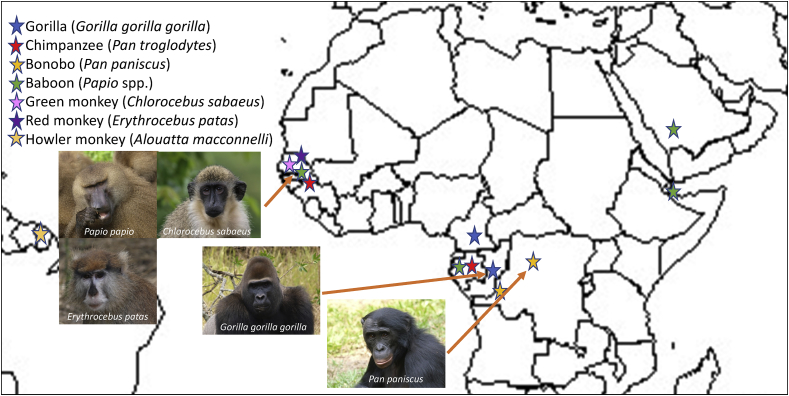
The genetic and morphologic similarities between primates and humans means that much information obtained from primates may be applied to humans, and However, habitat loss, hunting and the continued presence of humans have a negative effect on the biology and behaviour of almost all nonhuman primates. Noninvasive methods such as stool collection are among the safest alternative ways to study the multiple aspects of the biology of primates. Many epidemiologic issues (e.g. pathogen detection, microbiota studies) may be easily studied using stool samples from primates. Primates are undoubtedly among the first candidates suspected of becoming the source of one of the next emerging epidemic of zoonotic origin, as has already been observed with HIV, malaria and monkeypox. The Institut Hospitalo-Universitaire Méditerranée Infection in Marseille actively participates in the study, mostly epidemiologic, of nonhuman primates, using mostly stool samples.
灵长类动物与人类之间的基因和形态相似性意味着,从灵长类动物身上获得的许多信息都可以应用于人类。然而,栖息地丧失、捕猎以及人类的持续存在对几乎所有非人类灵长类动物的生物学特性和行为都产生了负面影响。诸如粪便采集等非侵入性方法是研究灵长类动物生物学多个方面最安全的替代方法之一。利用灵长类动物的粪便样本,可以轻松研究许多流行病学问题(例如病原体检测、微生物群研究)。灵长类动物无疑是最早被怀疑可能成为下一次人畜共患起源的新兴流行病源头的候选者之一,正如已经在艾滋病毒、疟疾和猴痘中观察到的那样。马赛的地中海感染大学医院研究所积极参与对非人类灵长类动物的研究,主要是流行病学研究,大多使用粪便样本。