1 Advance Care Planning Australia, Austin Health, Melbourne, VIC, Australia.
2 Sydney Medical School, The University of Sydney, Sydney, NSW, Australia.
Palliat Med. 2019 Mar;33(3):274-290. doi: 10.1177/0269216318809571. Epub 2018 Nov 8.
: Advance care planning aims to ensure that care received during serious and chronic illness is consistent with the person’s values, preferences and goals. However, less than 40% of people with dementia undertake advance care planning internationally.
: This study aims to describe the perspectives of people with dementia and their carers on advance care planning and end-of-life care.
: Systematic review and thematic synthesis of qualitative studies.
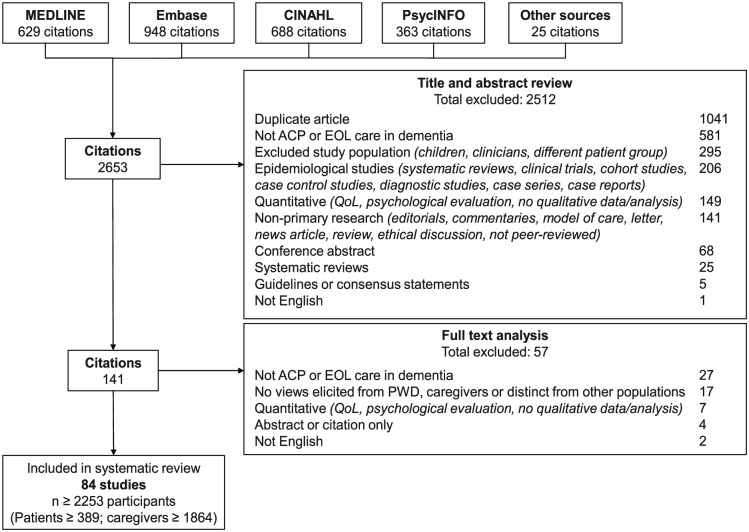
: Electronic databases were searched from inception to July 2018.
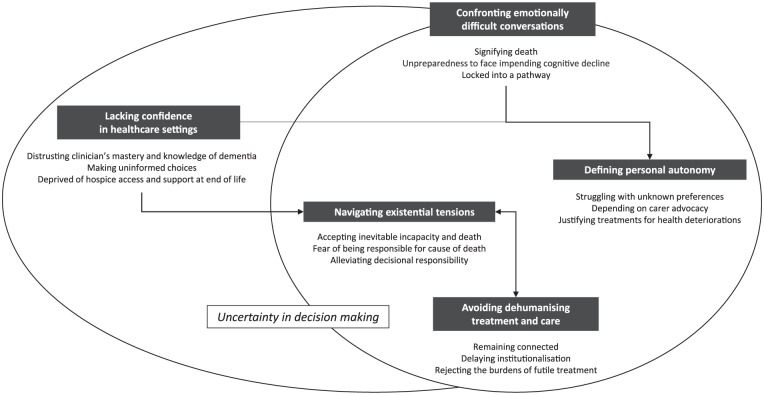
: From 84 studies involving 389 people with dementia and 1864 carers, five themes were identified: avoiding dehumanising treatment and care (remaining connected, delaying institutionalisation, rejecting the burdens of futile treatment); confronting emotionally difficult conversations (signifying death, unpreparedness to face impending cognitive decline, locked into a pathway); navigating existential tensions (accepting inevitable incapacity and death, fear of being responsible for cause of death, alleviating decisional responsibility); defining personal autonomy (struggling with unknown preferences, depending on carer advocacy, justifying treatments for health deteriorations); and lacking confidence in healthcare settings (distrusting clinicians’ mastery and knowledge, making uninformed choices, deprived of hospice access and support at end of life).
: People with dementia and their carers felt uncertain in making treatment decisions in the context of advance care planning and end-of-life care. Advance care planning strategies that attend to people’s uncertainty in decision-making may help to empower people with dementia and carers and strengthen person-centred care in this context.
预先医疗照护计划旨在确保在患有严重和慢性疾病期间所接受的护理符合患者的价值观、偏好和目标。然而,在国际上,只有不到 40%的痴呆症患者进行预先医疗照护计划。
本研究旨在描述痴呆症患者及其照护者对预先医疗照护计划和临终关怀的看法。
对定性研究进行系统评价和主题综合。
从创建到 2018 年 7 月,电子数据库进行了搜索。
从涉及 389 名痴呆症患者和 1864 名照护者的 84 项研究中,确定了五个主题:避免非人性化的治疗和护理(保持联系、延迟机构化、拒绝徒劳治疗的负担);面对情感上困难的对话(表示死亡、对即将发生的认知能力下降没有准备、陷入固定的路径);应对存在的紧张局势(接受不可避免的丧失能力和死亡、害怕对死因负责、减轻决策责任);定义个人自主权(与未知偏好作斗争、依赖照护者的倡导、为健康恶化的治疗辩护);以及对医疗保健环境缺乏信心(不信任临床医生的技能和知识、做出不明智的选择、临终时被剥夺获得临终关怀的机会和支持)。
痴呆症患者及其照护者在预先医疗照护计划和临终关怀的背景下对治疗决策感到不确定。关注人们在决策过程中的不确定性的预先医疗照护计划策略可能有助于赋予痴呆症患者和照护者权力,并在这种情况下加强以患者为中心的护理。