Department of Materials Science and Engineering, Stanford University, Stanford, CA, 94305, USA.
Department of Electrical Engineering, Stanford University, Stanford, CA, 94305, USA.
Nat Commun. 2018 Nov 7;9(1):4658. doi: 10.1038/s41467-018-07108-x.
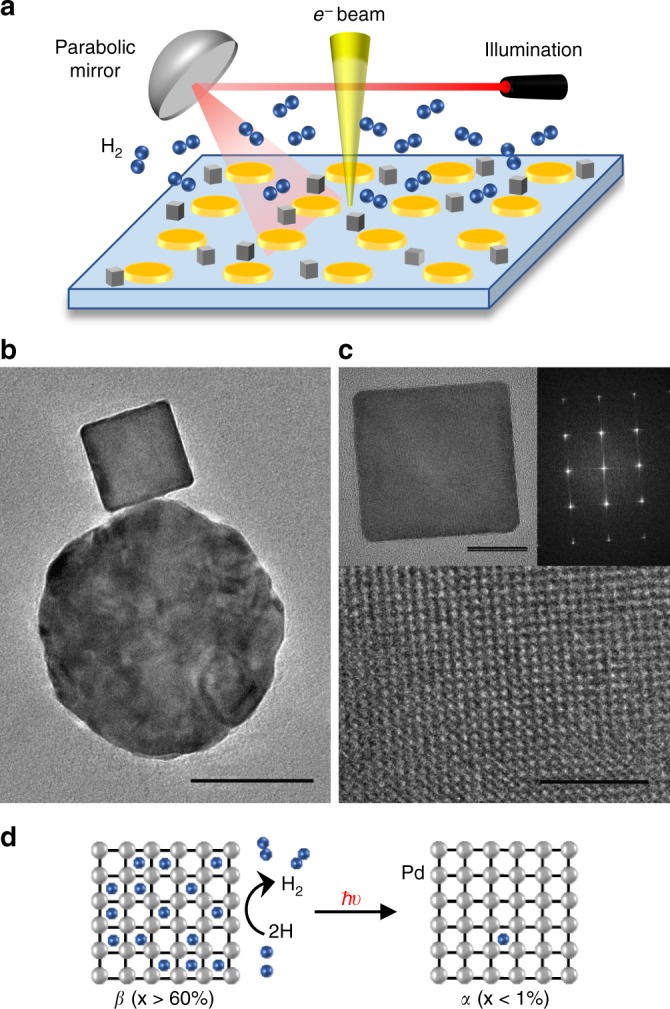
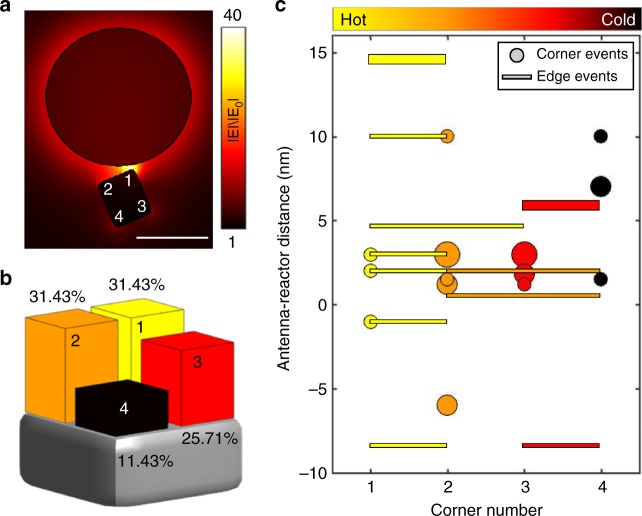
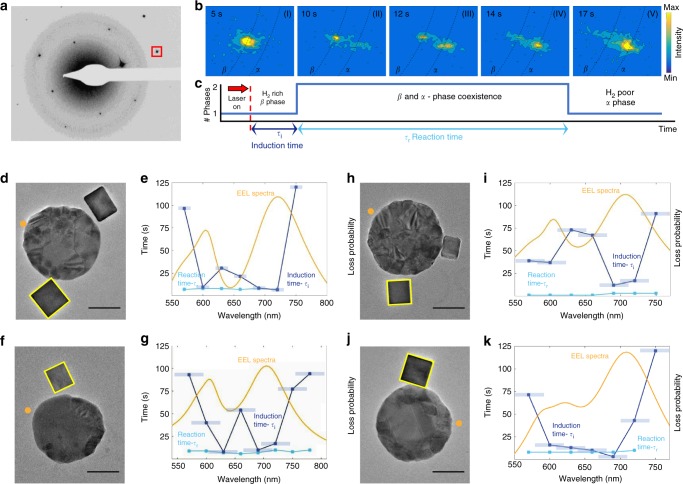
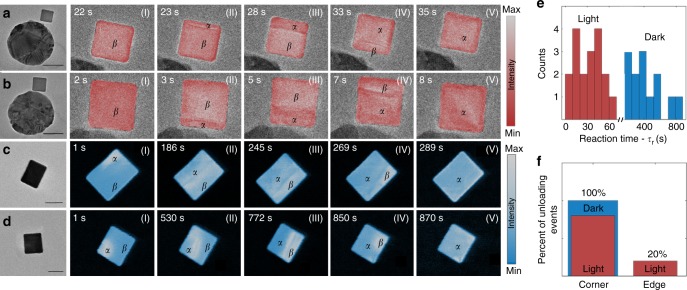
Plasmonic nanoparticle catalysts offer improved light absorption and carrier transport compared to traditional photocatalysts. However, it remains unclear how plasmonic excitation affects multi-step reaction kinetics and promotes site-selectivity. Here, we visualize a plasmon-induced reaction at the sub-nanoparticle level in-situ and in real-time. Using an environmental transmission electron microscope combined with light excitation, we study the photocatalytic dehydrogenation of individual palladium nanocubes coupled to gold nanoparticles with sub-2 nanometer spatial resolution. We find that plasmons increase the rate of distinct reaction steps with unique time constants; enable reaction nucleation at specific sites closest to the electromagnetic hot spots; and appear to open a new reaction pathway that is not observed without illumination. These effects are explained by plasmon-mediated population of excited-state hybridized palladium-hydrogen orbitals. Our results help elucidate the role of plasmons in light-driven photochemical transformations, en-route to design of site-selective and product-specific photocatalysts.
等离子体纳米粒子催化剂与传统的光催化剂相比,提供了改进的光吸收和载流子输运。然而,目前尚不清楚等离子体激发如何影响多步反应动力学并促进选择性。在这里,我们在亚纳米颗粒水平原位实时可视化等离子体诱导的反应。我们使用环境透射电子显微镜结合光激发,研究了与金纳米颗粒耦合的单个钯纳米立方体的光催化脱氢作用,具有亚 2 纳米的空间分辨率。我们发现等离子体增加了具有独特时间常数的不同反应步骤的速率;使反应成核发生在最接近电磁热点的特定位置;并且似乎开辟了一条在没有光照时观察不到的新反应途径。这些效应可以通过等离子体介导的激发态杂化钯-氢键轨道的填充来解释。我们的结果有助于阐明等离子体在光驱动光化学反应中的作用,为设计具有选择性和特定产物的光催化剂奠定了基础。