Biagi Elena, Aceti Arianna, Quercia Sara, Beghetti Isadora, Rampelli Simone, Turroni Silvia, Soverini Matteo, Zambrini Angelo Vittorio, Faldella Giacomo, Candela Marco, Corvaglia Luigi, Brigidi Patrizia
Unit of Microbial Ecology of Health, Department of Pharmacy and Biotechnology, University of Bologna, Bologna, Italy.
Neonatal Intensive Care Unit, Department of Medical and Surgical Sciences, University of Bologna, Bologna, Italy.
Front Microbiol. 2018 Oct 22;9:2512. doi: 10.3389/fmicb.2018.02512. eCollection 2018.
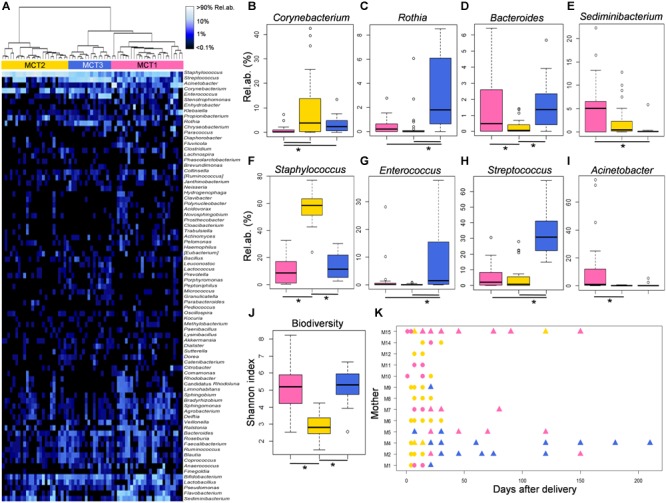
Mother's own milk represents the optimal source for preterm infant nutrition, as it promotes immune defenses and gastrointestinal function, protects against necrotizing enterocolitis, improves long-term clinical outcome and is hypothesized to drive gut microbiota assembly. Preterm infants at birth usually do not receive their mother's milk directly from the breast, because active suckling and coordination between suckling, swallowing and breathing do not develop until 32-34 weeks gestational age, but actual breastfeeding is usually possible as they grow older. Here, we enrolled moderately preterm infants (gestational age 32-34 weeks) to longitudinally characterize mothers' milk and infants' gut and oral microbiomes, up to more than 200 days after birth, through 16S rRNA sequencing. This peculiar population offers the chance to disentangle the differential contribution of human milk feeding vs. actual breastfeeding in the development of infant microbiomes, that have both been acknowledged as crucial contributors to short and long-term infant health status. In this cohort, the milk microbiome composition seemed to change following the infant's latching to the mother's breast, shifting toward a more diverse microbial community dominated by typical oral microbes, i.e., and Even if all infants in the present study were fed human milk, features typical of healthy, full term, exclusively breastfed infants, i.e., high percentages of and low abundances of in fecal and oral samples, respectively, were detected in samples taken after actual breastfeeding started. These findings underline the importance of encouraging not only human milk feeding, but also an early start of actual breastfeeding in preterm infants, since the infant's latching to the mother's breast might constitute an independent factor helping the health-promoting assembly of the infant gut microbiome.
母乳是早产儿营养的最佳来源,因为它能促进免疫防御和胃肠道功能,预防坏死性小肠结肠炎,改善长期临床结局,并被认为有助于肠道微生物群的组装。早产儿出生时通常无法直接从乳房获取母乳,因为主动吸吮以及吸吮、吞咽和呼吸之间的协调直到孕龄32 - 34周才发育完善,但随着他们长大,实际进行母乳喂养通常是可行的。在此,我们纳入了中度早产儿(孕龄32 - 34周),通过16S rRNA测序纵向表征母乳以及婴儿肠道和口腔微生物群,直至出生后200多天。这个特殊群体提供了一个机会,来厘清母乳喂养与实际母乳喂养在婴儿微生物群发育中的不同作用,这两者都被认为是婴儿短期和长期健康状况的关键因素。在这个队列中,母乳微生物群的组成似乎在婴儿 latch 到母亲乳房后发生了变化,向一个由典型口腔微生物主导的更加多样化的微生物群落转变,即 和 。即使本研究中的所有婴儿都喂养了母乳,但在实际母乳喂养开始后采集的样本中,检测到了健康足月纯母乳喂养婴儿的典型特征,即粪便和口腔样本中分别有高比例的 和低丰度的 。这些发现强调了不仅要鼓励母乳喂养,而且要尽早开始对早产儿进行实际母乳喂养的重要性,因为婴儿 latch 到母亲乳房可能是有助于婴儿肠道微生物群健康促进组装的一个独立因素。