Department of Clinical Laboratory, Peking Union Medical College Hospital, Peking Union Medical College & Chinese Academy of Medical Science, Beijing, 100730, China.
Department of Statistics, Institute of Basic Medical Sciences, Chinese Academy of Medical Sciences & Peking Union Medical College, Beijing, 100005, China.
Sci Rep. 2018 Nov 8;8(1):16533. doi: 10.1038/s41598-018-34913-7.
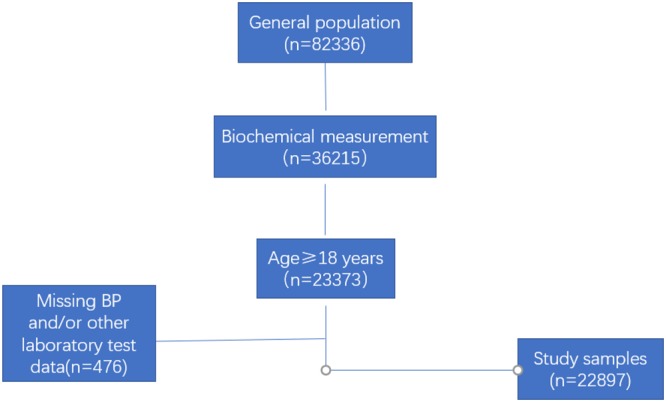
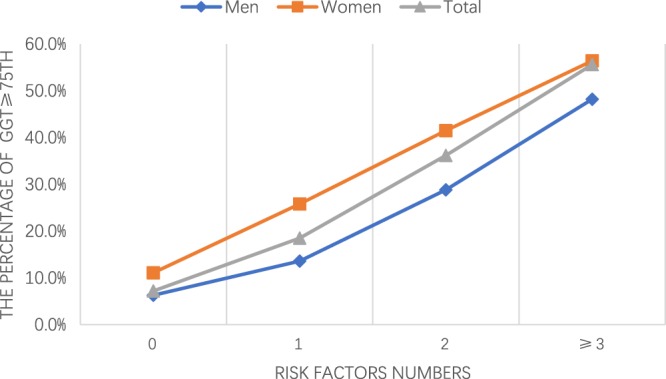
Serum gamma-glutamyltransferase (GGT), which is mainly derived from the liver, is a sensitive marker of liver cell damage and oxidative stress. More recently, it has been found that increased GGT plasma activity is also associated with cardiovascular disease (CVD). However, data on the relationship between GGT and cardiovascular risk factors (CRFs) are lacking in nationally representative samples of the Chinese population. Here, we aim to investigate both the association between GGT and CRFs and CRF clustering. A cross-sectional survey was conducted in a representative sample of 22897 adults aged 18 years and older from 2007 to 2011 nationally, which included a plurality of ethnic minorities. The participants were then divided into quartiles of sex-specific serum GGT. From the low to high GGT quartiles, the incidence of each CRF and clustered risk factors increased after adjusting for age, uric acid (UA), ethnicity, drinking, and all other risk factors. Individuals in the upper stratum (>75 percentile) had higher prevalence rates of CRFs than did those in the lower stratum (all P < 0.05). Furthermore, the subjects with clustering of 1, 2, or ≥3 CRFs were still more likely to belong to the upper GGT quartiles (75th percentiles) than were those without risk factors (all P < 0.05). In conclusion, our data highlight that there is an association between higher serum GGT levels and prevalence of CRFs, which tend to cluster with the increase in GGT activity in Chinese adults.
血清γ-谷氨酰转移酶(GGT)主要来源于肝脏,是肝细胞损伤和氧化应激的敏感标志物。最近,人们发现 GGT 血浆活性的增加也与心血管疾病(CVD)有关。然而,在中国人群的具有代表性的全国性样本中,关于 GGT 与心血管危险因素(CRFs)的关系的数据还很缺乏。在这里,我们旨在研究 GGT 与 CRFs 以及 CRF 聚类之间的关系。我们在 2007 年至 2011 年期间,在全国范围内对 22897 名年龄在 18 岁及以上的成年人进行了一项具有代表性的横断面调查,其中包括了多个少数民族。然后,根据性别特异性血清 GGT 将参与者分为四等份。在 GGT 四分位数中,从低到高,调整年龄、尿酸(UA)、种族、饮酒和所有其他危险因素后,每种 CRF 和聚类危险因素的发生率均增加。处于较高 GGT 四分位数(>75 百分位数)的个体比处于较低 GGT 四分位数的个体具有更高的 CRF 患病率(均 P<0.05)。此外,具有 1、2 或≥3 个 CRF 聚类的患者比没有危险因素的患者更有可能属于较高的 GGT 四分位数(75 百分位数)(均 P<0.05)。总之,我们的数据强调了血清 GGT 水平升高与 CRF 患病率之间存在关联,并且这种关联随着 GGT 活性的增加而趋于聚集。