Grzegorzewska Alicja E, Niepolski Leszek, Świderska Monika K, Mostowska Adrianna, Stolarek Ireneusz, Warchoł Wojciech, Figlerowicz Marek, Jagodziński Paweł P
Department of Nephrology, Transplantology and Internal Diseases, Poznan University of Medical Sciences (PUMS), Poznań, Poland.
Department of Physiology, PUMS, Poznań, Poland.
BMC Med Genet. 2018 Nov 9;19(1):194. doi: 10.1186/s12881-018-0708-4.
The energy homeostasis-associated gene (ENHO), retinoid X receptor alpha gene (RXRA), and liver X receptor alpha gene (LXRA) are involved in adipogenic/lipogenic regulation. We investigated whether single-nucleotide polymorphisms in these genes (ENHO rs2281997, rs72735260; RXRA rs749759, rs10776909, rs10881578; LXRA rs2279238, rs7120118, rs11039155) are associated with dyslipidaemia, related comorbidities and survival of haemodialysis (HD) patients also tested for T-helper (Th) cell interleukin genes (IL).
The study was carried out in 873 HD patients. Dyslipidaemia was diagnosed by the recommendations of the Kidney Disease Outcomes Quality Initiative (K/DOQI) guidelines (2003); atherogenic dyslipidaemia was referred to if the TG/HDL cholesterol ratio was equal to or higher than 3.8. Genotyping of ENHO SNPs, LXRA SNPs, and IL12A rs568408 was carried out using HRM analysis. RXRA SNPs, IL12B rs3212227, and IL18 rs360719 were genotyped using PCR-RFLP analysis. The circulating adropin concentration was determined in 126 patients by enzyme-linked immunosorbent assay. Survival probability was analysed using the Kaplan-Meier method in 440 patients followed through 7.5 years.
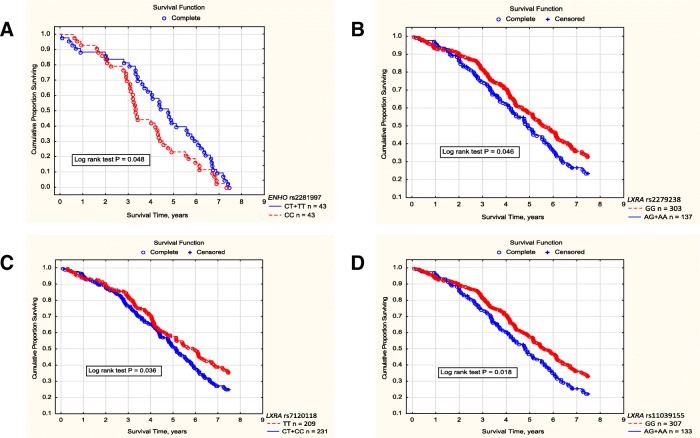
Dyslipidaemia by K/DOQI was diagnosed in 459 patients (91% revealed hyper-LDL- cholesterolaemia), atherogenic dyslipidaemia was diagnosed in 454 patients, and 231 patients were free of dyslipidaemia by both criteria. The variant allele (T) of ENHO rs2281997 was associated with the hyper-LDL cholesterolaemic pattern of dyslipidaemia by K/DOQI. The frequency of atherogenic dyslipidaemia was lower in T-allele bearers than in CC-genotype patients. The rs2281997 T allele was associated with lower cardiovascular mortality in HD patients showing atherogenic dyslipidaemia. ENHO, RXRA, and LXRA showed epistatic interactions in dyslipidaemia. Circulating adropin was lower in atherogenic dyslipidaemia than in non-atherogenic conditions. RXRA rs10776909 was associated with myocardial infarction. Bearers of LXRA rs2279238, rs7120118 or rs11039155 minor alleles showed higher mortality. ENHO SNP positions fell within the same DNase 1 hypersensitivity site expressed in the Th1 cell line. Epistatic interactions occurred between rs2281997 and Th1 IL SNPs (rs360719, rs568408).
Atherogenic dyslipidaemia occurs in HD patients in whom ENHO encodes less adropin. ENHO, RXRA, and LXRA SNPs, separately or jointly, are associated with dyslipidaemia, myocardial infarction, and survival in HD patients. Differences in the availability of transcription binding sites may contribute to these associations.
能量稳态相关基因(ENHO)、视黄酸X受体α基因(RXRA)和肝脏X受体α基因(LXRA)参与脂肪生成/脂质生成调节。我们研究了这些基因中的单核苷酸多态性(ENHO的rs2281997、rs72735260;RXRA的rs749759、rs10776909、rs10881578;LXRA的rs2279238、rs7120118、rs11039155)是否与血脂异常、相关合并症以及血液透析(HD)患者的生存率相关,同时也对辅助性T(Th)细胞白细胞介素基因(IL)进行了检测。
该研究纳入了873例HD患者。血脂异常根据《肾脏病预后质量倡议》(K/DOQI)指南(2003年)的建议进行诊断;如果甘油三酯/高密度脂蛋白胆固醇比值等于或高于3.8,则诊断为致动脉粥样硬化性血脂异常。采用高分辨率熔解曲线分析(HRM)对ENHO单核苷酸多态性(SNP)、LXRA SNP和IL12A rs568408进行基因分型。采用聚合酶链反应-限制性片段长度多态性分析(PCR-RFLP)对RXRA SNP、IL12B rs3212227和IL18 rs360719进行基因分型。通过酶联免疫吸附测定法测定了126例患者的循环中内脂素浓度。采用Kaplan-Meier方法对440例随访7.5年的患者的生存概率进行了分析。
根据K/DOQI标准,459例患者被诊断为血脂异常(91%表现为高LDL胆固醇血症),454例患者被诊断为致动脉粥样硬化性血脂异常,231例患者根据这两个标准均无血脂异常。ENHO rs2281997的变异等位基因(T)与K/DOQI定义的血脂异常的高LDL胆固醇血症模式相关。携带T等位基因者的致动脉粥样硬化性血脂异常频率低于CC基因型患者。rs2281997的T等位基因与表现出致动脉粥样硬化性血脂异常的HD患者较低的心血管死亡率相关。ENHO、RXRA和LXRA在血脂异常中表现出上位性相互作用。致动脉粥样硬化性血脂异常患者的循环内脂素水平低于非致动脉粥样硬化性血脂异常患者。RXRA rs10776909与心肌梗死相关。携带LXRA rs2279238、rs7120118或rs11039155次要等位基因者的死亡率较高。ENHO SNP位点位于Th1细胞系中表达的同一个DNA酶I超敏位点内。rs2281997与Th1白细胞介素SNP(rs360719、rs568408)之间发生了上位性相互作用。
在ENHO编码较少内脂素的HD患者中发生致动脉粥样硬化性血脂异常。ENHO、RXRA和LXRA的SNP单独或联合与HD患者的血脂异常、心肌梗死和生存率相关。转录结合位点可用性的差异可能导致了这些关联。