Boric-Skaro Dijana, Mizdrak Maja, Luketin Mirko, Martinovic Dinko, Tokic Daria, Vilovic Marino, Supe-Domic Daniela, Kurir Tina Ticinovic, Bozic Josko
Department of Nephrology and Dialysis, University Hospital of Split, 21000 Split, Croatia.
Department of Pathophysiology, University of Split School of Medicine, 21000 Split, Croatia.
Life (Basel). 2021 Apr 11;11(4):337. doi: 10.3390/life11040337.
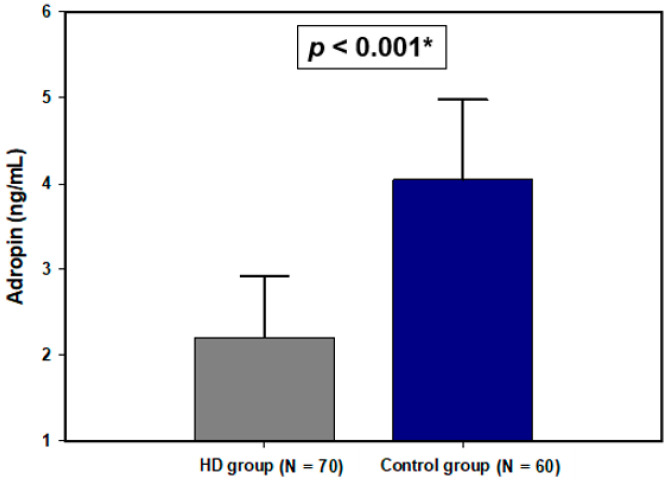
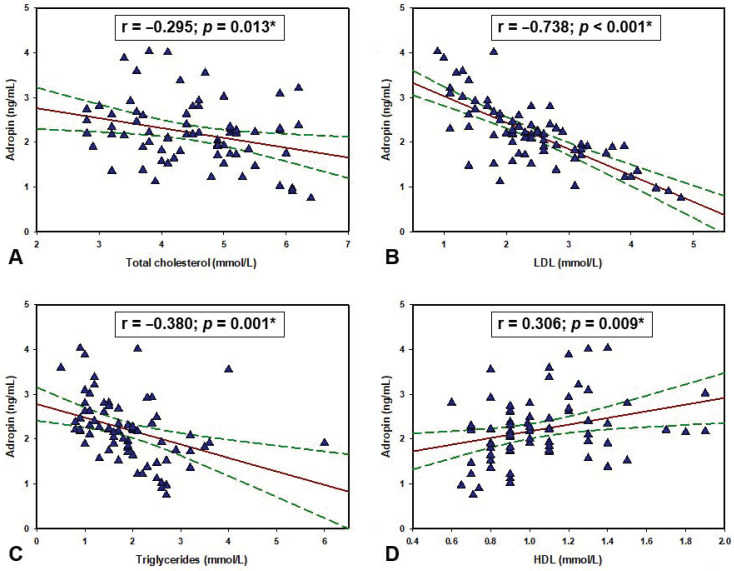
Adropin is a novel pleotropic peptide involved in energy homeostasis, with possible contribution to cardiovascular protection through production of nitric oxide and subsequent blood pressure regulation. Given that patients undergoing hemodialysis (HD) are related with high cardiovascular risk, hyperlipidemia, chronic low-grade inflammation, and malnutrition the aim of our study was to investigate serum adropin levels in HD patients to evaluate possible associations with nutritional status and other relevant clinical and laboratory parameters. The study included 70 patients on HD and 60 healthy controls. Serum adropin levels were determined by an enzyme-linked immunosorbent assay in a commercially available diagnostic kit. Serum adropin levels were significantly lower in the HD group compared to the control group (2.20 ± 0.72 vs. 4.05 ± 0.93 ng/mL, < 0.001). Moreover, there was a significant negative correlation with malnutrition-inflammation score (r = -0.476, < 0.001), dialysis malnutrition score (r = -0.350, = 0.003), HD duration (r = -0.305, = 0.010), and high sensitivity C-reactive protein (hsCRP) (r = -0.646, < 0.001). Additionally, there was a significant negative correlation between adropin levels and pre-dialysis systolic (r = -0.301, = 0.011) and diastolic blood pressure (r = -0.299, = 0.011). These results are implying that adropin is potentially involved in the pathophysiological mechanisms of chronic kidney disease (CKD)/HD and its complications. However, future larger scale longitudinal studies need to further address it.
内脂素是一种参与能量稳态的新型多效性肽,可能通过产生一氧化氮及随后的血压调节对心血管起到保护作用。鉴于接受血液透析(HD)的患者存在高心血管风险、高脂血症、慢性低度炎症和营养不良,我们研究的目的是调查HD患者的血清内脂素水平,以评估其与营养状况以及其他相关临床和实验室参数之间可能存在的关联。该研究纳入了70例HD患者和60例健康对照者。使用市售诊断试剂盒通过酶联免疫吸附测定法测定血清内脂素水平。HD组的血清内脂素水平显著低于对照组(2.20±0.72对4.05±0.93 ng/mL,<0.001)。此外,其与营养不良 - 炎症评分(r = -0.476,<0.001)、透析营养不良评分(r = -0.350,= 0.003)、HD持续时间(r = -0.305,= 0.010)和高敏C反应蛋白(hsCRP)(r = -0.646,<0.001)均呈显著负相关。此外,内脂素水平与透析前收缩压(r = -0.301,= 0.011)和舒张压(r = -0.299,= 0.011)之间也存在显著负相关。这些结果表明内脂素可能参与了慢性肾脏病(CKD)/HD及其并发症的病理生理机制。然而,未来需要更大规模的纵向研究进一步探讨这一问题。