School of Rehabilitation Sciences, Health Sciences University of Hokkaido, Ishikari-Tobetsu, Japan.
Graduate School of Rehabilitation Sciences, Health Sciences University of Hokkaido, Ishikari-Tobetsu, Japan.
J Physiol Anthropol. 2018 Nov 13;37(1):25. doi: 10.1186/s40101-018-0186-6.
Although the benefits of physical activity are well-known, levels of physical inactivity are increasing in many countries. Physical activity, particularly for preventive care of the elderly, must be encouraged. The level of physical activity undertaken by people is influenced by season; however, little is known about seasonal fluctuations of physical activity and its relation to muscle strength/mass. Consequently, we clarified the association between physical activity levels and muscle strength/skeletal muscle mass during non-snowy and snowy seasons in northern Japan.
Participants were community-dwelling elderly people aged 65 years or older living in Tobetsu, northern Japan. A 30-s chair-stand test (CS-30) and body composition measurements using bioelectrical impedance analysis were conducted prior to physical activity measurement using a three-dimensional acceleration sensor in both non-snowy and snowy seasons. Daily steps for the non-snowy and snowy seasons were compared using Welch's t test. The association between the CS-30/skeletal muscle index and daily steps in both seasons was estimated by fitting multiple linear regression models, with age and sex as covariates.
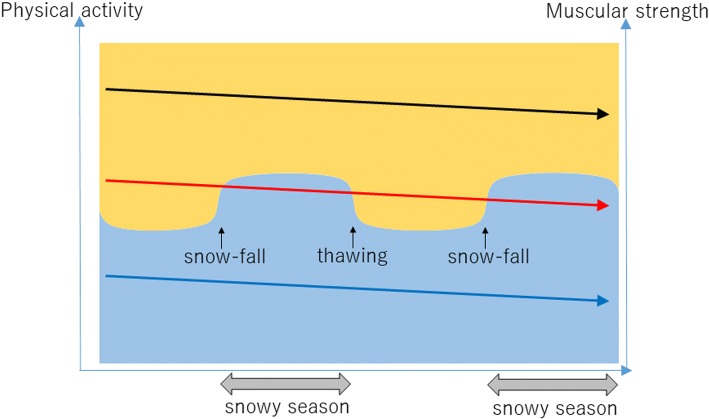
Average daily step counts were significantly lower during the snowy season, compared to the non-snowy season (P < .01). The CS-30 in the snowy season alone was significantly associated with daily step counts. Multiple linear regression analyses results revealed that, for the same muscle strength in both seasons, the daily step counts during the snowy season were fewer than those during the non-snowy season.
The muscle strength required to perform adequate physical activity depended on season. This study obtained basic knowledge to ensure health promotion for elderly people living in snowy-cold regions.
尽管人们已经熟知身体活动的益处,但许多国家的身体活动不足率却在不断上升。必须鼓励身体活动,特别是为老年人提供预防保健。人们进行的身体活动水平受到季节的影响;然而,人们对身体活动的季节性波动及其与肌肉力量/质量的关系知之甚少。因此,我们在日本北部非雪季和雪季期间,阐明了身体活动水平与肌肉力量/骨骼肌质量之间的关系。
参与者是居住在日本北部越后妻有的 65 岁及以上的社区居民。在使用三维加速度传感器测量身体活动之前,在非雪季和雪季分别进行了 30 秒椅子站立测试(CS-30)和使用生物电阻抗分析进行的身体成分测量。使用 Welch 的 t 检验比较了非雪季和雪季的每日步数。通过拟合多元线性回归模型,以年龄和性别为协变量,估计了 CS-30/骨骼肌指数与两个季节中每日步数的关系。
与非雪季相比,雪季的平均每日步数明显较低(P <.01)。仅在雪季时,CS-30 与每日步数显著相关。多元线性回归分析结果表明,在两个季节的肌肉力量相同的情况下,雪季的每日步数比非雪季少。
进行足够身体活动所需的肌肉力量取决于季节。本研究获得了确保生活在雪寒地区的老年人健康促进的基本知识。