Loughman Amy, Haslam Nick
Food & Mood Centre, Deakin University, Geelong, VIC, 3220, Australia.
Melbourne School of Psychological Sciences, University of Melbourne, Parkville, VIC, 3010, Australia.
Cogn Res Princ Implic. 2018 Nov 14;3(1):43. doi: 10.1186/s41235-018-0136-1.
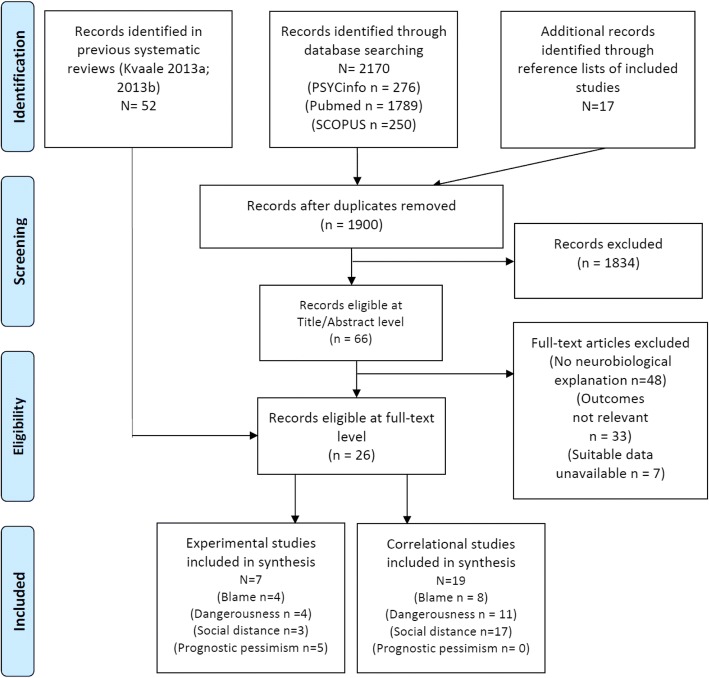
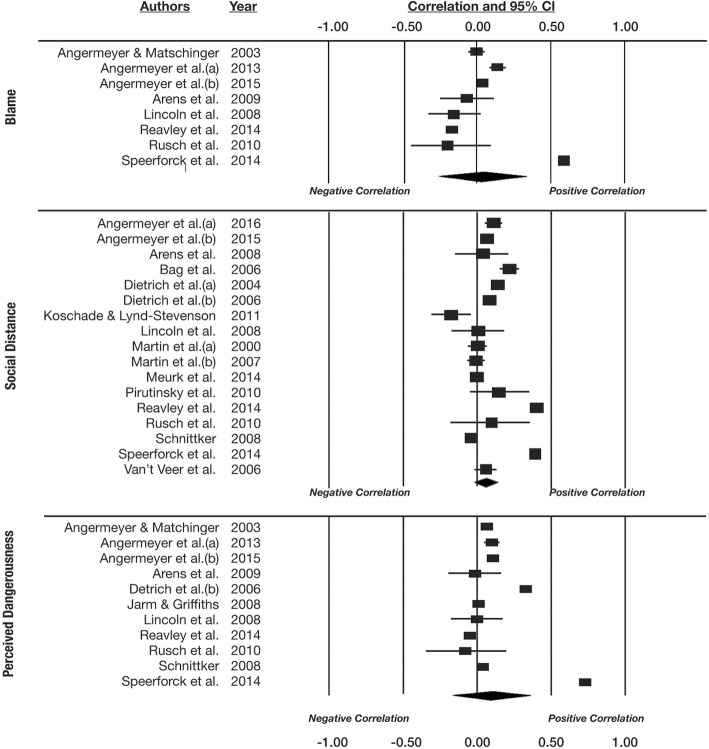
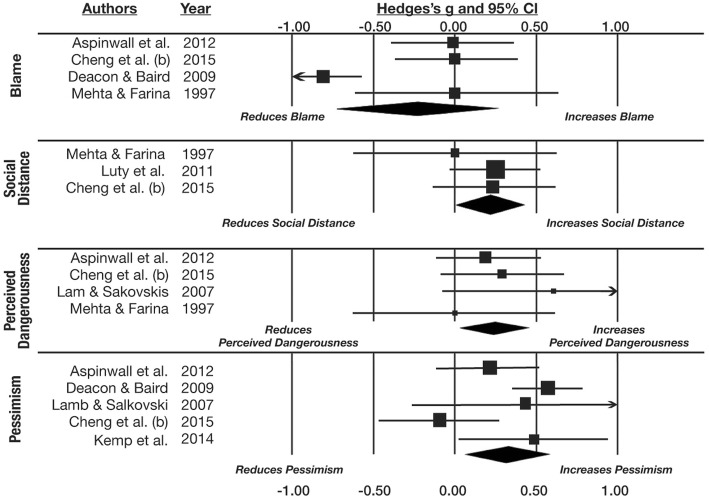
Genetic and other biological explanations appear to have mixed blessings for the stigma of mental disorder. Meta-analytic evidence shows that these "biogenetic" explanations reduce the blame attached to sufferers, but they also increase aversion, perceptions of dangerousness, and pessimism about recovery. These relationships may arise because biogenetic explanations recruit essentialist intuitions, which have known associations with prejudice and the endorsement of stereotypes. However, the adverse implications of biogenetic explanations as a set may not hold true for the subset of those explanations that invoke neurobiological causes. Neurobiological explanations might have less adverse implications for stigma than genetic explanations, for example, because they are arguably less essentialist. Although this possibility is important for evaluating the social implications of neuroscientific explanations of mental health problems, it has yet to be tested meta-analytically. We present meta-analyses of links between neurobiological explanations and multiple dimensions of stigma in 26 correlational and experimental studies. In correlational studies, neurobiological explanations were marginally associated with greater desire for social distance from people with mental health problems. In experimental studies, these explanations were associated with greater desire for social distance, greater perceived dangerousness, and greater prognostic pessimism. Neurobiological explanations were not linked to reduced blame in either set of studies. By implication, neurobiological explanations have the same adverse links to stigma as other forms of biogenetic explanation. These findings raise troubling implications about the public impact of psychiatric neuroscience research findings. Although such findings are not intrinsically stigmatizing, they may become so when viewed through the lens of neuroessentialism.
对于精神障碍的污名化而言,基因及其他生物学解释似乎是利弊参半。元分析证据表明,这些“生物遗传学”解释减少了对患者的指责,但同时也增加了厌恶感、对危险性的认知以及对康复的悲观情绪。这些关系的出现可能是因为生物遗传学解释引发了本质主义直觉,而本质主义直觉与偏见及对刻板印象的认可存在关联。然而,作为一个整体,生物遗传学解释的不利影响可能并不适用于那些援引神经生物学原因的解释子集。例如,神经生物学解释对污名化的不利影响可能比基因解释要小,因为可以说它们本质主义色彩没那么浓。尽管这种可能性对于评估神经科学对心理健康问题的解释所产生的社会影响很重要,但尚未通过元分析进行验证。我们对26项相关研究和实验研究中神经生物学解释与污名化的多个维度之间的联系进行了元分析。在相关研究中,神经生物学解释与人们希望与有心理健康问题的人保持更大社交距离的意愿存在微弱关联。在实验研究中,这些解释与更大的社交距离意愿、更强的危险感认知以及更强的预后悲观情绪相关。在这两组研究中,神经生物学解释均与指责的减少无关。这意味着,神经生物学解释与其他形式的生物遗传学解释一样,与污名化存在不利关联。这些发现对精神病神经科学研究结果的公众影响提出了令人不安的问题。尽管此类发现本身不会造成污名化,但从神经本质主义的角度来看,它们可能会导致污名化。