Developmental Signalling Laboratory, The Francis Crick Institute, 1 Midland Road, London NW1 1AT, UK.
High Throughput Screening Laboratory, The Francis Crick Institute, 1 Midland Road, London NW1 1AT, UK.
Cell Rep. 2018 Nov 13;25(7):1841-1855.e5. doi: 10.1016/j.celrep.2018.10.056.
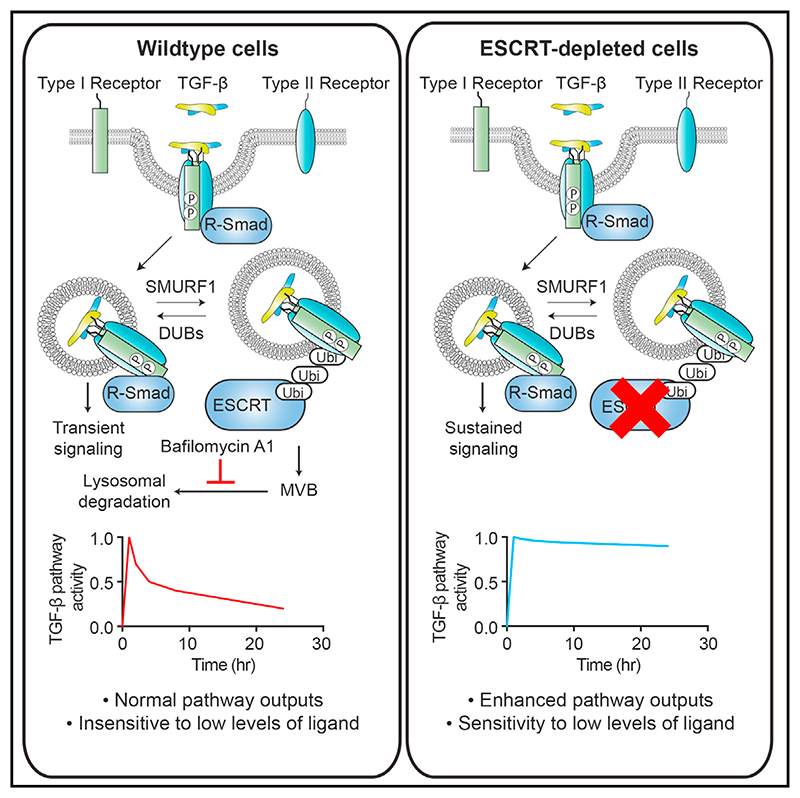
Signal transduction pathways stimulated by secreted growth factors are tightly regulated at multiple levels between the cell surface and the nucleus. The trafficking of cell surface receptors is emerging as a key step for regulating appropriate cellular responses, with perturbations in this process contributing to human diseases, including cancer. For receptors recognizing ligands of the transforming growth factor β (TGF-β) family, little is known about how trafficking is regulated or how this shapes signaling dynamics. Here, using whole genome small interfering RNA (siRNA) screens, we have identified the ESCRT (endosomal sorting complex required for transport) machinery as a crucial determinant of signal duration. Downregulation of ESCRT components increases the outputs of TGF-β signaling and sensitizes cells to low doses of ligand in their microenvironment. This sensitization drives an epithelial-to-mesenchymal transition (EMT) in response to low doses of ligand, and we demonstrate a link between downregulation of the ESCRT machinery and cancer survival.
细胞表面和细胞核之间的分泌生长因子刺激的信号转导途径在多个水平上受到严格调控。细胞表面受体的运输正在成为调节适当细胞反应的关键步骤,该过程的干扰会导致包括癌症在内的人类疾病。对于识别转化生长因子 β(TGF-β)家族配体的受体,人们对其运输如何受到调节以及如何影响信号动力学知之甚少。在这里,我们使用全基因组小干扰 RNA(siRNA)筛选,鉴定出内体分选复合物(ESCRT)作为信号持续时间的关键决定因素。ESCRT 成分的下调增加了 TGF-β信号的输出,并使细胞对微环境中低剂量配体敏感。这种敏感性驱动低剂量配体诱导的上皮-间充质转化(EMT),我们证明了 ESCRT 机制下调与癌症生存之间的联系。