• 文献检索
  • 文档翻译
  • 深度研究
  • 学术资讯
  • Suppr Zotero 插件Zotero 插件
  • 邀请有礼
  • 套餐&价格
  • 历史记录
应用&插件
Suppr Zotero 插件Zotero 插件浏览器插件Mac 客户端Windows 客户端微信小程序
定价
高级版会员购买积分包购买API积分包
服务
文献检索文档翻译深度研究API 文档MCP 服务
关于我们
关于 Suppr公司介绍联系我们用户协议隐私条款
关注我们

Suppr 超能文献

核心技术专利:CN118964589B侵权必究
粤ICP备2023148730 号-1Suppr @ 2026

文献检索

告别复杂PubMed语法,用中文像聊天一样搜索,搜遍4000万医学文献。AI智能推荐,让科研检索更轻松。

立即免费搜索

文件翻译

保留排版,准确专业,支持PDF/Word/PPT等文件格式,支持 12+语言互译。

免费翻译文档

深度研究

AI帮你快速写综述,25分钟生成高质量综述,智能提取关键信息,辅助科研写作。

立即免费体验

Iss2Image:一种基于 CNN 的人类活动识别的新型信号编码技术。

Iss2Image: A Novel Signal-Encoding Technique for CNN-Based Human Activity Recognition.

机构信息

Department of Computer Science and Engineering, Kyung Hee University, (Global Campus), 1732, Deogyeong-daero, Giheung-gu, Yongin-si, Gyeonggi-do 17104, Korea.

Department of Smart ICT Convergence, Konkuk University, 120 Neungdong-ro, Gwangjin-gu, Seoul 05029, Korea.

出版信息

Sensors (Basel). 2018 Nov 13;18(11):3910. doi: 10.3390/s18113910.

DOI:10.3390/s18113910
PMID:30428600
原文链接:https://pmc.ncbi.nlm.nih.gov/articles/PMC6263516/
Abstract

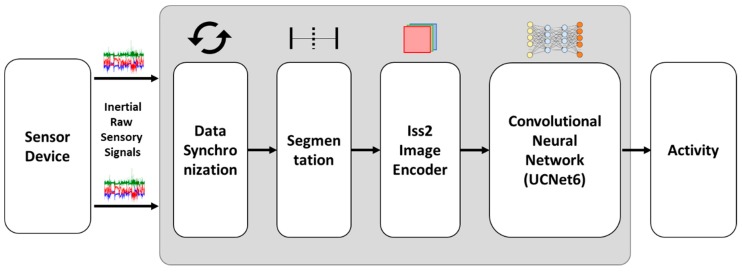
The most significant barrier to success in human activity recognition is extracting and selecting the right features. In traditional methods, the features are chosen by humans, which requires the user to have expert knowledge or to do a large amount of empirical study. Newly developed deep learning technology can automatically extract and select features. Among the various deep learning methods, convolutional neural networks (CNNs) have the advantages of local dependency and scale invariance and are suitable for temporal data such as accelerometer (ACC) signals. In this paper, we propose an efficient human activity recognition method, namely Iss2Image (Inertial sensor signal to Image), a novel encoding technique for transforming an inertial sensor signal into an image with minimum distortion and a CNN model for image-based activity classification. Iss2Image converts real number values from the , , and axes into three color channels to precisely infer correlations among successive sensor signal values in three different dimensions. We experimentally evaluated our method using several well-known datasets and our own dataset collected from a smartphone and smartwatch. The proposed method shows higher accuracy than other state-of-the-art approaches on the tested datasets.

摘要

在人类活动识别中,成功的最大障碍是提取和选择正确的特征。在传统方法中,特征是由人类选择的,这需要用户具有专业知识或进行大量的经验研究。新开发的深度学习技术可以自动提取和选择特征。在各种深度学习方法中,卷积神经网络(CNN)具有局部相关性和尺度不变性的优点,适用于加速度计(ACC)信号等时间数据。在本文中,我们提出了一种有效的人类活动识别方法,即 Iss2Image(惯性传感器信号到图像),这是一种将惯性传感器信号转换为图像的新颖编码技术,可最大限度地减少失真,以及用于基于图像的活动分类的 CNN 模型。Iss2Image 将 、 和 轴的实数值转换为三个颜色通道,以精确推断三个不同维度中连续传感器信号值之间的相关性。我们使用几个著名的数据集和我们自己从智能手机和智能手表收集的数据集对我们的方法进行了实验评估。所提出的方法在测试数据集上的准确性高于其他最先进的方法。
https://cdn.ncbi.nlm.nih.gov/pmc/blobs/5b92/6263516/6302b257b6e1/sensors-18-03910-g005.jpg
https://cdn.ncbi.nlm.nih.gov/pmc/blobs/5b92/6263516/2014f402f6d1/sensors-18-03910-g001.jpg
https://cdn.ncbi.nlm.nih.gov/pmc/blobs/5b92/6263516/09a9ebec3ca5/sensors-18-03910-g002.jpg
https://cdn.ncbi.nlm.nih.gov/pmc/blobs/5b92/6263516/57d67a80cc33/sensors-18-03910-g003.jpg
https://cdn.ncbi.nlm.nih.gov/pmc/blobs/5b92/6263516/b599b93b24a8/sensors-18-03910-g004.jpg
https://cdn.ncbi.nlm.nih.gov/pmc/blobs/5b92/6263516/6302b257b6e1/sensors-18-03910-g005.jpg
https://cdn.ncbi.nlm.nih.gov/pmc/blobs/5b92/6263516/2014f402f6d1/sensors-18-03910-g001.jpg
https://cdn.ncbi.nlm.nih.gov/pmc/blobs/5b92/6263516/09a9ebec3ca5/sensors-18-03910-g002.jpg
https://cdn.ncbi.nlm.nih.gov/pmc/blobs/5b92/6263516/57d67a80cc33/sensors-18-03910-g003.jpg
https://cdn.ncbi.nlm.nih.gov/pmc/blobs/5b92/6263516/b599b93b24a8/sensors-18-03910-g004.jpg
https://cdn.ncbi.nlm.nih.gov/pmc/blobs/5b92/6263516/6302b257b6e1/sensors-18-03910-g005.jpg

相似文献

1
Iss2Image: A Novel Signal-Encoding Technique for CNN-Based Human Activity Recognition.Iss2Image:一种基于 CNN 的人类活动识别的新型信号编码技术。
Sensors (Basel). 2018 Nov 13;18(11):3910. doi: 10.3390/s18113910.
2
Coarse-Fine Convolutional Deep-Learning Strategy for Human Activity Recognition.粗-细卷积深度学习策略在人体活动识别中的应用。
Sensors (Basel). 2019 Mar 31;19(7):1556. doi: 10.3390/s19071556.
3
Image Classification Using Biomimetic Pattern Recognition with Convolutional Neural Networks Features.基于卷积神经网络特征的仿生模式识别图像分类
Comput Intell Neurosci. 2017;2017:3792805. doi: 10.1155/2017/3792805. Epub 2017 Feb 16.
4
Human Physical Activity Recognition Using Smartphone Sensors.使用智能手机传感器进行人体活动识别。
Sensors (Basel). 2019 Jan 23;19(3):458. doi: 10.3390/s19030458.
5
A CNN-SVM combined model for pattern recognition of knee motion using mechanomyography signals.一种基于肌动电流图信号的用于膝关节运动模式识别的CNN-SVM组合模型。
J Electromyogr Kinesiol. 2018 Oct;42:136-142. doi: 10.1016/j.jelekin.2018.07.005. Epub 2018 Jul 26.
6
Smartwatch User Interface Implementation Using CNN-Based Gesture Pattern Recognition.基于卷积神经网络的手势模式识别的智能手表用户界面实现。
Sensors (Basel). 2018 Sep 7;18(9):2997. doi: 10.3390/s18092997.
7
Deep Learning for Sensor-Based Rehabilitation Exercise Recognition and Evaluation.基于传感器的康复运动识别与评估的深度学习。
Sensors (Basel). 2019 Feb 20;19(4):887. doi: 10.3390/s19040887.
8
Spatial Pyramid Pooling in Deep Convolutional Networks for Visual Recognition.空间金字塔池化在深度卷积网络中的视觉识别。
IEEE Trans Pattern Anal Mach Intell. 2015 Sep;37(9):1904-16. doi: 10.1109/TPAMI.2015.2389824.
9
Machine learning algorithms can classify outdoor terrain types during running using accelerometry data.机器学习算法可以使用加速度计数据对跑步过程中的户外地形类型进行分类。
Gait Posture. 2019 Oct;74:176-181. doi: 10.1016/j.gaitpost.2019.09.005. Epub 2019 Sep 5.
10
Falls Risk Classification of Older Adults Using Deep Neural Networks and Transfer Learning.基于深度神经网络和迁移学习的老年人跌倒风险分类。
IEEE J Biomed Health Inform. 2020 Jan;24(1):144-150. doi: 10.1109/JBHI.2019.2906499. Epub 2019 Mar 27.

引用本文的文献

1
Intelligent Sports Weights.智能运动哑铃
Sensors (Basel). 2025 Jun 18;25(12):3808. doi: 10.3390/s25123808.
2
Data Reconstruction Methods in Multi-Feature Fusion CNN Model for Enhanced Human Activity Recognition.用于增强人类活动识别的多特征融合卷积神经网络模型中的数据重建方法
Sensors (Basel). 2025 Feb 14;25(4):1184. doi: 10.3390/s25041184.
3
Human activity recognition from sensor data using spatial attention-aided CNN with genetic algorithm.使用带有遗传算法的空间注意力辅助卷积神经网络从传感器数据中进行人类活动识别。

本文引用的文献

1
Comparison of Data Preprocessing Approaches for Applying Deep Learning to Human Activity Recognition in the Context of Industry 4.0.将深度学习应用于工业 4.0 背景下的人体活动识别的数据预处理方法比较。
Sensors (Basel). 2018 Jul 3;18(7):2146. doi: 10.3390/s18072146.
2
Evolutionary Design of Convolutional Neural Networks for Human Activity Recognition in Sensor-Rich Environments.卷积神经网络在富含传感器环境下人类活动识别的进化设计。
Sensors (Basel). 2018 Apr 23;18(4):1288. doi: 10.3390/s18041288.
3
Divide and Conquer-Based 1D CNN Human Activity Recognition Using Test Data Sharpening.
Neural Comput Appl. 2023;35(7):5165-5191. doi: 10.1007/s00521-022-07911-0. Epub 2022 Oct 26.
4
Human Activity Recognition via Hybrid Deep Learning Based Model.基于混合深度学习的人体活动识别。
Sensors (Basel). 2022 Jan 1;22(1):323. doi: 10.3390/s22010323.
5
Predicting Human Motion Signals Using Modern Deep Learning Techniques and Smartphone Sensors.利用现代深度学习技术和智能手机传感器预测人体运动信号。
Sensors (Basel). 2021 Dec 10;21(24):8270. doi: 10.3390/s21248270.
6
A systematic review of smartphone-based human activity recognition methods for health research.一项针对健康研究中基于智能手机的人类活动识别方法的系统综述。
NPJ Digit Med. 2021 Oct 18;4(1):148. doi: 10.1038/s41746-021-00514-4.
7
Classifying Goliath Grouper () Behaviors from a Novel, Multi-Sensor Tag.从新型多传感器标签对大石斑鱼()行为进行分类。
Sensors (Basel). 2021 Sep 24;21(19):6392. doi: 10.3390/s21196392.
8
Analysis of Body Behavior Characteristics after Sports Training Based on Convolution Neural Network.基于卷积神经网络的体育训练后身体行为特征分析。
Comput Intell Neurosci. 2021 Jul 20;2021:7006541. doi: 10.1155/2021/7006541. eCollection 2021.
9
INIM: Inertial Images Construction with Applications to Activity Recognition.惯性图像构建及其在活动识别中的应用。
Sensors (Basel). 2021 Jul 13;21(14):4787. doi: 10.3390/s21144787.
10
Accelerometer-Based Human Activity Recognition for Patient Monitoring Using a Deep Neural Network.基于加速度计的人体活动识别用于使用深度神经网络进行患者监测
Sensors (Basel). 2020 Nov 10;20(22):6424. doi: 10.3390/s20226424.
基于分治策略的一维卷积神经网络的人类活动识别方法,通过测试数据锐化实现。
Sensors (Basel). 2018 Apr 1;18(4):1055. doi: 10.3390/s18041055.
4
Comparison of Feature Learning Methods for Human Activity Recognition Using Wearable Sensors.基于可穿戴传感器的人体活动识别中特征学习方法的比较。
Sensors (Basel). 2018 Feb 24;18(2):679. doi: 10.3390/s18020679.
5
IMU-Based Gait Recognition Using Convolutional Neural Networks and Multi-Sensor Fusion.基于惯性测量单元的卷积神经网络与多传感器融合步态识别
Sensors (Basel). 2017 Nov 27;17(12):2735. doi: 10.3390/s17122735.
6
Deep Recurrent Neural Networks for Human Activity Recognition.深度递归神经网络在人体活动识别中的应用。
Sensors (Basel). 2017 Nov 6;17(11):2556. doi: 10.3390/s17112556.
7
A Comparison Study of Classifier Algorithms for Cross-Person Physical Activity Recognition.跨人身体活动识别分类算法的比较研究
Sensors (Basel). 2016 Dec 30;17(1):66. doi: 10.3390/s17010066.
8
A Deep Learning Approach to on-Node Sensor Data Analytics for Mobile or Wearable Devices.一种用于移动或可穿戴设备的节点传感器数据分析的深度学习方法。
IEEE J Biomed Health Inform. 2017 Jan;21(1):56-64. doi: 10.1109/JBHI.2016.2633287. Epub 2016 Dec 23.
9
Deep Convolutional and LSTM Recurrent Neural Networks for Multimodal Wearable Activity Recognition.用于多模态可穿戴活动识别的深度卷积和长短期记忆循环神经网络
Sensors (Basel). 2016 Jan 18;16(1):115. doi: 10.3390/s16010115.
10
Hierarchical, multi-sensor based classification of daily life activities: comparison with state-of-the-art algorithms using a benchmark dataset.基于分层多传感器的日常生活活动分类:使用基准数据集与最先进算法的比较。
PLoS One. 2013 Oct 9;8(10):e75196. doi: 10.1371/journal.pone.0075196. eCollection 2013.