Gronek Piotr, Gronek Joanna, Lulińska-Kuklik Ewelina, Spieszny Michał, Niewczas Marta, Kaczmarczyk Mariusz, Petr Miroslav, Fischerova Patricia, Ahmetov Ildus I, Żmijewski Piotr
Laboratory of Genetics, Department of Gymnastics and Dance, University School of Physical Education in Poznań, Poznań, Poland.
Department of Tourism and Recreation, University of Physical Education and Sport, Gdańsk, Poland.
J Hum Kinet. 2018 Oct 15;64:87-98. doi: 10.1515/hukin-2017-0204. eCollection 2018 Sep.
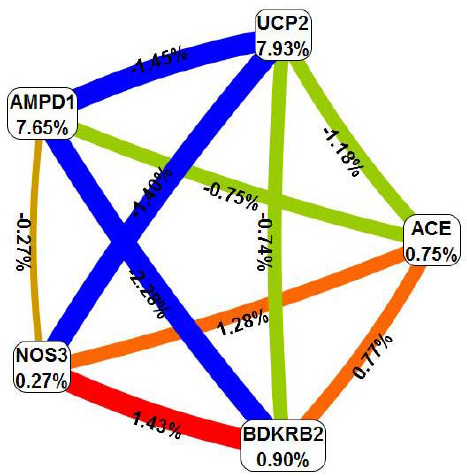
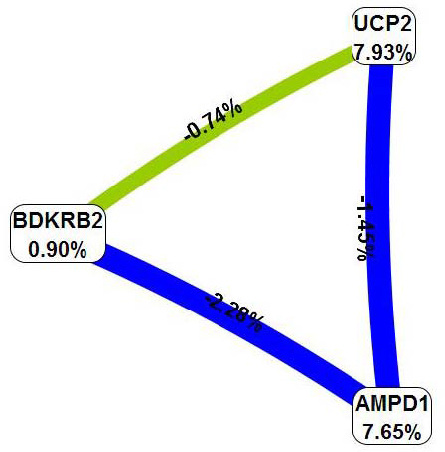
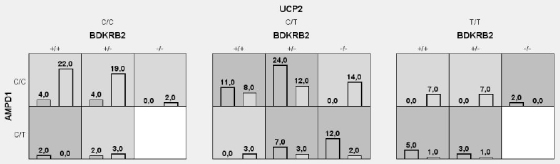
The purpose of this study was to investigate individually and in combination the association between the ACE (I/D), NOS3 (Glu298Asp), BDKRB2 (-9/+9), UCP2 (Ala55Val) and AMPD1 (Gln45Ter) variants with endurance performance in a large, performance-homogenous cohort of elite Polish half marathoners. The study group consisted of 180 elite half marathoners: 76 with time < 100 minutes and 104 with time > 100 minutes. DNA of the subjects was extracted from buccal cells donated by the runners and genotyping was carried out using an allelic discrimination assay with a C1000 Touch Thermal Cycler (Bio-Rad, Germany) instrument with TaqMan® probes (NOS3, UCP2, and AMPD1) and a T100™ Thermal Cycler (Bio-Rad, Germany) instrument (ACE and BDKRB2). We found that the UCP2 Ala55Val polymorphism was associated with running performance, with the subjects carrying the Val allele being overrepresented in the group of most successful runners (<100 min) compared to the >100 min group (84.2 vs. 55.8%; OR = 4.23, p < 0.0001). Next, to assess the combined impact of 4 gene polymorphisms, all athletes were classified according to the number of 'endurance' alleles (ACE I, NOS3 Glu, BDKRB2 -9, UCP2 Val) they possessed. The proportion of subjects with a high (4-7) number of 'endurance' alleles was greater in the better half marathoners group compared with the >100 min group (73.7 vs. 51.9%; OR = 2.6, p = 0.0034). These data suggest that the likelihood of becoming an elite half marathoner partly depends on the carriage of a high number of endurance-related alleles.
本研究的目的是在一个大型、表现同质化的波兰精英半程马拉松运动员队列中,单独及联合研究血管紧张素转换酶(ACE,I/D)、一氧化氮合酶3(NOS3,Glu298Asp)、缓激肽B2受体(BDKRB2,-9/+9)、解偶联蛋白2(UCP2,Ala55Val)和肌腺苷酸脱氨酶1(AMPD1,Gln45Ter)基因变体与耐力表现之间的关联。研究组由180名精英半程马拉松运动员组成:76人用时<100分钟,104人用时>100分钟。从跑步者捐赠的颊细胞中提取受试者的DNA,并使用配备TaqMan®探针(用于NOS3、UCP2和AMPD1)的C1000 Touch Thermal Cycler(德国伯乐公司)仪器以及T100™ Thermal Cycler(德国伯乐公司)仪器(用于ACE和BDKRB2)通过等位基因鉴别分析进行基因分型。我们发现,UCP2 Ala55Val多态性与跑步表现相关,与用时>100分钟的组相比,携带Val等位基因的受试者在最成功的跑步者组(<100分钟)中占比过高(84.2%对55.8%;优势比=4.23,p<0.0001)。接下来,为了评估4种基因多态性的综合影响,根据所有运动员所拥有的“耐力”等位基因(ACE I、NOS3 Glu、BDKRB2 -9、UCP2 Val)数量对他们进行分类。用时较短的半程马拉松运动员组中拥有高数量(4 - 7个)“耐力”等位基因的受试者比例高于用时>100分钟的组(73.7%对51.9%;优势比=2.6,p = 0.0034)。这些数据表明,成为精英半程马拉松运动员可能性的部分取决于携带大量与耐力相关的等位基因。