
“通督调神”针法改善大脑中动脉闭塞模型大鼠认知功能障碍
'Governor vessel-unblocking and mind-regulating' acupuncture therapy ameliorates cognitive dysfunction in a rat model of middle cerebral artery occlusion.
机构信息
Department of Rehabilitation, Guangdong Provincial Hospital of Traditional Chinese Medicine Integrated with Western Medicine, Foshan, Guangdong 528200, P.R. China.
Department of Traditional Chinese Medicine, People's Hospital of Nanhai District Foshan, Foshan, Guangdong 528200, P.R. China.
出版信息
Int J Mol Med. 2019 Jan;43(1):221-232. doi: 10.3892/ijmm.2018.3981. Epub 2018 Nov 6.
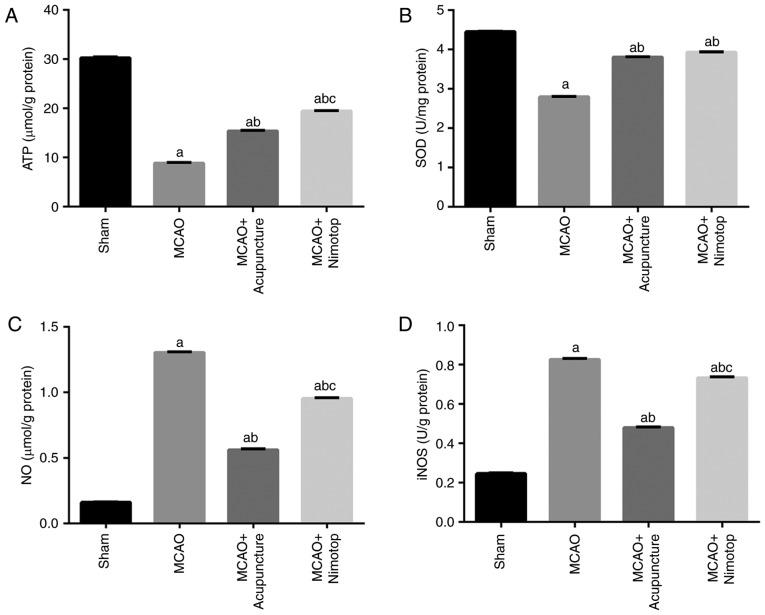
Acupuncture is a traditional Chinese medicinal therapy, which is used for the amelioration of cognitive dysfunction. The aim of this study was to investigate the effectiveness and relevancy mechanisms of 'governor vessel‑unblocking and mind‑regulating' acupuncture therapy for cognitive dysfunction in rats with ischemia. For this purpose, we used the middle cerebral artery occlusion (MCAO) method to induce cognitive dysfunction in rats. The behavioral changes in the rats were examined using the Morris water maze (MWM) test. The effects of the treatment on oxidative stress response and the function of the mitochondria in brain tissues were also assessed. The results revealed that 'governor vessel‑unblocking and mind‑regulating' acupuncture therapy markedly improved the cognitive ability of the rats with cognitive dysfunction. The production of pro‑oxidative stress factors, including nitric oxide (NO) and inducible nitric oxide synthase (iNOS), was also blocked along with the amelioration of cognitive function, while the production of adenosine triphosphate (ATP), superoxide dismutase (SOD) and cyclooxygenase (COX) was restored. At the molecular level, the accumulation of amyloid β (Aβ) in the mitochondria was suppressed by 'governor vessel‑unblocking and mind‑regulating' acupuncture therapy, which may be attributed to the inhibition of the function of translocase of outer mitochondrial membrane 40 (TOMM40) and translocase of inner mitochondrial membrane 17A (TIMM17A). On the whole, the findings of the present study confirm the effects of 'governor vessel‑unblocking and mind‑regulating' acupuncture therapy on cognitive dysfunction induced by brain ischemia in rats, and that the mechanisms underlying the effects of this treatment might be mediated through the inhibition of TOMM40 and TIMM17A synthesis, which can relieve mitochondrial dysfunction from the accumulation of Aβ.
针灸是一种传统的中医治疗方法,用于改善认知功能障碍。本研究旨在探讨“通督调神”针刺疗法对缺血性大鼠认知功能障碍的疗效及相关机制。为此,我们采用大脑中动脉闭塞(MCAO)法诱导大鼠认知功能障碍。采用 Morris 水迷宫(MWM)试验检测大鼠的行为变化。还评估了治疗对氧化应激反应和脑组织线粒体功能的影响。结果表明,“通督调神”针刺疗法显著改善了认知功能障碍大鼠的认知能力。还阻断了促氧化应激因子(包括一氧化氮(NO)和诱导型一氧化氮合酶(iNOS))的产生,同时改善了认知功能,而三磷酸腺苷(ATP)、超氧化物歧化酶(SOD)和环氧化酶(COX)的产生得到恢复。在分子水平上,“通督调神”针刺疗法抑制了线粒体中淀粉样β(Aβ)的积累,这可能归因于对外膜转位酶 40(TOMM40)和内膜转位酶 17A(TIMM17A)功能的抑制。总的来说,本研究的结果证实了“通督调神”针刺疗法对脑缺血诱导的大鼠认知功能障碍的疗效,其作用机制可能是通过抑制 TOMM40 和 TIMM17A 的合成,从而缓解线粒体功能障碍和 Aβ的积累。





 Zotero 插件