Hölzel Christina Susanne, Tetens Julia Louisa, Schwaiger Karin
1 Animal Hygiene and Animal Health Management, Faculty of Agricultural and Nutritional Sciences, Christian-Albrechts-University Kiel (CAU) , Kiel, Germany .
2 Department of Veterinary Sciences, Institute of Food Safety, Ludwig-Maximilians-University Munich (LMU) , Munich, Germany .
Foodborne Pathog Dis. 2018 Nov;15(11):671-688. doi: 10.1089/fpd.2018.2501.
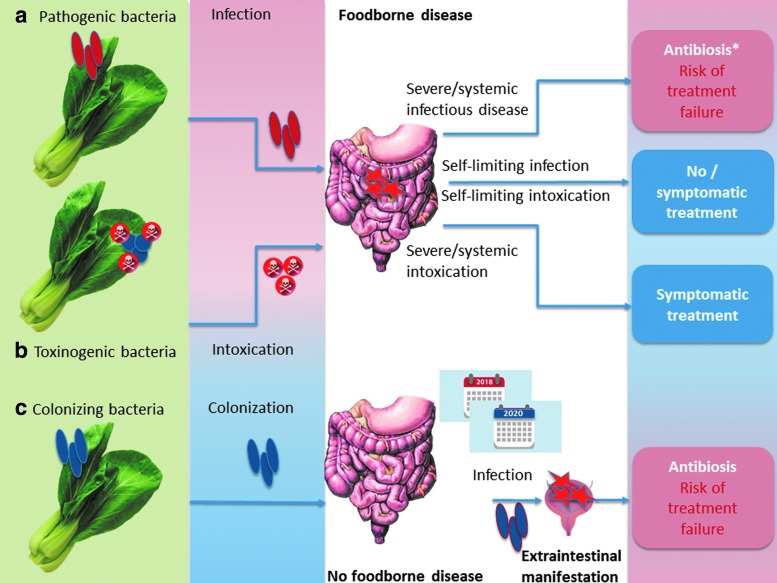
In recent years, vegetables gain consumer attraction due to their reputation of being healthy in combination with low energy density. However, since fresh produce is often eaten raw, it may also be a source for foodborne illness. The presence of antibiotic-resistant bacteria might pose a particular risk to the consumer. Therefore, this review aims to present the current state of knowledge concerning the exposure of humans to antibiotic-resistant bacteria via food of plant origin for quantitative risk assessment purposes. The review provides a critical overview of available information on hazard identification and characterization, exposure assessment, and risk prevention with special respect to potential sources of contamination and infection chains. Several comprehensive studies are accessible regarding major antimicrobial-resistant foodborne pathogens (e.g., Salmonella spp., Listeria spp., Bacillus cereus, Campylobacter spp., Escherichia coli) and other bacteria (e.g., further Enterobacteriaceae, Pseudomonas spp., Gram-positive cocci). These studies revealed vegetables to be a potential-although rare-vector for extended-spectrum beta-lactamase-producing Enterobacteriaceae, mcr1-positive E. coli, colistin- and carbapenem-resistant Pseudomonas aeruginosa, linezolid-resistant enterococci and staphylococci, and vancomycin-resistant enterococci. Even if this provides first clues for assessing the risk related to vegetable-borne antimicrobial-resistant bacteria, the literature research reveals important knowledge gaps affecting almost every part of risk assessment and management. Especially, the need for (comparable) quantitative data as well as data on possible contamination sources other than irrigation water, organic fertilizer, and soil becomes obvious. Most crucially, dose-response studies would be needed to convert a theoretical "risk" (e.g., related to antimicrobial-resistant commensals and opportunistic pathogens) into a quantitative risk estimate.
近年来,蔬菜因其健康的声誉以及低能量密度而受到消费者的青睐。然而,由于新鲜农产品通常是生食的,它也可能是食源性疾病的一个来源。抗生素耐药菌的存在可能会给消费者带来特别的风险。因此,本综述旨在呈现关于人类通过植物源食品接触抗生素耐药菌的现有知识状态,以进行定量风险评估。该综述对关于危害识别与特征描述、暴露评估以及风险预防的现有信息进行了批判性概述,特别关注潜在的污染源和感染链。关于主要的耐抗生素食源性病原体(如沙门氏菌属、李斯特菌属、蜡样芽孢杆菌、弯曲杆菌属、大肠杆菌)和其他细菌(如其他肠杆菌科细菌、假单胞菌属、革兰氏阳性球菌)有几项全面的研究。这些研究表明,蔬菜是产超广谱β-内酰胺酶肠杆菌科细菌、mcr1阳性大肠杆菌、耐黏菌素和碳青霉烯类的铜绿假单胞菌、耐利奈唑胺肠球菌和葡萄球菌以及耐万古霉素肠球菌的潜在(尽管罕见)传播媒介。即使这为评估与蔬菜传播的抗生素耐药菌相关的风险提供了初步线索,但文献研究揭示了几乎影响风险评估和管理各个方面的重要知识空白。特别是,(可比的)定量数据以及除灌溉水、有机肥料和土壤之外的可能污染源的数据的需求变得明显。最关键的是,需要剂量反应研究将理论上的“风险”(如与抗生素耐药共生菌和机会性病原体相关的风险)转化为定量风险估计。