de Verdal Hugues, Vandeputte Marc, Mekkawy Wagdy, Chatain Béatrice, Benzie John A H
CIRAD, UMR116 ISEM, TA B-116/16, 73 rue Jean-François Breton, 34398, Montpellier Cedex 5, France.
Worldfish, Jalan Batu Maung, 11960, Bayan Lepas, Penang, Malaysia.
BMC Genet. 2018 Nov 16;19(1):105. doi: 10.1186/s12863-018-0691-y.
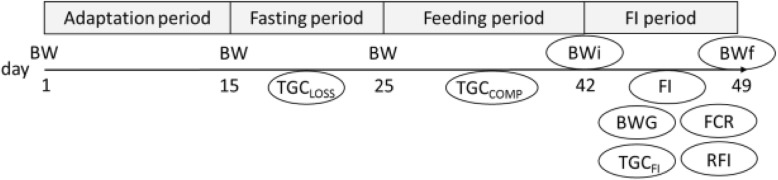
Improving feed efficiency in fish is crucial at the economic, social and environmental levels with respect to developing a more sustainable aquaculture. The important contribution of genetic improvement to achieve this goal has been hampered by the lack of accurate basic information on the genetic parameters of feed efficiency in fish. We used video assessment of feed intake on individual fish reared in groups to estimate the genetic parameters of six growth traits, feed intake, feed conversion ratio (FCR) and residual feed intake in 40 pedigreed families of the GIFT strain of Nile tilapia, Oreochromis niloticus. Feed intake and growth were measured on juvenile fish (22.4 g mean body weight) during 13 consecutive meals, representing 7 days of measurements. We used these data to estimate the FCR response to different selection criteria to assess the potential of genetics as a means of increasing FCR in tilapia.
Our results demonstrate genetic control for FCR in tilapia, with a heritability estimate of 0.32 ± 0.11. Response to selection estimates showed FCR could be efficiently improved by selective breeding. Due to low genetic correlations, selection for growth traits would not improve FCR. However, weight loss at fasting has a high genetic correlation with FCR (0.80 ± 0.25) and a moderate heritability (0.23), and could be an easy to measure and efficient criterion to improve FCR by selective breeding in tilapia.
At this age, FCR is genetically determined in Nile tilapia. A selective breeding program could be possible and could help enabling the development of a more sustainable aquaculture production.
在发展更可持续的水产养殖方面,提高鱼类饲料效率在经济、社会和环境层面都至关重要。由于缺乏关于鱼类饲料效率遗传参数的准确基础信息,遗传改良对实现这一目标的重要贡献受到了阻碍。我们利用视频评估法对尼罗罗非鱼(奥利亚罗非鱼)吉富品系40个家系中群体饲养的个体鱼的采食量进行了评估,以估计6个生长性状、采食量、饲料转化率(FCR)和残饵摄入量的遗传参数。在连续13餐(相当于7天的测量时间)期间对幼鱼(平均体重22.4克)的采食量和生长情况进行了测量。我们利用这些数据来估计FCR对不同选择标准的反应,以评估遗传学作为提高罗非鱼FCR手段的潜力。
我们的结果表明罗非鱼的FCR受遗传控制,遗传力估计值为0.32±0.11。选择反应估计表明,通过选择性育种可以有效提高FCR。由于遗传相关性较低,对生长性状的选择不会提高FCR。然而,禁食时的体重减轻与FCR具有较高的遗传相关性(0.80±0.25)和中等遗传力(0.23),并且可能是一种易于测量且有效的标准,可通过对罗非鱼进行选择性育种来提高FCR。
在这个年龄段,尼罗罗非鱼的FCR由基因决定。选择性育种计划是可行的,并且有助于实现更可持续的水产养殖生产的发展。