Department of Ecology, Evolution, and Environmental Biology, Columbia University, 1200 Amsterdam Ave., 10027 New York, NY, United States.
School of Science, Royal Melbourne Institute of Technology, 124 La Trobe St., Melbourne, Australia.
Ticks Tick Borne Dis. 2019 Feb;10(2):258-268. doi: 10.1016/j.ttbdis.2018.10.013. Epub 2018 Nov 3.
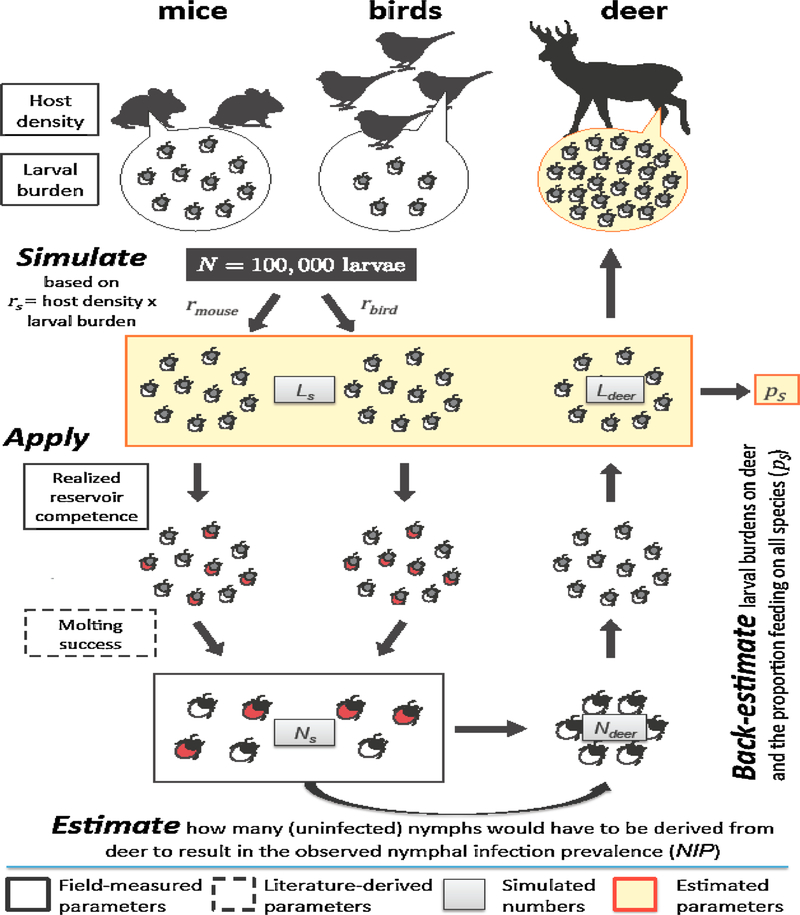
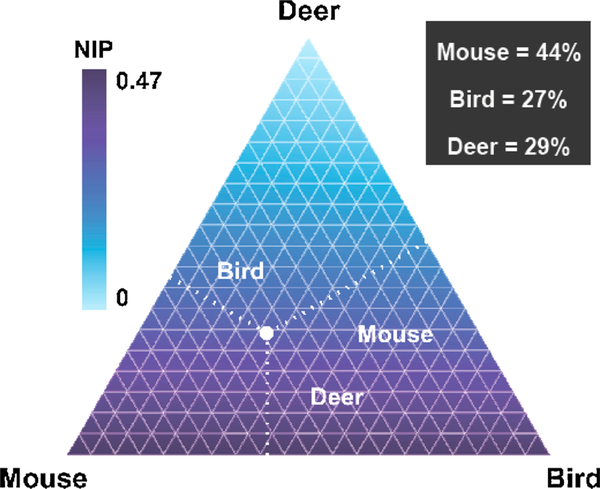
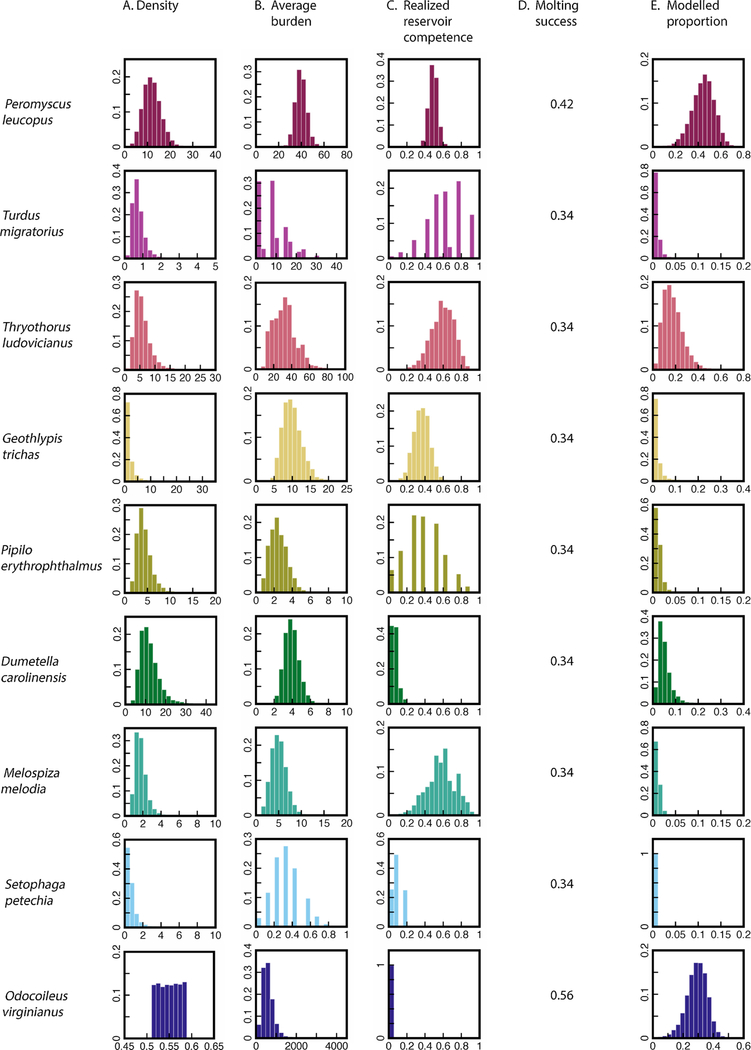
An inverse relationship between biodiversity and human health has been termed the 'dilution effect' paradigm. In the case of tick-borne infections such as Lyme disease, the key assumption is that Borrelia burgdorferi sensu lato abundance is increased by the loss of less competent (dilution) hosts as biodiversity declines. White-tailed deer play a dual role in the pathogen cycle, as key reproductive hosts for adult ticks and incompetent hosts for the pathogen. While the role of deer as hosts of adult ticks is well established, the extent to which deer also feed immature ticks and reduce the proportion infected is unknown because of logistic constraints in measuring this empirically. We estimated the proportion of larvae that fed on deer in an extremely species-poor community on Block Island, RI, where tick nymphal infection prevalence was found to be lower than expected. In 2014, we measured the density, larval tick burdens, and realized reservoir competence of small mammal and bird hosts on Block Island, RI. In 2015, we measured the infection prevalence of host-seeking Ixodes scapularis nymphs resulting from larvae fed on available hosts in 2014. We back-estimated the proportion of larvae expected to have fed on deer in 2014 (the only unknown parameter) to result in the nymphal infection prevalence observed in 2015. Back-estimation predicted that 29% of larval ticks must have fed on deer to yield the observed 30% nymphal infection prevalence. In comparison, the proportion of larvae feeding on mice was 44% and 27% on birds. Our study identified an influential role of deer in reducing nymphal tick infection prevalence and a potential role as dilution hosts if the reduction in nymphal infection prevalence outweighs the role of deer as tick population amplifiers. Because both deer and competent hosts may increase in anthropogenic, fragmented habitats, the links between fragmentation, biodiversity, and Lyme disease risk may be complex and difficult to predict. Furthermore, a nonlinear relationship between deer abundance and Lyme disease risk would reduce the efficacy of deer population reduction efforts to control Lyme disease.
生物多样性与人类健康之间的反比关系被称为“稀释效应”范式。在莱姆病等蜱传感染的情况下,关键假设是,随着生物多样性的减少,较少有能力的(稀释)宿主的丧失会增加 Borrelia burgdorferi sensu lato 的丰度。白尾鹿在病原体循环中发挥双重作用,既是成年蜱的关键繁殖宿主,也是病原体的低效宿主。虽然鹿作为成年蜱宿主的作用已经得到充分证实,但由于在测量这一作用时存在逻辑上的限制,鹿还会喂养不成熟的蜱并降低感染比例,这一点尚不清楚。我们估计了在罗得岛布洛克岛一个物种非常贫乏的社区中,以鹿为食的幼虫比例,那里的蜱幼虫感染率低于预期。2014 年,我们测量了罗得岛布洛克岛的小型哺乳动物和鸟类宿主的密度、幼虫蜱的负担和实现的储库能力。2015 年,我们测量了 2014 年从可用宿主身上取食的宿主觅食的伊蚊幼虫的感染率,这些宿主导致了 2015 年观察到的若虫感染率。我们对 2014 年(唯一未知参数)预期以鹿为食的幼虫比例进行了回溯估计,以产生 2015 年观察到的若虫感染率。回溯估计预测,为了产生观察到的 30%的若虫感染率,必须有 29%的幼虫以鹿为食。相比之下,以老鼠为食的幼虫比例为 44%,以鸟类为食的幼虫比例为 27%。我们的研究确定了鹿在降低若虫蜱感染率方面的重要作用,如果降低若虫感染率超过鹿作为蜱种群放大器的作用,则鹿可能成为稀释宿主。由于鹿和有能力的宿主都可能在人为的、碎片化的栖息地中增加,因此,碎片化、生物多样性和莱姆病风险之间的联系可能是复杂的,难以预测。此外,鹿的丰度与莱姆病风险之间的非线性关系将降低减少鹿种群以控制莱姆病的努力的效果。