Ralaidovy Ambinintsoa H, Gopalappa Chaitra, Ilbawi André, Pretorius Carel, Lauer Jeremy A
1Information, Evidence and Research, World Health Organization, Avenue Appia 20, Geneva, Switzerland.
Mechanical and Industrial Engineering, 219 Engineering Laboratory, University of Massachusetts, 160 Governors Drive, Amherst, MA 01003-2210 USA.
Cost Eff Resour Alloc. 2018 Oct 29;16:38. doi: 10.1186/s12962-018-0157-0. eCollection 2018.
Following the adoption of the Global Action Plan for the Prevention and Control of NCDs 2013-2020, an update to the Appendix 3 of the action plan was requested by Member States in 2016, endorsed by the Seventieth World Health Assembly in May 2017 and provides a list of recommended NCD interventions. The main contribution of this paper is to present results of analyses identifying how decision makers can achieve maximum health gain using the cancer interventions listed in the Appendix 3. We also present methods used to calculate new WHO-CHOICE cost-effectiveness results for breast cancer, cervical cancer, and colorectal cancer in Southeast Asia and eastern sub-Saharan Africa.
We used "Generalized Cost-Effectiveness Analysis" for our analysis which uses a hypothetical null reference case, where the impacts of all current interventions are removed, in order to identify the optimal package of interventions. All health system costs, regardless of payer, were included. Health outcomes are reported as the gain in healthy life years due to a specific intervention scenario and were estimated using a deterministic state-transition cohort simulation (Markov model).
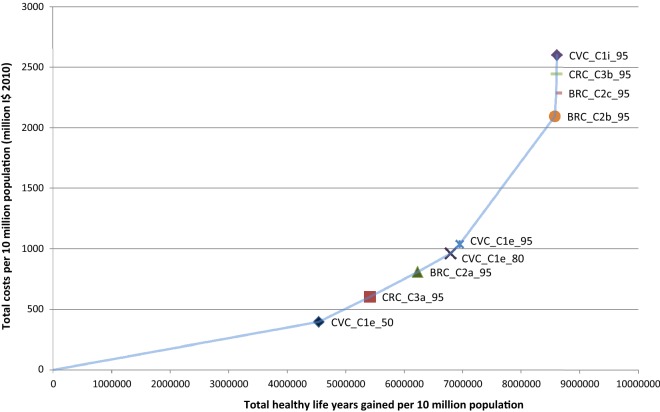
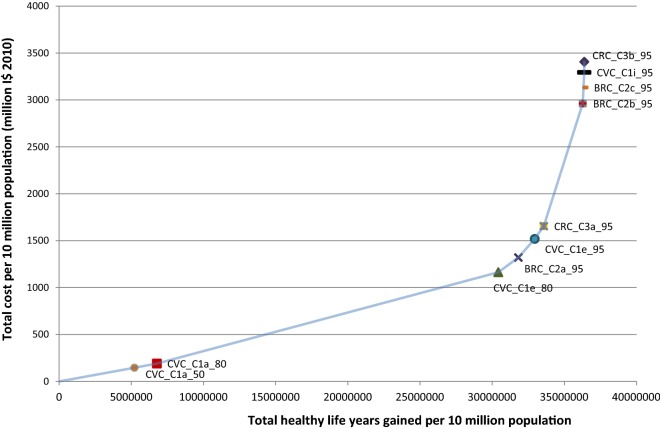
Vaccination against human papillomavirus (two doses) for 9-13-year-old girls (in eastern sub-Saharan Africa) and HPV vaccination combined with prevention of cervical cancer by screening of women aged 30-49 years through visual inspection with acetic acid linked with timely treatment of pre-cancerous lesions (in Southeast Asia) were found to be the most cost effective interventions. For breast cancer, in both regions the treatment of breast cancer, stages I and II, with surgery ± systemic therapy, at 95% coverage, was found to be the most cost-effective intervention. For colorectal cancer, treatment of colorectal cancer, stages I and II, with surgery ± chemotherapy and radiotherapy, at 95% coverage, was found to be the most cost-effective intervention.
The results demonstrate that cancer prevention and control interventions are cost-effective and can be implemented through a step-wise approach to achieve maximum health benefits. As the global community moves toward universal health coverage, this analysis can support decision makers in identifying a core package of cancer services, ensuring treatment and palliative care for all.
在通过《2013 - 2020年预防和控制非传染性疾病全球行动计划》之后,会员国于2016年要求对该行动计划附录3进行更新,该更新于2017年5月得到第七十届世界卫生大会的认可,并提供了一份推荐的非传染性疾病干预措施清单。本文的主要贡献在于呈现分析结果,以确定决策者如何利用附录3中列出的癌症干预措施实现最大的健康收益。我们还介绍了用于计算世界卫生组织-CHOICE在东南亚和撒哈拉以南非洲东部地区乳腺癌、宫颈癌和结直肠癌的新成本效益结果的方法。
我们在分析中使用了“广义成本效益分析”,该分析采用了一个假设的零参考案例,即去除所有当前干预措施的影响,以确定最佳干预措施组合。纳入了所有卫生系统成本,无论支付者是谁。健康结果报告为由于特定干预情景导致的健康生命年的增加,并使用确定性状态转换队列模拟(马尔可夫模型)进行估计。
在撒哈拉以南非洲东部地区,为9至13岁女孩接种两剂人乳头瘤病毒疫苗,以及在东南亚地区,人乳头瘤病毒疫苗接种与通过醋酸目视检查筛查30至49岁妇女宫颈癌并及时治疗癌前病变相结合,被发现是最具成本效益的干预措施。对于乳腺癌,在这两个地区,以95%的覆盖率采用手术±全身治疗对I期和II期乳腺癌进行治疗,被发现是最具成本效益的干预措施。对于结直肠癌,以95%的覆盖率采用手术±化疗和放疗对I期和II期结直肠癌进行治疗,被发现是最具成本效益的干预措施。
结果表明,癌症预防和控制干预措施具有成本效益,可以通过逐步推进的方式实施以实现最大的健康效益。随着国际社会朝着全民健康覆盖迈进,该分析可以支持决策者确定核心癌症服务包,确保为所有人提供治疗和姑息治疗。