Cognitive & Information Sciences, University of California, Merced, California, United States of America.
Psychological Sciences, University of California, Merced, California, United States of America.
PLoS One. 2018 Nov 19;13(11):e0207213. doi: 10.1371/journal.pone.0207213. eCollection 2018.
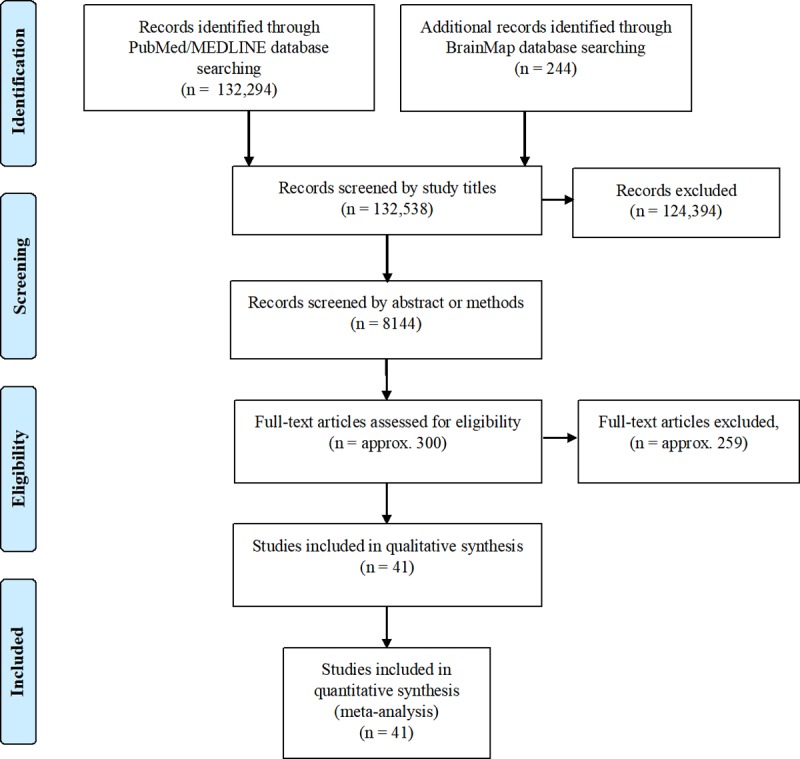
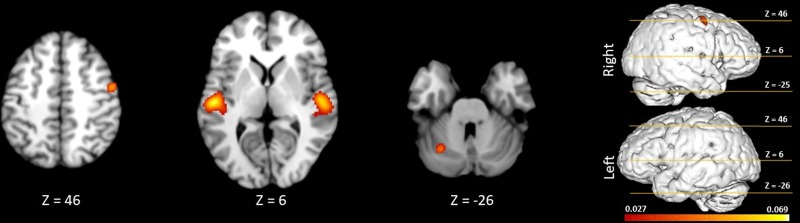
Several neuroimaging studies have shown that listening to music activates brain regions that reside in the motor system, even when there is no overt movement. However, many of these studies report the activation of varying motor system areas that include the primary motor cortex, supplementary motor area, dorsal and ventral pre-motor areas and parietal regions. In order to examine what specific roles are played by various motor regions during music perception, we used activation likelihood estimation (ALE) to conduct a meta-analysis of neuroimaging literature on passive music listening. After extensive search of the literature, 42 studies were analyzed resulting in a total of 386 unique subjects contributing 694 activation foci in total. As suspected, auditory activations were found in the bilateral superior temporal gyrus, transverse temporal gyrus, insula, pyramis, bilateral precentral gyrus, and bilateral medial frontal gyrus. We also saw the widespread activation of motor networks including left and right lateral premotor cortex, right primary motor cortex, and the left cerebellum. These results suggest a central role of the motor system in music and rhythm perception. We discuss these findings in the context of the Action Simulation for Auditory Prediction (ASAP) model and other predictive coding accounts of brain function.
几项神经影像学研究表明,即使没有明显的运动,听音乐也会激活位于运动系统中的大脑区域。然而,这些研究中的许多报告了不同的运动系统区域的激活,包括初级运动皮层、辅助运动区、背侧和腹侧前运动区以及顶叶区域。为了研究在音乐感知过程中各个运动区域具体扮演什么角色,我们使用激活似然估计(ALE)对被动听音乐的神经影像学文献进行了荟萃分析。在广泛搜索文献后,分析了 42 项研究,总共涉及 386 名独特的受试者,共计 694 个激活焦点。正如预期的那样,在双侧颞上回、横颞回、脑岛、锥体、双侧中央前回和双侧额内侧回都发现了听觉激活。我们还观察到运动网络的广泛激活,包括左、右侧外侧前运动皮层、右侧初级运动皮层和左侧小脑。这些结果表明运动系统在音乐和节奏感知中起着核心作用。我们将这些发现置于听觉预测的动作模拟(ASAP)模型和大脑功能的其他预测编码理论的背景下进行讨论。