Department of Virology and Immunology, Texas Biomedical Research Institute, San Antonio, TX 78227, USA.
Current Affiliation: Graduate School of Biomedical Sciences, University of Texas Health Science Center at San Antonio, San Antonio, TX 78229, USA.
Viruses. 2018 Nov 16;10(11):642. doi: 10.3390/v10110642.
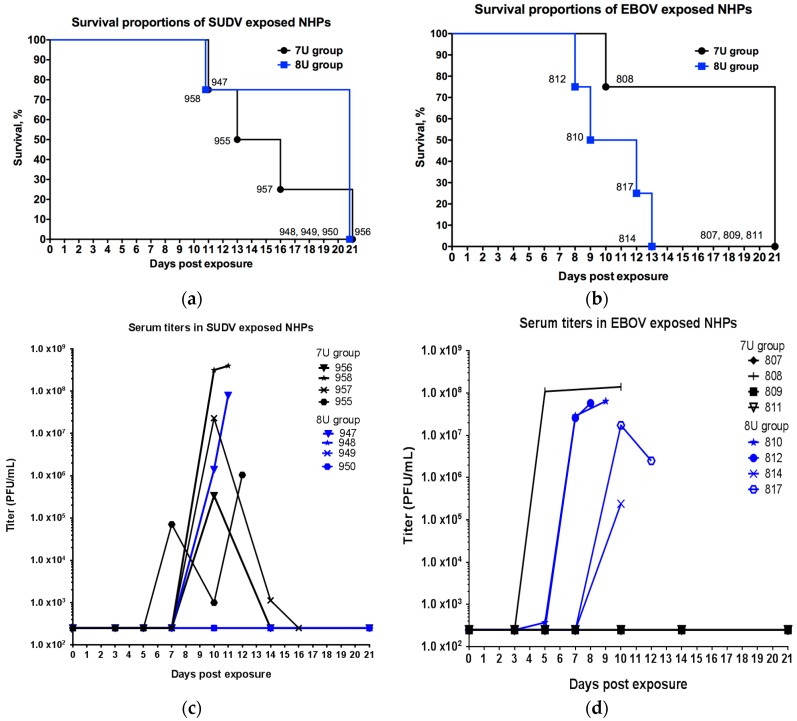
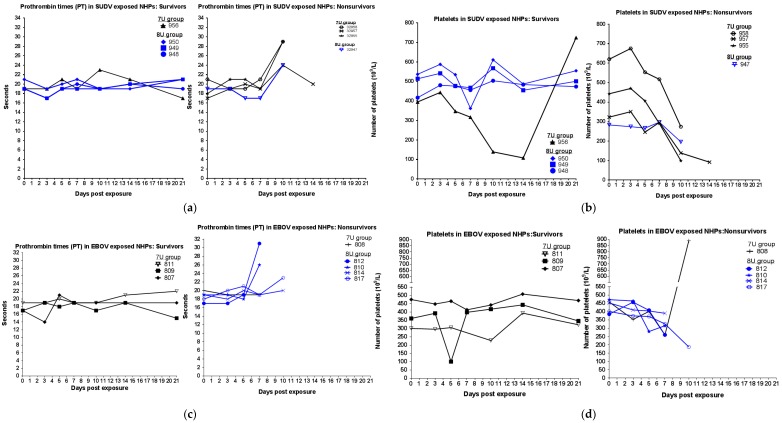
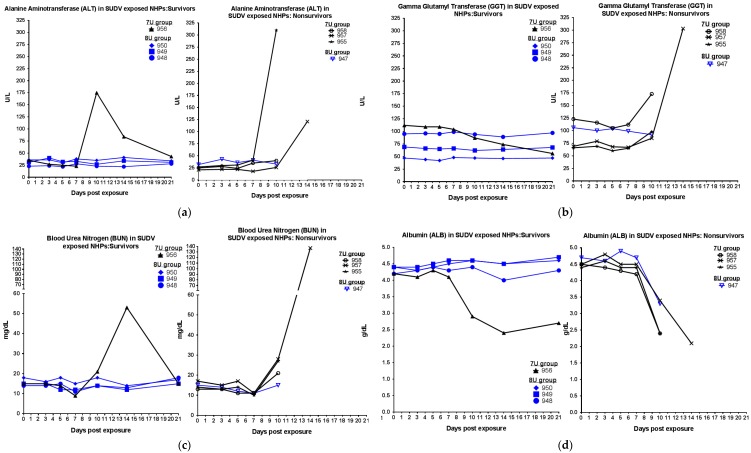
The filoviruses Ebola virus (EBOV) and Sudan virus (SUDV) can cause severe diseases, and there are currently no licensed countermeasures available for use against them. Transmission occurs frequently via contact with bodily fluids from infected individuals. However, it can be difficult to determine when or how someone became infected, or the quantity of infectious virus to which they were exposed. Evidence suggests the infectious dose is low, but the majority of published studies use high exposure doses. This study characterized the outcome of exposure to a low dose of EBOV or SUDV, using a model. Further, because the effect of virus passage in cell culture may be more pronounced when lower exposure doses are used, viruses that possessed either the characteristics of wild type viruses (possessing predominantly 7-uridine (7U) genotype and a high particle-to-plaque forming unit (PFU) ratio) or cell culture-passaged viruses (predominantly 8-uridine (8U) genotype, a lower particle-to-PFU ratio) were used. The time to death after a low dose exposure was delayed in comparison to higher exposure doses. These data demonstrated that an extremely low dose of EBOV or SUDV is sufficient to cause lethal disease. A low dose exposure model can help inform studies on pathogenesis, transmission, and optimization of prevention strategies.
丝状病毒埃博拉病毒(EBOV)和苏丹病毒(SUDV)可引起严重疾病,目前尚无针对它们的许可对策。传播通常通过接触受感染者的体液发生。然而,很难确定某人何时或如何感染,或接触到的传染性病毒的数量。有证据表明感染剂量很低,但大多数已发表的研究都使用高暴露剂量。本研究使用模型来描述接触低剂量 EBOV 或 SUDV 的后果。此外,由于当使用较低的暴露剂量时,病毒在细胞培养中的传代可能更明显,因此使用具有野生型病毒特征(主要具有 7-尿嘧啶(7U)基因型和高粒子到空斑形成单位(PFU)比)或细胞培养传代病毒(主要是 8-尿嘧啶(8U)基因型,粒子到 PFU 比低)的病毒。与高暴露剂量相比,低剂量暴露后死亡的时间延迟。这些数据表明,极低剂量的 EBOV 或 SUDV 足以引起致命疾病。低剂量暴露模型可以帮助了解发病机制、传播以及预防策略的优化研究。